

Choose the business model in the USA Choosing a product, service, or consulting firm is one of the most important decisions for Brazilian companies planning to expand internationally.
Many entrepreneurs begin their internationalization journey by asking questions such as:
“"In which state should I open my business?"”
Or:
“Should I open an LLC or a Corporation?”
These questions are important.
But there is an even more strategic question that needs to be answered before any legal or operational decision:
Does your business model in the US really have traction in the American market?
Because the truth is simple:
Not everything that works in Brazil works in the United States.
And the opposite is also true.
Business models that grow easily in the Brazilian market often encounter resistance, lower margins, or difficulty converting when they try to scale in the US.
Therefore, before thinking about corporate structure, visas, marketing, or local operations…
The real question is:
Product, service, or consulting — which model truly best suits the behavior of the American customer?
The first mistake: thinking that selling in the US depends solely on translation.
Many businesspeople believe that internationalization means:
- translate the website into English
- open a company in the United States
- Create an international LinkedIn profile.
- Invest in paid traffic.
But the reality of the American market is more demanding.
In the United States, companies do not buy translated versions of Brazilian businesses.
The market buys:
- specialization
- clarity of positioning
- operational efficiency
- proof of result
- real differentiation
If your business model doesn't communicate this…
Expansion becomes a cost.
This point connects directly to:
Strategic planning for entering the US: what needs to exist before the operation.
https://naventia.com/planejamento-estrategico-entrar-nos-eua/
Model 1: Physical products
Can Brazilian products perform well in the American market?
Yes.
But there are significant challenges.
Main barriers
Companies that sell physical products typically face the following challenges:
- international logistics
- import costs
- regulatory compliance
- margin compression
- need for operational scale
Therefore, products tend to perform better in specific scenarios.
When products typically work best
Premium niche
Products with strong differentiation tend to perform better.
Examples:
- cosmetics
- wellness
- special foods
- original design
- Lifestyle
Specific communities
Products can find strong traction in:
- Brazilian community
- Latino community
- specific cultural niches
Technical or industrial problems
Specialized products can also perform well in segments such as:
- industry
- engineering
- construction
- applied technology
- specialized equipment
The greatest risk
Without a clear scale or differentiation…
Products enter a price war.
And in the United States, competing with giants like Amazon or large distributors is often extremely difficult.
Model 2: Specialized services
For many Brazilian companies, services tend to have a lower barrier to entry.
Especially in areas such as:
- marketing
- technology
- recruitment
- operations
- finances
- BPO
- corporate services
Why do services tend to come online faster?
Because they typically require:
- lower initial investment
- lower need for working capital
- Faster business validation
- possibility of remote operation
This isn't just market intuition. The official guide itself... US Small Business Administration on market research and competitive analysis This reinforces the point: companies that validate demand and map the competition before committing capital have a measurably lower failure rate than those that jump straight to launch.
This model also communicates directly with:
How to validate demand in the US before opening operations.
https://naventia.com/como-validar-demanda-nos-eua/
The real challenge
In the United States, generic services tend to lose traction.
Terms such as:
- Marketing Agency
- Business Consulting
- Financial Services
On their own, they rarely generate high conversion rates.
The American market typically buys:
Specialization by niche.
Examples that perform best:
- Growth Strategy for SaaS Companies
- Financial Operations for Healthcare Groups
- Recruiting for Construction Companies
When there is a clear niche…
The conversion rate changes completely.
Model 3: Consulting
Consulting is often one of the formats with the greatest potential for experienced Brazilian entrepreneurs.
Especially when it exists:
- practical experience
- technical authority
- proven track record
- proprietary methodology
- intellectual differentiation
In the United States, consulting can scale very well.
But there is a condition:
You need to sell transformation — not hours.
Consulting firms that tend to perform better
The strongest segments tend to be:
- international expansion
- processes and operational efficiency
- compliance
- growth strategy
- technology
- BAD
- private advisory
- corporate operations
The most common mistake
Submit a generic proposal.
If your consulting firm does not have:
- clear method
- proprietary framework
- strong positioning
- defined niche
The American market will compare your company based on price.
And that destroys the margin.
This point relates directly to:
How to set up a business process in the US without inflating the structure too early.
https://naventia.com/processo-comercial-nos-eua/
Ultimately, the choice between product, service, or consulting is not an aesthetic decision—it's a decision about risk, capital, and speed of validation. Brazilian companies that treat this choice as a strategic starting point, and not as an operational detail, enter the American market with a cost structure compatible with the reality they will encounter, instead of discovering this in the most expensive way possible: while already operating.
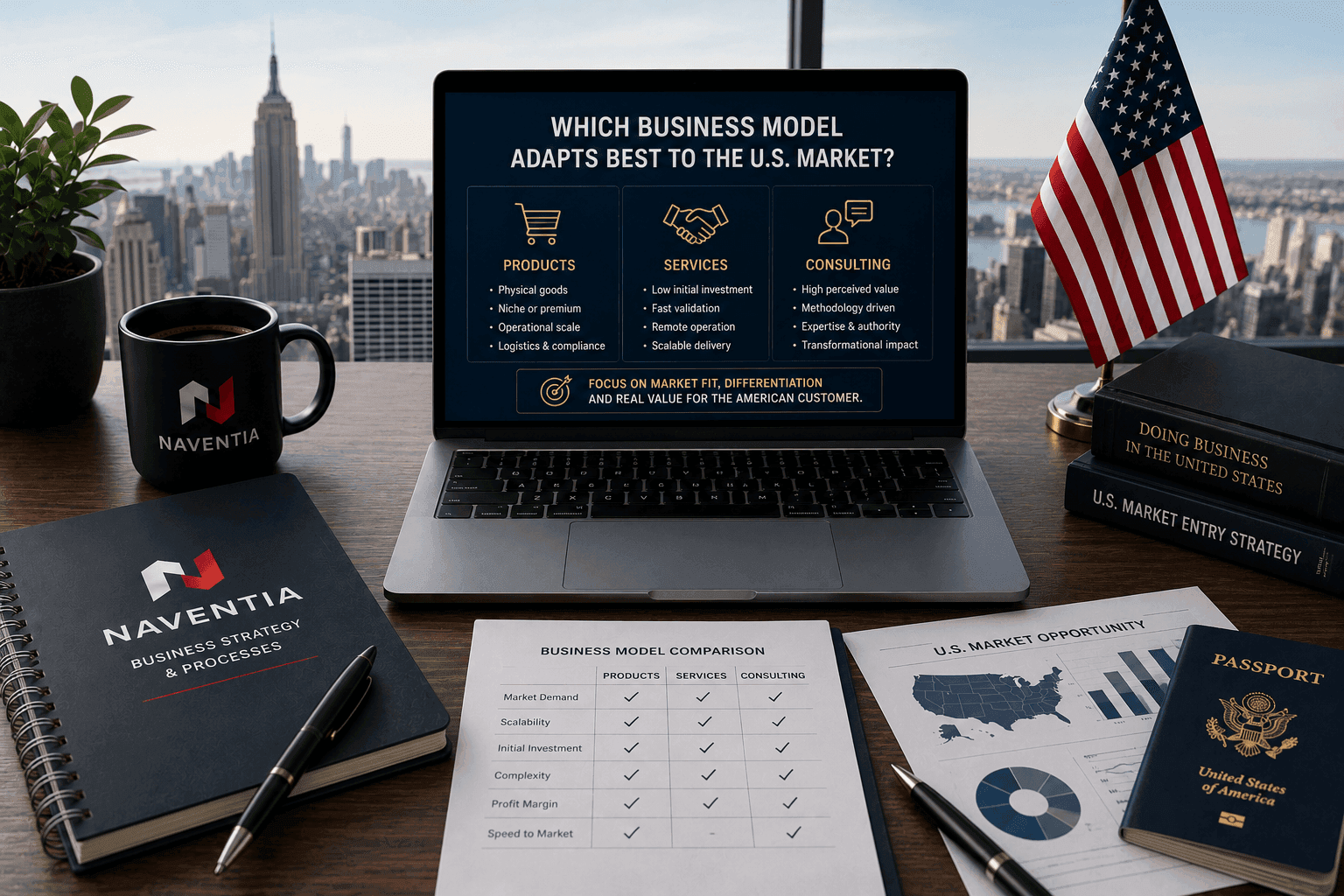
So, which business model in the US adapts best?
The professional response always depends on the company's maturity: the best business model in the US changes according to the stage of internationalization.
But looking at speed to entry, business validation, and operational risk…
The order is usually:
1. Specialized services
Faster to validate.
Lower initial investment.
Greater flexibility.
2. Niche consulting
Larger margin.
Highest authority.
Less need for heavy infrastructure.
3. Physical products
Greater potential for scale.
But also greater operational complexity.
What smart companies do before entering the US market.
Before starting operations, mature companies validate:
- Is there real demand?
- Does my position make sense?
- Is my ticket price competitive?
- Does my model scale?
- Does my operation support delivery?
Because internationalization doesn't begin with documents.
It starts with market fit.
Conclusion
The best business model in the US is not necessarily the one that works best in Brazil.
It's the model that best suits the behavior of the American customer.
And that difference can save years of trial and error.
Before opening a business.
Before hiring.
Before investing in marketing.
Ask a question:
Is your business model truly ready to compete in the United States?
This answer changes everything.
Naventia works alongside companies who want to expand with strategy, security and a global vision.
If this is your moment, perhaps it's time to give it a try. next step — with those who already understand the way.