
There's a curious shift in the lives of many entrepreneurs. It doesn't happen when the company doubles its revenue. Nor when it opens an operation in the United States. Much less when it buys its first property abroad.
It happens silently.
One day, you run a company.
Months later, without realizing exactly when it happened, he begins managing companies, real estate, investments, shareholdings, accounts in different countries, and assets that no longer fit within the logic with which the business was built.
That's where many people make a mistake.
He continues to manage assets as if he were still only managing a company.
In my experience, it is precisely at this point that the greatest risks begin. Not because the family has made bad investments. Nor because they chose the wrong country to expand into.
But why didn't anyone stop to realize that managing wealth requires different skills than those needed to build it?.
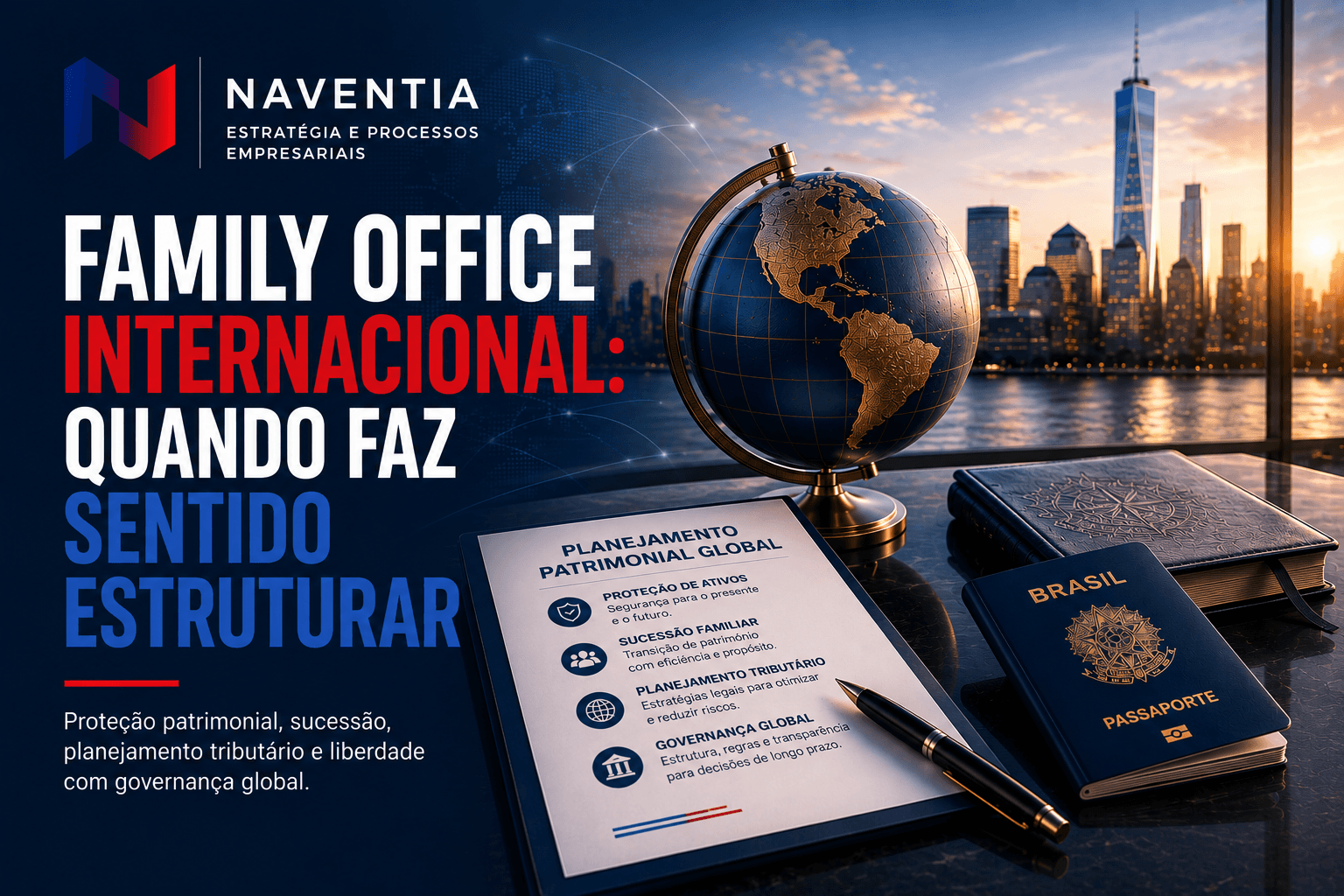
It is precisely at this point that a International Family Office It ceases to appear as a sophisticated structure reserved for the very wealthy and begins to make sense as a coordination tool.
Most families come to this conclusion too late.
Wealth grows. The way it's managed almost never keeps pace.
There is a very widespread idea among Brazilian businesspeople.
As long as the company is growing, everything else can wait.
First comes the business.
Then the assets.
Then the succession.
Then comes governance.
In practice, it rarely works that way.
The company's assets grow along with its growth.
Almost always in a disorganized way.
First, an international operation appears.
Then a property.
Later, an American company.
A financial investment.
A stake in another company.
A holding company.
When the family realizes it, there is an asset structure distributed across different countries, different currencies, and different legal systems.
Interestingly, the decision-making process remains exactly the same.
Everything goes through the founder.
It all depends on the founder's schedule.
Everything is awaiting the founder's approval.
This model helped the company grow.
But it is unlikely to be the model that will allow us to preserve the heritage built up along this path.
That is precisely why companies that begin a process of internationalization to the USA They eventually realize that international growth and asset management are two conversations that need to happen simultaneously.
https://naventia.com/internacionalizacao-para-os-eua/
The greatest risk is rarely financial.
When someone hears the expression International Family Office, Normally, people think about investments.
This association makes sense.
But, interestingly, investment tends to be the most organized part of the story.
Banks manage portfolios.
Asset management companies administer funds.
Consultants structure operations.
Lawyers design law firms.
Accountants handle the tax aspects.
The problem arises among these specialties.
Who coordinates all of this?
Who can guarantee that a decision made at the company won't have unexpected consequences for the family's succession?
Who assesses whether a real estate acquisition in the United States aligns with the holding company's asset management strategy?
Who verifies whether the structure created today will still make sense when the children start participating in the decisions?
In most families, nobody.
Each specialist solves their own problem.
Few people see heritage as an integrated system.
That's precisely where the greatest risk lies.
It's not about losing money.
It's a loss of coordination.
An international family office is not a luxury. It's a change in mindset.
Perhaps this is the biggest misconception about the topic.
For many years, Family Offices were associated only with billionaire families.
This perception leads many business owners to dismiss the idea before even understanding its function.
In practice, a International Family Office It should not be seen as a symbol of wealth.
It represents a change in the way assets are managed.
While the assets are relatively simple, the coordination happens naturally.
As complexity increases, this coordination ceases to happen on its own.
Someone needs to take on this role.
It won't always be your own team.
In many cases, a model of Multi Family Office It perfectly meets the family's needs.
In other cases, it makes sense to structure a dedicated operation.
The decision doesn't depend solely on the size of the estate.
It depends mainly on the complexity of the decisions that need to be made.
International heritage changes the questions.
For a long time, business owners have been asking questions like:
“Which investment offers the best return?”
“Which corporate structure is more efficient?”
“Is it worth opening a business in the United States?”
These remain important questions.
But there comes a point when they are no longer enough.
The questions then become different.
Who coordinates all these assets?
How can we ensure that different consultants are working in the same direction?
Who manages the relationship between business assets and family assets?
Who is preparing the next generation to assume responsibilities that currently belong to the founder?
It's curious to note that almost none of these questions relate to the financial market.
They all relate to governance.
That is precisely why structures like a International Patrimonial Holding They often walk alongside the construction of a Family Office.

When does an international Family Office really make sense?
There's a question that tends to come up too early.
“"What assets do I need to create a Family Office?"”
In my view, that's the wrong question.
Because wealth is not what determines the need for a Family Office.
Complex, yes.
A family can manage tens of millions of reais in a relatively simple way.
Another may face enormous difficulties with a much smaller estate.
The difference is almost never in the money.
It lies in the sheer number of decisions that need to be coordinated with each other.
When there are companies in different countries.
Financial investments managed by different institutions.
International real estate.
Different corporate structures.
Tax issues.
Succession planning.
Children starting to participate in decisions.
The family has stopped managing assets.
She went on to manage a system.
And systems don't work just because there are good professionals.
They work because someone ensures that all the pieces are looking in the same direction.
It is precisely this coordination that a International Family Office offers.
The problem is not a lack of specialists. It's an excess of them.
This is perhaps the most overlooked aspect by family businesses.
Competence is almost never lacking.
There is the tax lawyer.
The accountant.
The investment manager.
The private bank.
The corporate consultant.
The succession specialist.
They are all excellent at what they do.
Even so, many families continue to make contradictory decisions.
Why?
Because each professional only sees a part of the asset.
The lawyer thinks about the legal structure.
The manager is thinking about profitability.
The accountant is thinking about tax efficiency.
The bank is thinking about investments.
Few people are looking at the whole picture.
And international heritage demands exactly that.
Someone needs to connect all these decisions.
Otherwise, each specialist optimizes a part of the structure while no one optimizes the family's assets as a whole.
In practice, the international Family Office emerges more as a coordination center than as a financial center.
Governance and Family Office go hand in hand.
There is another mistaken association.
Many people believe that you should organize your assets first.
Then we think about governance.
In reality, the two things evolve together.
The greater the internationalization, the greater the need to define who decides, how they decide, and what criteria guide those decisions.
This topic has gained even more importance as family businesses have begun to build wealth in different countries.
Organizing companies is no longer enough.
Relationships need to be organized.
Relationships between partners.
Between generations.
Between companies.
Among assets.
That's exactly why we recently discussed why... Global heritage requires global governance..
https://naventia.com/governanca-global/
The Family Office becomes one of the tools of this governance.
Not the only one.
But perhaps most importantly, this happens when business assets and family assets begin to mix.
Succession begins long before the actual succession.
There is a widespread idea that succession is a matter for the future.
In practice, succession begins the moment the estate starts to be built.
Every company that opens.
Each property acquired.
Every international investment.
Each new corporate structure.
All of this already represents a succession decision.
That's precisely why families with international assets often analyze topics such as US Estate Tax, asset holdings and corporate structures in an integrated way.
Not because they are expecting a successor event.
But because they understand that reorganizing assets is usually much simpler before they become excessively complex.
https://naventia.com/estate-tax-eua/
When this vision exists, the Family Office ceases to simply manage assets.
It will now manage continuity.
The international Family Office organizes decisions, not investments.
Perhaps this is the most important sentence in this article.
Investments can always be managed by excellent managers.
But managers don't manage families.
They don't run companies.
They do not coordinate succession.
They do not define criteria for the distribution of assets.
They do not resolve conflicts between different generations.
They do not establish governance rules.
This work belongs to the Family Office.
Its true value lies not in choosing where to invest.
The goal is to ensure that all decisions related to assets make sense when analyzed together.
This difference seems small.
But it completely changes how family businesses view this structure.
The estate needs to continue to make sense when the founder is no longer making decisions.
Perhaps the entire discussion about Family Offices can be summarized in a single question.
Who is managing the assets while everyone else is busy running the companies?
For a long time, this answer tends to be simple.
The founder.
He knows every asset.
Every investment.
Every relationship.
Every opportunity.
But international heritage cannot depend forever on a single person.
There comes a point when preserving wealth requires something different from the entrepreneurial skills that built it.
It requires a method.
Coordination.
Governance.
Continuity.
It is precisely at this moment that a International Family Office It ceases to represent a sophisticated structure.
He comes to represent maturity.
Conclusion
There is an important difference between building heritage and preserving it.
The first often depends on the ability to undertake projects, take risks, and make quick decisions.
The second requires discipline, coordination, and a long-term vision.
Business owners who internationalize their businesses usually notice this change gradually.
First, the company grows.
Then investments grow.
Then come real estate, holding companies, new companies, and different jurisdictions.
At some point, managing assets becomes more complex than managing the company itself.
It is at this point that the International Family Office it makes sense.
Not because the family has reached a certain level of net worth.
But because it has reached a level of complexity that demands a new way of deciding.
Perhaps this is the main change in mindset.
The international Family Office does not exist to manage wealth.
It exists to ensure that wealth continues to exist when it no longer depends exclusively on those who created it.
Naventia works alongside companies that want to expand with strategy, security, and a global vision.
If this is your moment, perhaps it's time to take the next step — with someone who already understands the way.