
B2B sales in the US: Entering the American market requires more than just translating your communication.
Commercial adaptation must occur alongside prevention of Mistakes that most compromise the expansion of Brazilian companies in the United States..
It demands Reprogram your sales mindset.
Because American customers don't shop like Brazilian customers.
He decides differently. He evaluates differently. He trusts differently.
And most importantly:
👉 He has no patience for ambiguity.
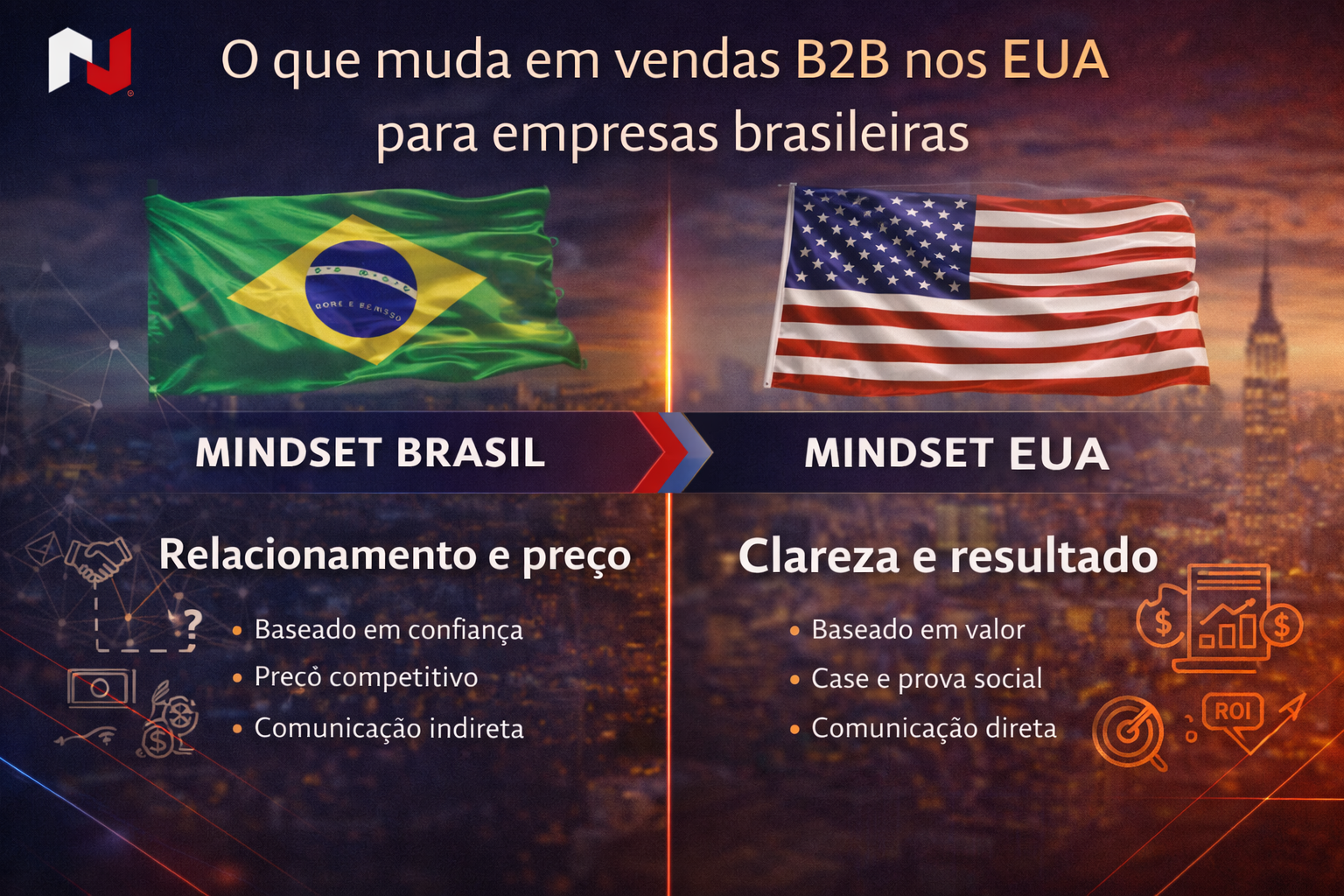
1. In the US, clarity wins over relationships.
In Brazil, B2B sales often happen like this:
- strong relationship
- Trust built over time.
- flexibility in negotiation
- constant adaptation
In the US:
👉 You are evaluated on the clarity of your proposal — not on how approachable you are.
The customer wants to know:
- what do you do
- for whom
- which problem does it solve
- what result does it deliver
- how much does it cost
Without beating around the bush.
If he doesn't understand quickly…
He doesn't continue the conversation.
2. Perceived value is more important than price.
Brazilian companies often try to compete in this way:
👉 “Let’s get in cheaper”
Error.
In the American market:
- Low prices breed distrust.
- Weak positioning reduces authority.
- Discount does not replace value.
The customer wants to understand:
👉 Why you are the best choice — not the cheapest.
3. The business process is not optional.
In Brazil, it is still common to:
- Founder-based sales
- improvisation
- negotiation without structure
- poorly defined funnel
In the US:
👉 Without a process, you can't scale — and often you can't even sell.
You need to have:
- ICP clear
- structured funnel
- defined steps
- consistent narrative
- professional follow-up
Selling is no longer an "art".
Turn the system around.
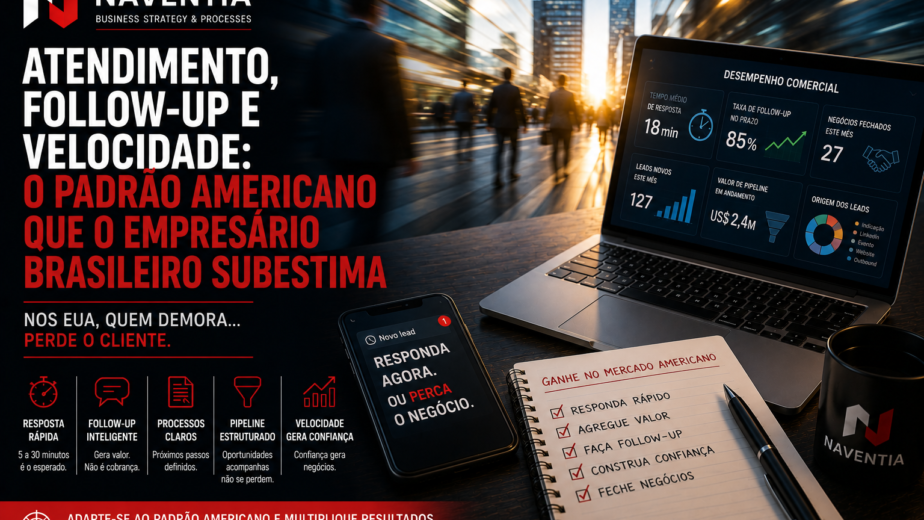
4. Response time directly impacts sales.
That's brutal.
Brazilian companies are losing sales due to:
- taking too long to respond
- not giving a clear response
- not having a defined next step
In the US:
👉 Speed = professionalism
If you delay, the customer assumes:
- lack of organization
- lack of prioritization
- or lack of ability
And on to the next supplier.
5. The decision is more rational and results-oriented.
In Brazil:
- Personal confidence is very important.
- historical influence
- Flexibility is valued.
In the US:
👉 The central question is always:
“"Does this solve my problem efficiently?"”
The customer rates:
- ROI
- predictability
- risk
- real impact
Less emotion. More logic.
6. Social proof is mandatory.
You can be excellent.
But if you don't prove it…
It doesn't matter.
In the US, the customer expects:
- cases
- numbers
- testimonials
- historical
- concrete evidence
👉 Authority needs to be demonstrated — not declared.
7. Communication needs to be direct (and simple).
This is a major culture shock.
Brazilian companies tend to:
- over-explaining
- use complex language
- try to “convince”
In the US:
👉 Simplicity sells.
Effective messages are:
- direct
- specific
- results-oriented
Example:
❌ “Customized strategic solutions for sustainable growth”
✅ “We help SaaS companies reduce CAC by 30% in 6 months”
8. The client expects professionalism from the very first contact.
Details matter more than you think:
- well-written email
- structured proposal
- clear presentation
- organized agenda
- punctuality
👉 Everything communicates positioning.
Even before you make the sale, the customer has already decided:
“"Is this company reputable or not?"”
9. The sale begins before the commercial contact.
In Brazil, sales are still very dependent on direct contact.
In the US:
👉 The customer arrives already pre-evaluating you.
He searches:
- site
- positioning
- content
- reputation
If this isn't aligned…
You lose even before the conversation begins.
How to structure B2B sales in the US with predictability.
B2B sales in the US require a sales operation that can be explained, measured, and repeated. Before expanding prospecting, the Brazilian company must define who the ideal client is, what concrete problem it solves, and what evidence supports the promise. Without this foundation, the team wastes energy on poorly qualified meetings and proposals that don't move forward.
The starting point is to transform the sales In a process: objective qualification criteria, a person responsible for each stage, a response time, and documented next steps. This reduces the founder's dependence, improves the potential client's experience, and allows you to see where the funnel is losing opportunities.
In the B2B sales in the US, The proposal also needs to link value to results. Instead of just presenting capabilities, show operational impact, financial gain, or risk reduction. A short case study, a verifiable metric, and a clear scope make the conversation more objective and help the buyer defend the decision internally.
Another important consideration is aligning marketing, content, and sales. The prospect usually researches the company before the first conversation; therefore, the website, LinkedIn profile, sales materials, and the team's approach should all answer the same question: why is this solution relevant now? Small Business Administration It brings together useful marketing and sales guidelines for small businesses in the American market.
Finally, follow the B2B sales in the US Using simple indicators such as: opportunity origin, progress rate, average cycle time, contract value, and reason for loss. This data allows for strategy adjustments without improvisation and makes sales more predictable as the company's presence in the United States matures.

The standard that differentiates those who sell from those who don't.
Brazilian companies that manage to sell in the US do three things well:
- They adapt their communication. (not translated)
- They structure the commercial process.
- They position value with extreme clarity.
Those who cannot:
- maintain a local mindset
- They operate by improvising.
- They compete on price.
- They communicate poorly.
The truth that few accept.
The problem is rarely:
- the market
- the customer
- or the product
👉 The problem is the sales model.
Conclusion
Entering the American market requires more than just a presence.
It requires adaptation.
Why:
Selling in Brazil doesn't necessarily mean selling in the US.
But those who learn how to sell in the US are playing on another level.
Part of this involves how you communicate value to the American customer — see How to adapt a value proposition for the American customer..
Naventia works alongside companies that want to expand with strategy, security, and a global vision.
If that is
How to shorten the sales cycle without sacrificing margin.
In the B2B sales in the US, Speed doesn't mean pressuring the buyer. It means making each step simple to understand, easy to approve, and useful for those involved in the decision. A Brazilian company gains traction when it presents, from the first contact, an objective diagnosis, a scope proportional to the problem, and a next step with a date, responsible party, and success criteria.
That commercial process You need to anticipate the most common objections: integration with current suppliers, implementation risk, data security, turnaround time, and local support capacity. Instead of answering each question in isolation, transform those answers into reusable materials—a case study page, a comparison of alternatives, a proposal with a timeline, and an onboarding roadmap. This reduces friction and reinforces consistency throughout the funnel.
It is also important to distinguish between interest and priority. American market, Many contacts may recognize value, but only move forward when there is a concrete problem, a compatible budget, and someone capable of internally advocating for the hire. Qualifying this combination early protects the sales agenda and allows the team to dedicate energy to opportunities with a higher probability of closing.
Finally, the company should review its wins and losses monthly: which segments respond best, which arguments accelerate the decision, and at what point the cycle stalls. This learning transforms B2B sales in the US into a predictable operation, not a sequence of negotiations dependent on improvisation.
Your moment has arrived, perhaps it's time to give it a try. next step — with those who already understand the way.
Naventia conducts the strategic diagnosis and provides all the necessary structuring for your company to safely enter the US market. Learn more about our services.
https://naventia.com/servicos/