
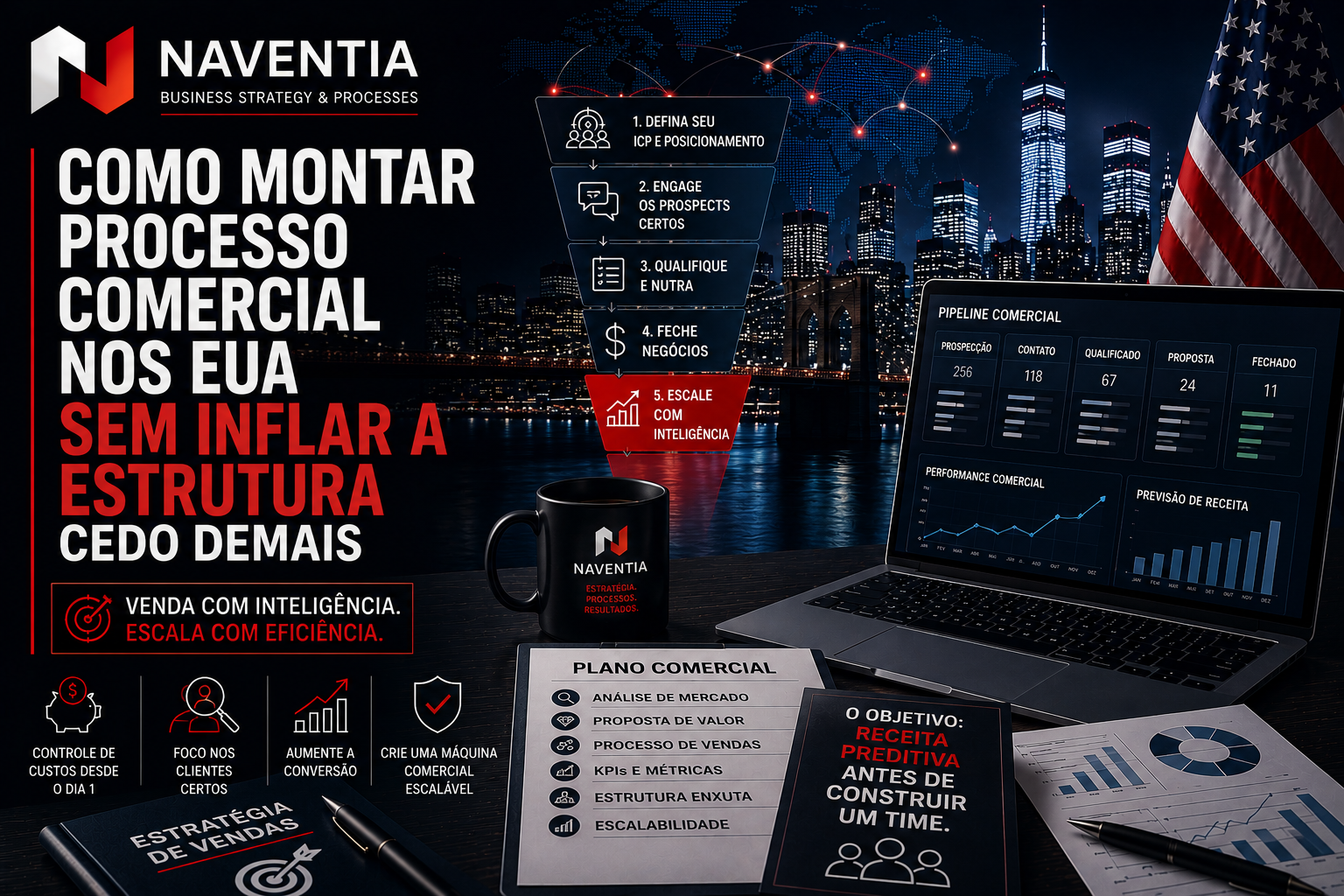
Assemble a commercial process in the USA Doing it the right way is what separates companies that scale sales with predictability from those that burn through cash by hiring too early.
One of the most common scenarios among Brazilian entrepreneurs who decide to enter the American market is predictable.
In the first few months of expansion, the company already:
- opens entity in the United States
- hires local team
- invests in international branding
- implements CRM
- purchase commercial tools
- launches marketing campaigns
- and, in some cases, even rents an office.
Everything looks professional.
The problem?
There is still no commercial predictability.
And when revenue doesn't keep pace with the rate of increase in costs, the operation collapses.
What should be growth turns into financial pressure.
In the United States, the mistake is not in growing.
The error lies in Scaling costs before scaling demand.
Before even hiring or setting up a local operation, it's ideal to validate the market.
This topic was explored in more detail in:
How to validate demand in the US before opening operations.
https://naventia.com/como-validar-demanda-nos-eua/
Without validation, the structure becomes a cost.
No competitive advantage.
The mistake that destroys the most cash registers at the entrance in the US.
Businesspeople accustomed to the Brazilian market often try to replicate the same operational logic abroad.
The reasoning is usually simple:
“"If I set up a professional structure from the start, clients will see the value."”
In the United States, this rarely works.
Because the American market doesn't buy infrastructure.
He buys:
- clarity of positioning
- proof of result
- specialization
- delivery predictability
- business efficiency
I.e:
Before hiring people…
You need to build a commercial machine.
This mistake frequently occurs in companies that enter the market without a plan.
We talk more about this in:
Entering the US without planning: the most expensive mistakes Brazilian entrepreneurs make.
https://naventia.com/erros-ao-entrar-nos-eua-os-erros-mais-caros-que-empresarios-brasileiros-cometem/
The business process in the US doesn't begin with hiring.
This is one of the biggest mistakes companies make when expanding internationally.
Many believe that sales in the US begin with hiring:
- Sales Representative
- Business Development Manager
- Account Executive
- SDR
But the reality is different.
Hiring without a process doesn't generate sales.
It only creates costs.
Before hiring, your company needs to validate five business pillars.
Definition of ICP (Ideal Customer Profile)
Who actually buys your solution?
Your ideal customer is in:
- startups?
- middle market?
- enterprise?
- Family businesses?
- industries?
Without a clear ICP (Ideal Customer Profile), prospecting becomes a waste.
Commercial message adapted to the American market.
The discourse that works in Brazil doesn't always work in the United States.
American companies buy:
- objectivity
- ROI
- predictability
- specialization
They don't buy generic presentations.
This point was explored in more detail here:
How to adapt your value proposition for the American customer.
https://naventia.com/como-adaptar-proposta-de-valor-para-o-cliente-americano/
Offer with commercial appeal
Your proposal needs to answer:
- What problem do you solve?
- Why does your solution matter?
- What results do you deliver?
- Why choose your company?
Without clarity, there is no healthy pipeline.
Sustainable average ticket price
Its price supports:
- International CAC?
- business cycle?
- Follow-up?
- Paid acquisition?
- Future expansion?
Many companies enter the market with inadequate pricing and lose margin right from the start.
Real sales cycle
How long does it take an American customer to make a purchase?
- 7 days?
- 30 days?
- 90 days?
- 6 months?
Without this predictability, hiring becomes a gamble.
The methodology used by smarter companies
At Naventia, the international sales process typically follows three phases.
Phase 1: Market test
Before any hiring process, we test:
Positioning
Who answers best?
Message
Which narrative generates a response?
Offer
What really converts?
Channel
The market responds best in:
- LinkedIn?
- Email outbound?
- Referral?
- Paid media?
- Partnerships?
The goal at this stage is not scaling.
The goal is predictability.
Phase 2: Lean business process
With the market validated, we created the minimum viable operation.
Structured CRM
Organized pipeline.
No improvisation.
Commercial cadence
Predictable follow-ups.
Consistent messages.
Commercial scripts
Replicable process.
Business indicators
We track KPIs such as:
- meetings booked
- show rate
- proposal rate
- close rate
- sales cycle
Now the company is no longer selling through effort.
And it starts selling through the process.
Phase 3: Smart scaling
Only after that does the hiring make sense.
And now, clearly:
- who to hire
- in which role
- at which stage
- with what goal
- with what expected payback
At this time, the team is not entering the market to explore it.
He's joining to scale something that's already working.

The most expensive mistake of all.
According to SBA marketing and sales guide, In the US, a well-defined business process is what differentiates companies that grow predictably from those that only react to the market.
Many business owners still think:
“"I'm going to hire in order to sell."”
More mature companies think differently:
“"I'll validate it before hiring."”
This simple change can save tens — and in some cases hundreds — of thousands of dollars in the first year of operation.
Conclusion
Expanding into the United States doesn't necessarily mean setting up a large structure.
It means putting together the right structure.
The company that grows in the American market is not the one that hires the earliest.
It's the one that learns the fastest.
Before hiring.
Before setting up the office.
Before inflating the payroll.
Ask a question:
Does your sales process already generate sales without relying on cumbersome infrastructure?
If the answer is no…
Your company is not yet ready to scale.
Talk to Naventia
At Naventia, we help Brazilian companies structure international business processes with predictability, efficiency, and sustainable growth.
If your company is entering the American market, perhaps the next step isn't hiring.
Perhaps it's a matter of validating.
Naventia works alongside companies that want to expand with strategy, security, and a global vision.
If this is your moment, perhaps it's time to give it a try. next step — with those who already understand the way.