
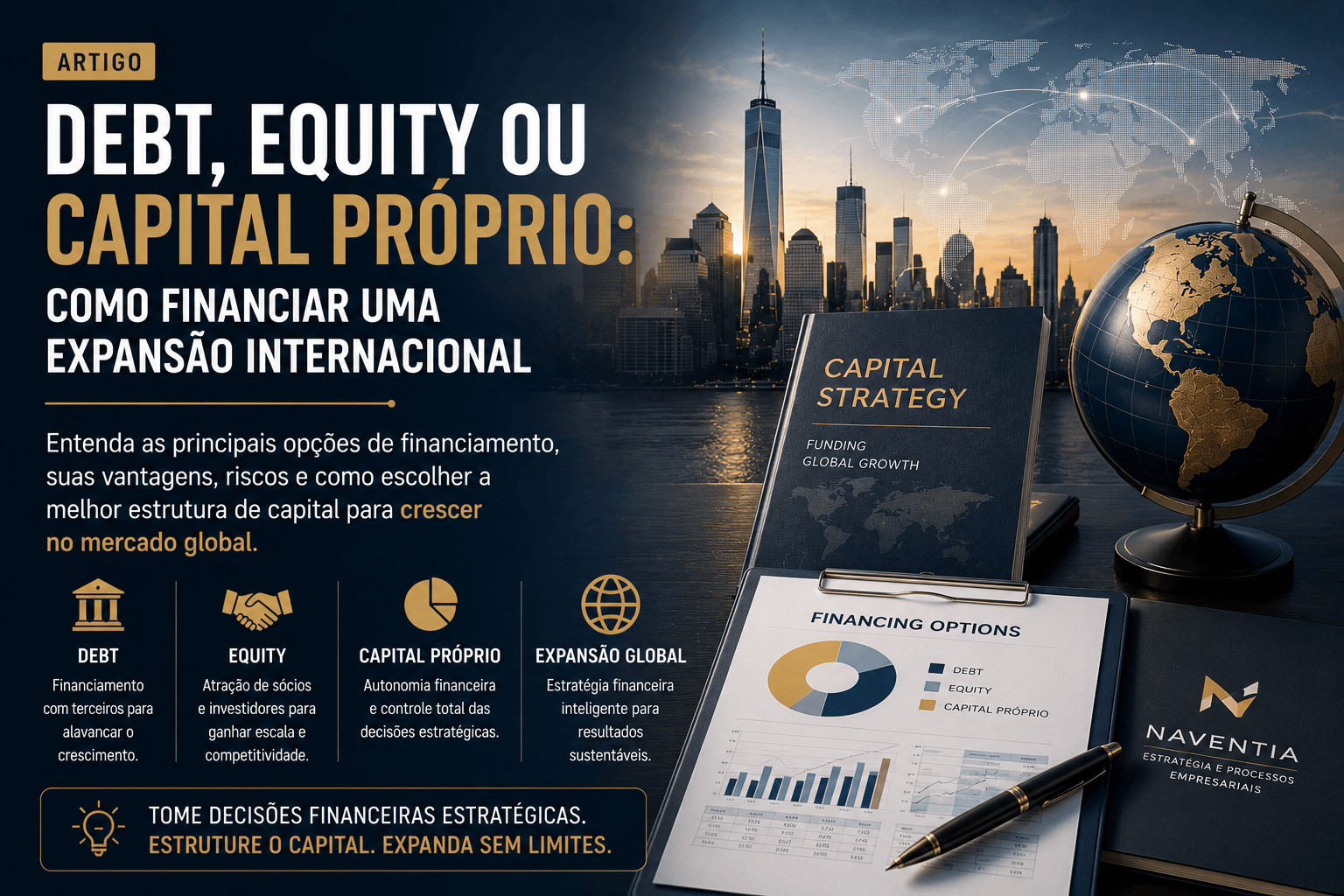
Financing for international expansion This is one of the most important decisions for companies that intend to grow outside of Brazil. Opening an operation in another country requires investments in corporate structure, staff, technology, marketing, business development, and regulatory compliance. The question that naturally arises is: what is the best way to finance this growth?
There is no single answer.
Some companies use their own resources to maintain complete autonomy over decisions. Others resort to loans to accelerate expansion without diluting the shareholders' stake. Still others choose to attract investors in exchange for equity, seeking not only capital, but also knowledge, relationships, and access to new markets.
Each alternative has advantages, risks, and impacts on the company's future. More important than finding the cheapest option is understanding which model aligns with the growth strategy and maturity of the business.
The biggest mistake is deciding on the source of funding before defining the strategy.
When a company decides to expand internationally, the first question is usually "how much money will be needed?".
In practice, this shouldn't be the primary concern.
Before discussing the source of funding, it is necessary to define how the expansion will take place.
Does the company intend to open an operational unit or just a sales office?
Will local employees be hired?
Will the growth be organic or through acquisition?
Is there validated demand in that market?
These answers determine the amount of capital needed and directly influence the choice between debt, equity, or own capital.
That's exactly why a strategic planning for entering the USA This should precede any financial decision. Companies that raise capital before validating their strategy often end up using the capital inefficiently.
Equity capital: more autonomy, slower speed
Many entrepreneurs prefer to finance their expansion with their own resources.
This decision offers a clear advantage: the partners maintain full control over the company, preserve their shareholding, and do not assume financial commitments to third parties.
Furthermore, strategic decisions are often made with greater freedom, without the need to answer to investors or financial institutions.
On the other hand, using only one's own capital also has limitations.
Expansion tends to occur more slowly, as it depends on the company's cash generation capacity. In some cases, the business misses out on important opportunities because it chose to preserve liquidity instead of accelerating its growth.
Equity capital tends to work best when the company has good profitability, healthy cash flow, and the ability to finance expansion without compromising its core operations.
Debt: growing without sacrificing society.
Another widely used alternative is debt financing, known internationally as debt.
In this model, the company obtains resources from banks, credit funds, or other financial institutions and undertakes to repay this capital plus interest.
The main advantage is preserving the founders' shareholding.
The partners continue to control the business, while using third-party resources to accelerate growth.
However, debt requires financial predictability.
Companies that still have unstable revenues or are entering a completely new market may find it difficult to meet payment obligations and financial charges if expansion does not occur as planned.
Therefore, debt levels must be compatible with the company's cash generation capacity.
For a broader view of the capital options available, the US Small Business Administration This book brings together a complete guide on self-financing, investors, and loans.
A healthy capital structure is not one that avoids debt.
It is the one that manages to administer them sustainably.
Equity: when the investor delivers more than just money.
Equity represents the entry of investors in exchange for a stake in the company.
For many business owners, this alternative generates immediate resistance because it involves diluting the partners' stake.
However, reducing the discussion solely to the company's percentage is usually a mistake.
Strategic investors often contribute much more than just financial resources.
They can open doors to new markets, facilitate future rounds of investment, strengthen governance, enhance company credibility, and accelerate growth processes.
Naturally, this relationship also requires greater transparency, professional management, and alignment between the objectives of the founders and investors.
Companies seeking to raise equity need to understand that they will be building an organization prepared to share strategic decisions.
The American market tends to view capital differently.
A striking characteristic of the American business environment is the way companies use capital to grow.
While many Brazilian entrepreneurs prioritize expansion financed exclusively by cash generation, American companies frequently use a combination of their own resources, debt, and external investments to accelerate their growth.
This does not mean taking unnecessary risks.
It means understanding that capital is a strategic tool.
When used effectively, it allows companies to seize market opportunities before their competitors, expand operational capacity, and increase their value.
Naturally, this strategy requires financial planning, governance, and execution capacity.
Raising capital without a strategy only increases risks.
A strategy lacking resources limits growth.
The financial structure influences the valuation.
The way a company finances its expansion also influences its perception among investors.
Companies that are excessively indebted can convey a greater financial risk.
On the other hand, organizations that refuse any type of external capital may limit their growth potential.
Balance is usually valued more.
A financial structure that matches the company's stage of development demonstrates maturity in management and the ability to make decisions aligned with long-term objectives.
This factor directly influences the international valuation, Because investors evaluate not only financial results, but also the quality of capital management.

There is no universal solution.
Asking whether debt is better than equity is like asking whether an airplane is better than a ship.
It all depends on fate.
Family businesses, startups, manufacturing companies, technology companies, and organizations undergoing internationalization have completely different needs.
In some cases, using only your own resources will be the smartest decision.
In other cases, a combination of equity and debt will produce better results.
There are also situations where the entry of a strategic investor represents the most efficient way to accelerate growth and reduce risks.
The important thing is to understand that the source of funding should support the business strategy, not determine its objectives.
Conclusion
Financing for international expansion It's not just about raising funds to open an operation in another country.
It represents a strategic decision capable of influencing growth rate, corporate structure, governance, investment capacity, and long-term company value.
Equity capital, debt, and equity are not competing alternatives.
These are different tools, each suited to specific phases of the company and specific objectives. If the source of funding is not yet defined, it's worth understanding beforehand. what needs to exist before the operation.
Companies that understand this logic stop viewing financing merely as a financial necessity and begin to use it as one of the main drivers of international expansion.
Naventia works alongside companies that want Expand with strategy, security, and a global vision..
If this is your moment, perhaps it's time to take the next step — with someone who already understands the way.