
For a long time, internationalizing a company meant simply opening a commercial operation in the United States. The goal was to sell more, access new markets, or get closer to strategic clients.
This scenario has changed.
Today, Brazilian entrepreneurs are not only expanding their operations, but also building wealth outside of Brazil. They buy real estate, invest in financial assets, establish holding companies, acquire equity stakes, and consolidate part of their assets in dollars.
This transformation represents a natural evolution of internationalization. However, it also brings responsibilities that often remain off the radar of investors.
One of them is the US Estate Tax.
Interestingly, few entrepreneurs are aware of this tax before starting their international investments. Most often, the topic only comes up during a succession process, when many structural decisions have already been made and planning options are significantly limited.
This is perhaps the biggest misconception of those who build international wealth: believing that estate planning can wait.
In practice, the greater a family or company's presence in the United States, the greater the need tends to be to integrate business strategy, asset protection, and family governance into a single long-term vision.
That is precisely why the US Estate Tax It should be understood not only as a tax obligation, but as an important component of the internationalization strategy.
The growth of international assets has changed the profile of the Brazilian entrepreneur.
In recent years, the relationship between Brazilian companies and the American market has become much more sophisticated.
While previously the focus was on exporting or opening a branch, today expansion involves a combination of investments, corporate planning, and building international assets.
Technology companies are seeking American investors. Industries are establishing distribution centers. Family groups are acquiring commercial real estate. Investors are diversifying their investments in international stock markets.
At the same time, there is a growing number of businesspeople interested in protecting part of their assets against exchange rate fluctuations and increasing their exposure to the world's largest economy.
This movement explains why the internationalization to the USA It has ceased to be a strategy restricted to large corporations and has become part of the planning of medium-sized companies and family businesses.
https://naventia.com/internacionalizacao-para-os-eua/
However, there is a consequence that is rarely discussed.
When assets cross borders, the rules governing their succession also change.
And it is precisely at this point that many entrepreneurs discover the US Estate Tax.
The problem is not the US Estate Tax.
There is a natural tendency to associate any tax discussion with the amount of tax.
However, this is not usually the main concern of family businesses.
The real problem is discovering the existence of US Estate Tax when the entire asset structure is already consolidated.
Imagine a businessman who, over the course of ten years, acquired real estate, invested in American assets, and opened companies in the United States.
All of these decisions were made with growth, asset protection, and diversification in mind.
But none of them considered how this heritage would be passed on to future generations.
When this scenario arrives at the time of succession, several reorganization alternatives are no longer available.
That's why consulting firms specializing in internationalization treat wealth planning as a step in the international expansion process itself—and not as an isolated topic.
Just as a company defines its business strategy before entering a new market, it also makes sense to pre-structure how its international assets will be organized.
So, what exactly is the US Estate Tax?
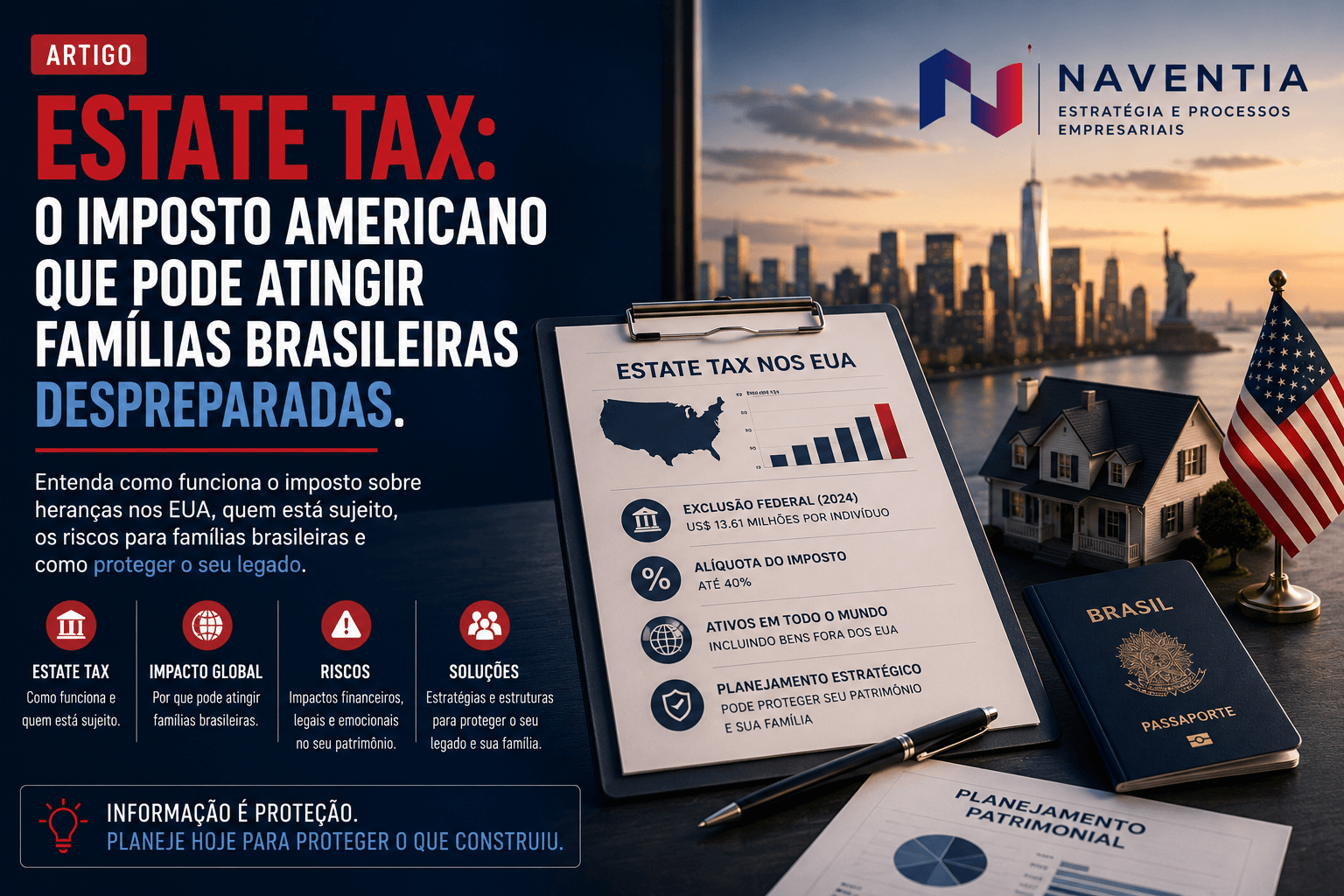
O US Estate Tax It is a federal tax levied on the transfer of certain assets after the death of their owner.
Its application follows specific rules of US law and can cover assets considered to be located in the United States (US situs assets), even when they belong to people who are neither citizens nor residents of the country.
According to Internal Revenue Service (IRS), The analysis depends on factors such as the nature of the assets, their location, and how they are structured.
The official rules can be found directly on the IRS website:
https://www.irs.gov/businesses/small-businesses-self-employed/estate-tax
This point deserves attention because many families believe that owning property in the United States only produces tax effects during the acquisition or exploitation of those assets.
In reality, certain decisions made today can directly influence how this wealth will be managed and transferred in the future.
The US Estate Tax is a consequence of a decision made years earlier.
There is an aspect that rarely comes up in discussions on this topic.
O US Estate Tax It typically doesn't arise when an investor dies.
It starts much earlier.
It begins when a property is acquired.
When a company is opened.
When is a holding company structured?.
When international investments are made.
In other words, taxes are usually just the consequence of asset management decisions made over several years.
For this reason, business families often evaluate not only which assets they wish to own in the United States, but also what is the most appropriate structure to manage them.
This analysis often involves choosing between different corporate models, a topic we explore in more detail in the article. LLC, Corporation, or Holding Company: which structure makes sense for each stage of a company?
https://naventia.com/llc-corporation-ou-holding/
More than defining the legal structure of the transaction, this decision influences aspects related to governance, asset protection, and international succession.

The 7 risks that Brazilian entrepreneurs often ignore.
1. Focusing only on business expansion and forgetting about asset expansion.
When a company decides to enter the American market, a large portion of its energy is directed towards commercial aspects: opening operations, prospecting for clients, hiring employees, and adapting to the regulatory environment.
This is a natural priority.
The problem is that, as the company grows, the entrepreneur's net worth also begins to change. Properties are acquired, investments are diversified, and new assets become part of the family's wealth.
In many cases, these investments occur in isolation, without an integrated wealth management strategy.
The result is that international expansion becomes well-planned from an operational standpoint, but poorly structured from the perspective of succession and asset protection.
It is precisely in this scenario that the US Estate Tax It ceases to be a tax issue and becomes a strategic risk.
2. Choosing the corporate structure based solely on the operation.
One of the most frequently asked questions among Brazilian business owners is:
“"What is the best business structure for opening my company in the United States?"”
The answer almost never depends solely on fiscal aspects.
It involves factors such as governance, asset protection, investor entry, estate planning, profit distribution, and long-term goals.
Therefore, the decision between an LLC, a Corporation, or a Holding company should be analyzed strategically.
The choice of legal structure can influence not only the operational efficiency of the company, but also how certain assets will be managed in the future.
This is why Naventia recommends evaluating this topic early in international expansion.
Learn more at LLC, Corporation, or Holding Company: which structure makes sense for each stage of a company?
https://naventia.com/llc-corporation-ou-holding/
3. Discovering the Estate Tax only during an inheritance process.
This is perhaps the most common risk.
In practice, few families begin their international investments with succession in mind.
The focus is usually on profitability, asset appreciation, and the legal security of the American market.
Succession is usually treated as a future concern.
The problem is that, when it finally happens, several asset reorganization alternatives can no longer be implemented.
That is why estate planning should not be understood as a response to the death of an investor.
It is part of the decisions made long before the acquisition of the first international asset.
4. Treat international assets and business as separate matters.
Well-structured family businesses rarely make this separation.
They understand that business growth and asset preservation are part of the same strategy.
When a company internationalizes its operations, the assets of its partners also tend to internationalize.
Consequently, decisions related to corporate structure, governance, and succession begin to move forward together.
This integrated vision reduces risks and offers greater predictability for future generations.
5. Not reviewing the asset structure throughout the growth phase.
An efficient structure for a company starting its international operations will not always remain adequate five or ten years later.
New investments, the entry of partners, asset growth, and family changes completely alter the landscape.
Therefore, internationalized companies typically review their asset structure periodically.
This practice allows the company's organizational structure to adapt to the new stage of the business and reduce risks that naturally arise during the expansion process.
International wealth planning is not a project with a beginning, middle, and end.
It is an ongoing governance process.
6. Ignoring the fact that governance also protects assets.
When discussing corporate governance, many business leaders associate the concept only with large companies.
In reality, governance means creating clear rules for decision-making, defining responsibilities, and establishing mechanisms capable of ensuring business continuity.
This logic also applies to international heritage.
An organized asset structure reduces family conflicts, facilitates inheritance processes, and increases predictability in asset management.
Therefore, companies that treat governance as part of their strategy tend to face fewer difficulties in succession processes.
7. Viewing Estate Tax as a tax problem.
Perhaps this is the biggest misconception of all.
O US Estate Tax It should not be analyzed in isolation.
It's part of a much broader discussion about internationalization, heritage, and business continuity.
Companies expanding their operations to the United States typically also need to assess issues such as corporate structure, international investments, governance, succession planning, and asset protection.
It is precisely this integration that differentiates sustainable international expansion from simply opening a company abroad.
What internationalized companies do differently
There is a common characteristic among family businesses that manage to preserve assets across generations.
They understand that internationalization doesn't end when an operation is opened.
It continues in the way assets are structured, managed, and transferred.
Therefore, decisions related to US Estate Tax They are usually part of a broader plan, which also involves defining the corporate structure, asset protection, and international growth strategy.
This reasoning is directly connected to other topics we have already covered at Naventia, such as Internationalization to the USA (https://naventia.com/internacionalizacao-para-os-eua/and International Patrimonial Holding (https://naventia.com/holding-patrimonial-internacional-eua/).
When these issues are addressed in an integrated manner, entrepreneurs are able to build more efficient operations, reduce future risks, and preserve the wealth created during the expansion process.
Conclusion
Most Brazilian entrepreneurs begin their international journey with growth in mind.
That's natural.
Ultimately, expanding into the United States represents access to new markets, investors, technologies, and business opportunities.
However, as this expansion consolidates, an equally important responsibility arises: ensuring that the assets built follow the same planning logic adopted by the company.
O US Estate Tax It perfectly symbolizes this change of perspective.
More than understanding a tax, businesspeople need to understand that international assets require international planning.
Business families that adopt this vision are able to integrate succession, governance, corporate structure, and asset protection into a single strategy, prepared not only for business growth but also for its continuity across future generations.
In an increasingly global economic environment, building wealth is only part of the journey. Preserving it is what transforms growth into legacy.
Naventia works alongside companies that want to expand with strategy, security, and a global vision.
If this is your moment, perhaps it's time to take the next step — with someone who already understands the way.