
Internationalization to the US is one of the main objectives of Brazilian companies seeking growth, scale, and global positioning.
As a central reference, see the The most costly mistakes Brazilian companies make when expanding into the US..
There is a narrative that is frequently repeated when the subject is international expansion:
“"If I open a company in the United States, my business will scale."”
The idea is seductive.
The American market is impressive.
A strong currency attracts attention.
The business environment seems more predictable.
The corporate structure seems simple.
All of this is real.
But there is a truth that rarely appears in advertisements, quick fixes, or "open your LLC in a few days" videos:
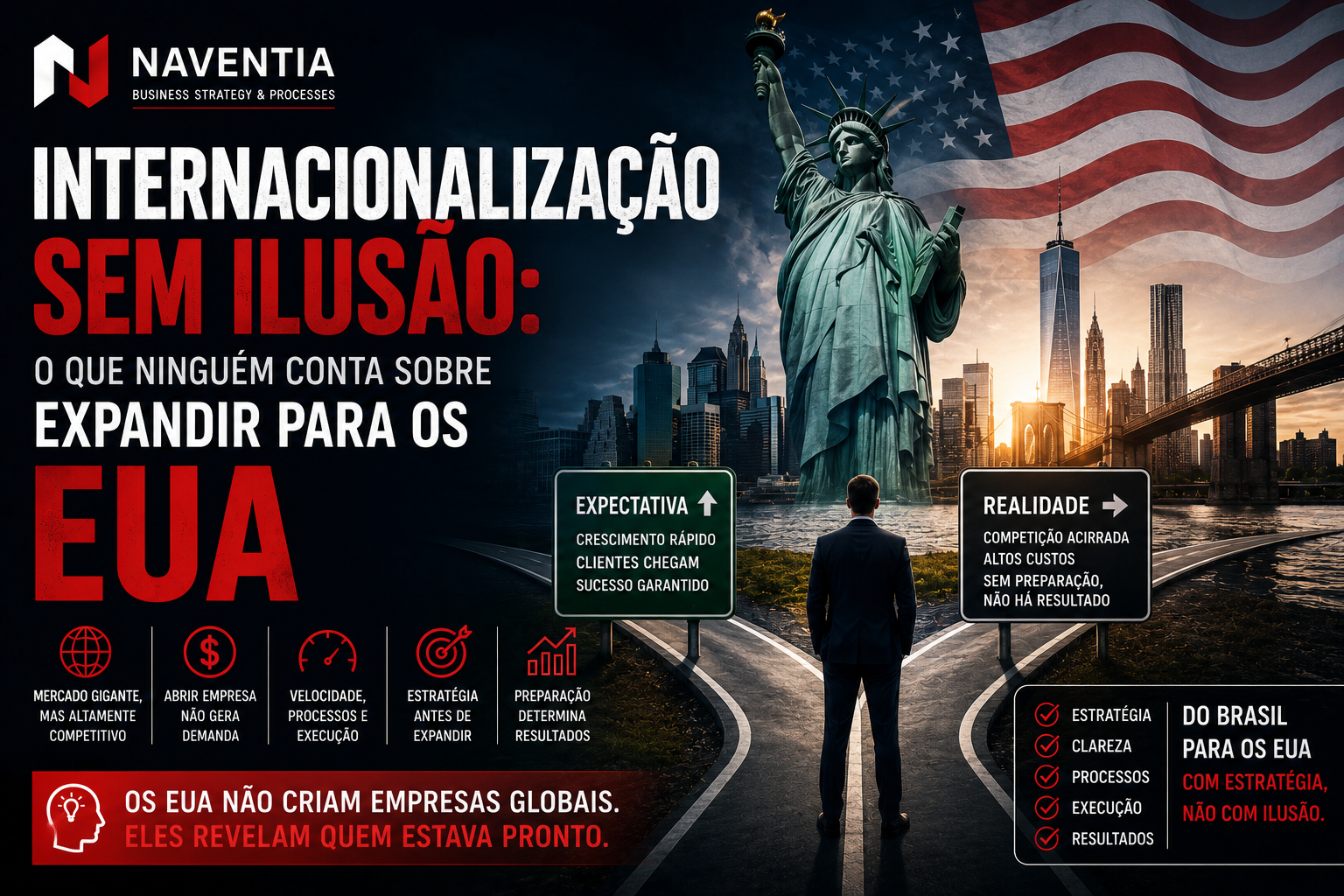
The United States does not transform unprepared companies into global corporations.
Most of the time…
They simply expose, even faster, everything that was already wrong.
Internationalization to the USA: the first shock is that the market doesn't wait for you to learn.
In Brazil, many companies manage to grow even while operating with limitations such as:
- improvised processes
- inconsistent follow-up
- emotional pricing
- low business predictability
- direct dependence on the founder
In the American market…
This model tends to collapse.
Because the United States doesn't adjust its pace to foreign businessmen.
It is the company that needs to adapt its operation to the pace of the market.
And this pace tends to be faster, more competitive, and more demanding.
It's not your imagination: according to U.S. Department of Commerce's SelectUSA program, The country has already facilitated over US$400 billion in foreign investment, precisely because it offers a large, competitive market with clear rules — which demands a higher standard of execution from companies arriving from abroad, right from day one.
This topic is directly connected to:
Service, follow-up, and speed: the American standard that Brazilian entrepreneurs underestimate.
https://naventia.com/atendimento-comercial-nos-eua/
The second shock: starting a business doesn't generate demand.
Many entrepreneurs invest first in:
- corporate opening
- international bank account
- visual identity
- website in English
- global digital presence
And then they discover something unsettling:
No customers showed up.
Because starting a business doesn't mean creating a market.
Structure does not replace demand.
LLC does not replace positioning.
EIN does not close deals.
This mistake often happens when companies start with execution and ignore strategy.
This topic was explored in more detail in:
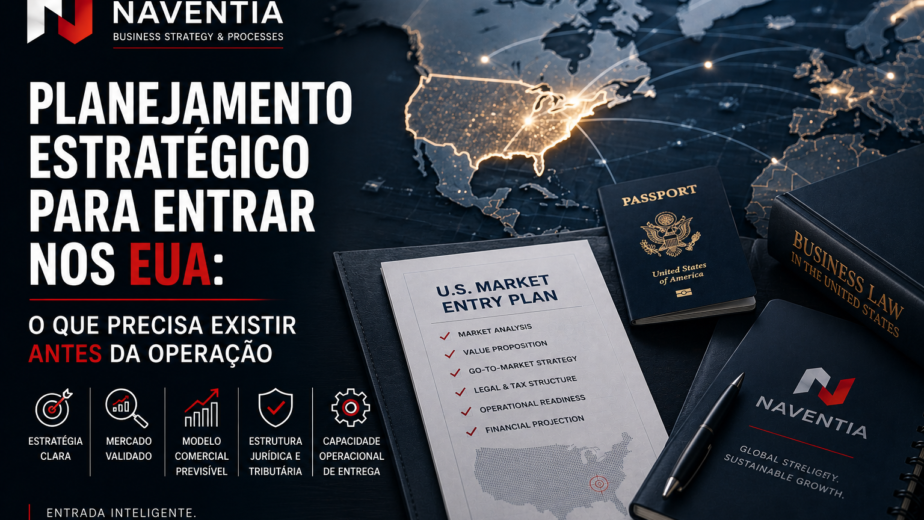
Strategic planning for entering the US: what needs to exist before the operation.
https://naventia.com/planejamento-estrategico-entrar-nos-eua/
The third shock: the American customer doesn't buy sympathy.
In Brazil, relationships often accelerate business deals.
In the United States, the relationship remains important.
But it's usually not the main deciding factor.
The American customer tends to buy:
- perceived competence
- clarity of proposal
- execution speed
- risk reduction
- operational predictability
If your company doesn't communicate this quickly…
The opportunity simply passes by.
The fourth shock: competing costs money.
In the United States, acquiring customers typically requires real investment.
Depending on the segment, this may involve:
- corporate events
- strategic networking
- structured outbound
- paid media
- SDRs
- CRM and sales automation
And many business owners arrive with an emotional budget.
Believing that:
“"Once it opens, the market will come."”
It's not coming.
Mature markets require predictable investment.
This topic connects with:
How to validate demand in the US before opening operations.
https://naventia.com/como-validar-demanda-nos-eua/
The fifth shock: the operation reveals the founder.
Brazilian companies that are highly centralized tend to suffer more in the United States.
Because international expansion requires:
- operational autonomy
- clear processes
- commercial playbooks
- KPIs
- data-driven management
- teams that execute without depending on the founder.
If everything depends on just one person…
Growth is stalled.
This topic also relates to:
How to set up a business process in the US without inflating the structure too early.
https://naventia.com/processo-comercial-nos-eua/
The most expensive mistake of all.
The biggest mistake isn't opening the wrong business.
The biggest mistake is going in believing that:
“"It will be easier in the United States."”
It won't work.
It will be:
- more professional
- faster
- more competitive
- more demanding
- more performance-oriented
And that's exactly why…
Much more scalable for Companies prepared to enter the American market..
What successful companies do differently
Before entering the American market, mature companies validate:
- product-market fit
- clarity of positioning
- international tax structure
- commercial process
- operational capacity
- execution capital
They don't go international to discover.
They internationalize to accelerate.
In practice, this means treating internationalization to the US as a structured project, not a gamble. Successful companies start small: they test their offering in a specific market, measure real sales results, and only then scale their investment. They also dedicate time to understanding how the American sales process works before hiring their first person in the US, because hiring without a validated process only accelerates mistakes. Well-executed internationalization to the US takes time and discipline—but it costs far less than correcting mistakes after they've already been made.

Conclusion
Expanding into the United States could multiply:
- invoicing
- valuation
- global credibility
- access to capital
- market expansion
But it can also multiply:
- errors
- costs
- inefficiencies
- poorly structured decisions
The difference is never in the country.
It depends on the level of preparedness of the company entering the market.
At the end…
The United States does not create global companies.
They reveal which companies were truly ready to become one.
Talk to Naventia
At Naventia, we help Brazilian entrepreneurs enter the American market with strategy, structure, and real-world execution.
Internationalization to the USA: what to validate before entering.
Internationalization to the U.S. requires attention to the official rules applicable to the formation and operation of companies. Consult the guidelines of the Securities and Exchange Commission: https://www.sec.gov/
It is also important to consider the OECD guidelines on taxation and cross-border economic activities: https://www.oecd.org/tax/
Therefore, internationalization to the US must be analyzed in conjunction with positioning, demand, governance, taxation, and execution capacity.
Internationalizing to the US with this type of support changes the outcome: instead of discovering mistakes in practice, your company enters with clarity regarding corporate structure, taxation, contracts, and local operations. Internationalizing to the US doesn't have to be a leap in the dark—it can be a structured process with clear checkpoints before any significant investment.
Companies that treat internationalization to the US as a real project, with defined stages and responsibilities, arrive at the American operation with less rework and lower correction costs later on.
Naventia works alongside companies that want to expand with strategy, security, and a global vision.
If this is your moment, perhaps it's time to give it a try. next step — with those who already understand the way.