


International asset diversification It is often associated with the idea of distributing assets across different countries, currencies, and markets. For a Brazilian business family, this might mean keeping the main company in Brazil, acquiring real estate in the United States, investing part of the resources in the American financial market, and eventually establishing corporate structures in other jurisdictions. At first glance, the assets seem diversified. However, when one observes where the cash flow comes from, what economic factors determine the value of the assets, and what risks can affect them simultaneously, the conclusion can be quite different.
Geographic location is only one dimension of diversification. An asset base can be distributed between Brazil, the United States, and Europe and still remain excessively dependent on a single company, the same economic sector, a predominant currency, or the decision-making capacity of the founder himself.
This distinction gains relevance as Brazilian entrepreneurs internationalize not only their companies, but also their personal and family assets. The challenge is no longer simply accessing other markets, but understanding whether each new asset effectively reduces existing concentration or merely adds complexity to the structure.
It is in this context that an important question arises: does owning assets in multiple countries truly mean being diversified?
1. Wealth diversification should not be measured by the number of countries.
A asset diversification It has a relatively clear economic function: to reduce excessive dependence on a single source of risk. In the financial market, this principle is widely known. Investor.gov, the financial education portal of the U.S. Securities and Exchange Commission. Diversification is defined as the practice of distributing resources among different investments with the goal of reducing risk.
For family businesses, however, this analysis needs to go beyond a portfolio of stocks and bonds.
Consider a businessman whose Brazilian company is worth US$15 million. Over the years, the dividends generated by the business have been used to acquire US$5 million in real estate in the United States and to build an investment portfolio of another US$5 million in the American market. The family's net worth now totals US$25 million and is distributed between two countries and different asset classes.
The photograph suggests diversification. The economic dynamics, perhaps, do not.
If the Brazilian company remains the family's primary source of cash flow, a significant deterioration in the business could simultaneously affect their ability to maintain real estate, make new investments, and finance their standard of living. A significant portion of their international assets was created from the same source and may remain economically tied to it.
This doesn't mean the structure is inadequate. It simply means that diversification needs to be evaluated based on the nature of the risks, not the number of points on a map.
2. An international heritage site may conceal significant concentrations.
The construction of a international heritage It usually happens gradually. Rarely does a family start with a perfectly designed global architecture. Assets are incorporated as opportunities arise: a property in Miami, a stake in an American company, an investment account, a second home, or a new business venture.
The result can be a visually sophisticated portfolio, composed of different assets and entities, but still economically concentrated.
A family linked to the technology sector, for example, may have a large part of its wealth in the company founded by the patriarch and, in parallel, invest in technology funds, shares of large companies in the sector, and real estate located in regions whose economic activity also depends heavily on this industry. The assets are legally different and may be geographically separated, but they respond to similar economic factors.
The same reasoning applies to real estate concentration. Owning properties in São Paulo, Miami, and Lisbon reduces certain local risks, but does not eliminate the family's exposure to the behavior of the real estate sector as a whole, the need for maintenance, low liquidity, or credit conditions.
Therefore, a consistent analysis of international heritage It should consider not only where each asset is located, but also what factors determine its performance and what events could affect several of them at the same time.
3. International asset diversification also needs to consider currencies.
Internationalization often begins with seeking exposure to the dollar. For Brazilian entrepreneurs, this decision can make sense as part of a broader strategy, especially when there are business ventures, investments, future expenses, or family goals in the United States.
The problem arises when replacing one concentration with another is confused with diversification.
A family might significantly reduce its exposure to the Brazilian real and, a few years later, realize that virtually all of its international assets, financial income, and investments are denominated in dollars. This doesn't necessarily make the strategy bad, but it shows that... international asset diversification It requires a joint analysis of assets, liabilities, and future needs.
The SEC highlights that international investments carry, among other factors, exchange rate risk: movements in exchange rates can increase or decrease the return obtained by the investor. The agency also draws attention to differences in liquidity, information, regulation, and market conditions between countries.
For a business-owning family, currency analysis must also consider where its members intend to live, study, invest, and consume. A family that intends to finance education in the United States, maintain residences in more than one country, or transfer part of its business activities abroad has different currency needs than a family whose economic life remains primarily in Brazil.
In this context, currency ceases to be merely an investment decision and becomes part of wealth planning.
4. International wealth planning should precede the next acquisition.
One of the main challenges of international wealth planning The truth is that heritage sites are rarely built following a linear plan. In practice, opportunities arise before the architecture is even complete.
A businessman receives an offer to purchase a property in the United States and decides to seize the opportunity. Some time later, he opens an LLC. Then, a private investment, a new bank account, or the possibility of participating in another business arises. Each decision has its own logic, but few families periodically stop to analyze how the new pieces have altered the whole picture.
It is precisely at this point that strategy and opportunity can come into conflict.
Before incorporating a new asset into the portfolio, it would be important to understand whether it reduces any existing concentration, improves liquidity, adds exposure to a new source of return, or simply increases a position that is already significant.
The same logic applies to the corporate structure. In the article about international wealth holding company in the United States, Naventia starts precisely from the need to define the structure's function within the overall assets before deciding which vehicle to use. An LLC may be suitable in certain situations, but the entity, in isolation, does not constitute an asset management strategy.
This reasoning should also apply to each new acquisition. An asset may be attractive individually and yet contribute little to the quality of the existing heritage architecture.
5. Asset diversification also involves liquidity.
A family can own businesses, real estate, private holdings, and alternative investments, and still face difficulties in obtaining resources quickly without destroying value. This is a more common situation than it seems, especially among business owners whose wealth has been built from operating assets.
A asset diversification, Therefore, liquidity also needs to be considered.
Imagine a family with a net worth of US$30 million, of which US$20 million is concentrated in the family business and another US$7 million in real estate. Although the net worth is substantial, only a relatively small portion may be readily available to quickly meet a financial need.
This need can arise in different contexts: an acquisition opportunity, a business crisis, a tax obligation, a change of residence, or an inheritance event. When the family does not have sufficient liquidity, it may be forced to sell assets under conditions it would not voluntarily choose.
Diversification, in this case, also needs to be analyzed in terms of the asset base's ability to absorb unexpected events. An asset structure comprised of many illiquid assets may appear diversified on a spreadsheet, but remain vulnerable when cash is needed.
6. Internationalizing assets also means internationalizing liabilities.
The construction of a international heritage It adds a dimension that doesn't exist in the same way in a purely domestic portfolio: each new jurisdiction can introduce its own tax, corporate, inheritance, and compliance rules.
A property in the United States, for example, represents more than just exposure to the American real estate market. Depending on the method of acquisition and the owner's profile, it can have specific tax and inheritance implications. An American company can create business opportunities while simultaneously generating new reporting obligations. An efficient structure in a particular jurisdiction may produce different effects when analyzed in the country of residence of its owners.
This is one of the reasons why Naventia warns about... asset protection in the United States, This highlights the risks of establishing entities before clearly defining their function. A hastily created structure can add obligations and complexity without necessarily improving asset protection or efficiency.
This perspective changes the way international diversification is evaluated. Adding a new country may reduce certain economic exposure, but simultaneously increase fiscal, inheritance, or regulatory risks. The decision needs to consider the net effect on the family structure.
7. International asset management needs to identify risks that do not appear in isolation.
Perhaps the most important point of a international asset management The goal is to understand the relationships between the assets. Individual analyses may conclude that each investment makes sense, yet still fail to perceive a significant concentration within the overall portfolio.
Consider again a Brazilian business family. The operating company is in Brazil, part of the financial assets are invested in the United States, and there are American properties. At first glance, there is diversification between the company, the financial market, and real estate.
A deeper analysis, however, may reveal that the resources used to support international investments continue to come primarily from the Brazilian company. It may also show that the financial portfolio has strong exposure to the same sector as the family-owned company or that certain assets were offered as collateral in related transactions.
None of these elements necessarily represents a problem in isolation. The risk arises from the correlation between them.
That's precisely why the international asset management It requires a consolidated vision. The question ceases to be whether each asset is good or bad and becomes what role it plays within the overall portfolio and how it behaves when other components of the structure face pressure.
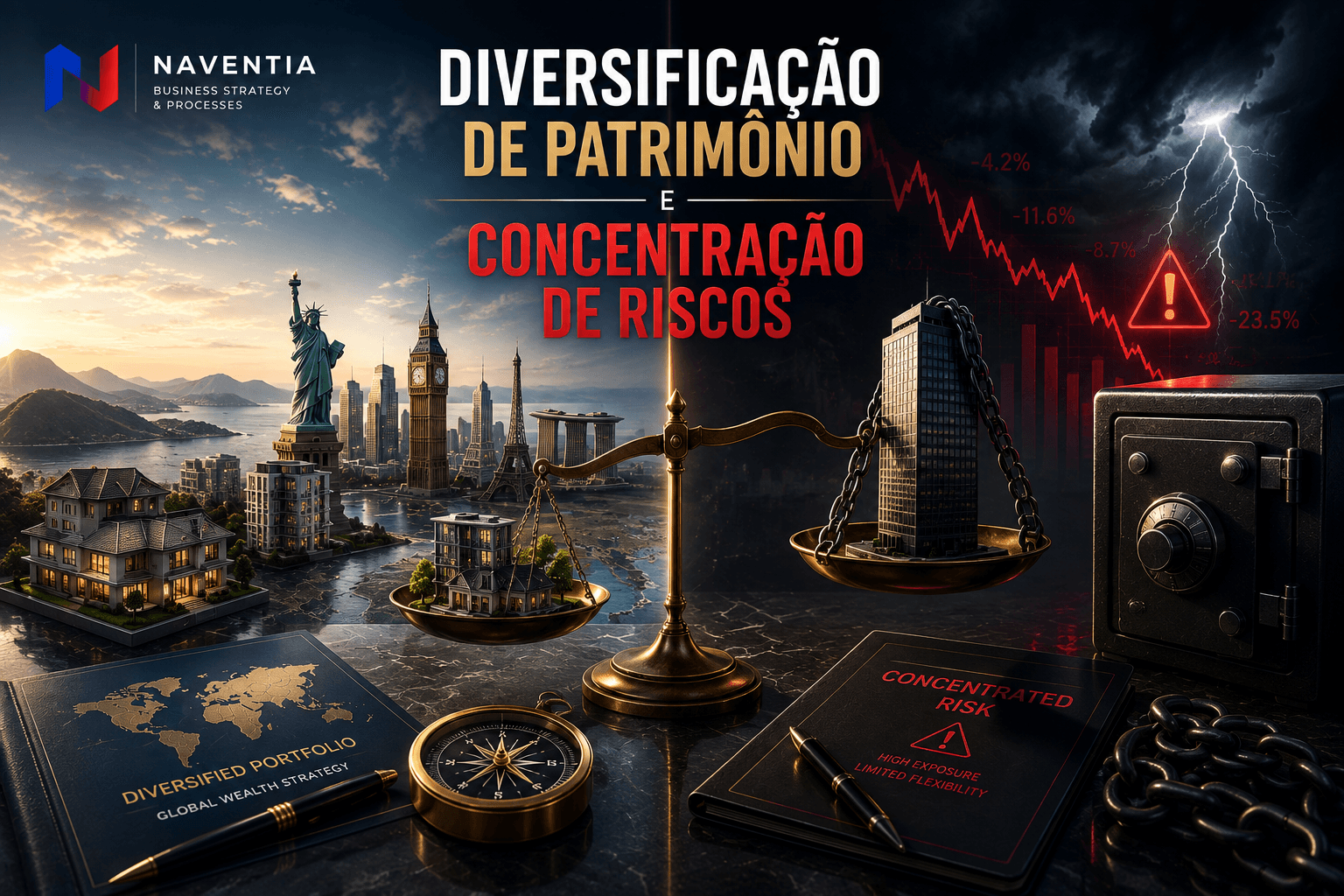
Having multiple corporate structures does not mean being diversified.
The internationalization of assets is often accompanied by new entities. LLCs, corporations, holding companies, and other structures become part of the family organizational chart and can fulfill legitimate functions of operation, ownership, risk segregation, or governance.
However, legal complexity should not be confused with economic diversification.
Naventia addresses this difference by analyzing LLC, Corporation or Holding and the function of each structure.. The right choice depends on the company's objectives and stage of development or its assets; there is no universally superior vehicle.
A family can have five entities controlling different assets and still remain dependent on the same business, the same currency, or the same source of cash generation. In this scenario, there has been legal diversification of the structure, but not necessarily diversification of risk.
Furthermore, each entity adds administrative, accounting, tax, and governance costs. The sophistication of an asset management architecture should be measured by its ability to fulfill its objectives with clarity and efficiency, not by the number of boxes in the organizational chart.
International estate planning needs to follow the family's trajectory.
There is a dimension of diversification that doesn't appear in investment reports: the evolution of the family itself.
Over the course of ten or twenty years, children may study abroad, establish residency in other countries, take on positions within or outside the family business, and develop different financial needs. The founder may also reduce their stake in the operation, sell the business, or convert business assets into financial assets.
These changes alter the logic of international wealth planning.
A structure designed for a family that lived entirely in Brazil may not be the most suitable when part of the next generation moves to the United States. Similarly, a portfolio primarily focused on appreciation may need to be reviewed when the assets begin to finance different family units.
This shows why asset diversification should not be treated as a static snapshot. The right balance depends not only on the characteristics of the assets, but also on the goals, obligations, and location of the people who will depend on them.
International asset management is increasingly a coordination problem.
As wealth grows, so does the number of specialists involved. Lawyers, accountants, banks, investment managers, and tax consultants may participate in different parts of the structure. Each professional tends to correctly analyze the dimension for which they are responsible, but this does not guarantee that the wealth is being monitored in an integrated way.
A financial portfolio can be well diversified and, at the same time, poorly coordinated with the succession strategy. A holding company may perfectly fulfill its corporate function, but have been created without considering future changes in the heirs' residence. An investment may offer an excellent expected return and yet amplify an already significant economic concentration.
It is at this point that the international asset management It's no longer just a matter of selecting good assets, but requires coordination between financial, corporate, tax, and family decisions.
The very structure of Naventia's internationalization services It follows this logic by integrating diagnosis, corporate structuring, tax planning, and asset organization, instead of treating each decision as an independent process.
For more complex international assets, the quality of coordination can be as important as the individual quality of each decision.
A global map is not necessarily a map of diversification.
A useful way to assess an international heritage is to imagine two different maps.
The first map shows where the assets are located: Brazil, the United States, Europe, and other jurisdictions. This map is important because it reveals geographic, legal, and currency exposure.
The second map should show which factors these same assets depend on: operating company, economic sector, real estate market, variable income, credit, currencies, liquidity, taxation, succession, and management capacity.
It is possible that the first map appears extremely diverse while the second reveals a significant concentration.
This is probably the main distinction behind international asset diversification. Geography helps to understand where the property is located; risk analysis helps to understand what could affect it.
Families with global wealth need both perspectives.
Conclusion
A international asset diversification Internationalization should not be measured by the number of countries, bank accounts, properties, or companies present in the family's assets. These elements show that internationalization has occurred, but they are not sufficient to demonstrate that there has been an effective reduction in concentration.
A more comprehensive analysis needs to consider the source of cash flow, which sectors influence assets, in which currencies revenues and liabilities are held, how much of the equity is liquid, which jurisdictions add tax or inheritance risks, and to what extent different investments remain interdependent.
It is in this context that asset diversification, international heritage, international asset management e international wealth planning They become part of the same discussion.
For business families, the goal shouldn't simply be to accumulate assets in different locations. The challenge is to build an architecture where risks, liquidity, structures, and family objectives make sense together and can be revised as the wealth and the family itself evolve.
Having assets in five countries can represent a consistent global strategy. It can also represent five independent decisions that have never been analyzed as a whole.
The difference between these two situations is not on the map.
It's part of the strategy.

Naventia works alongside companies that want to expand with strategy, security, and a global vision.
If this is your moment, perhaps it's time to take the next step — with someone who already understands the way.