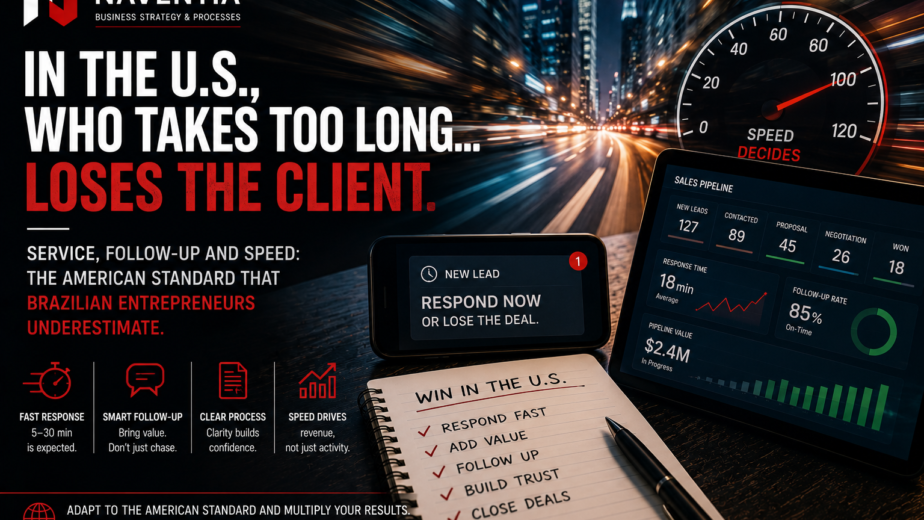

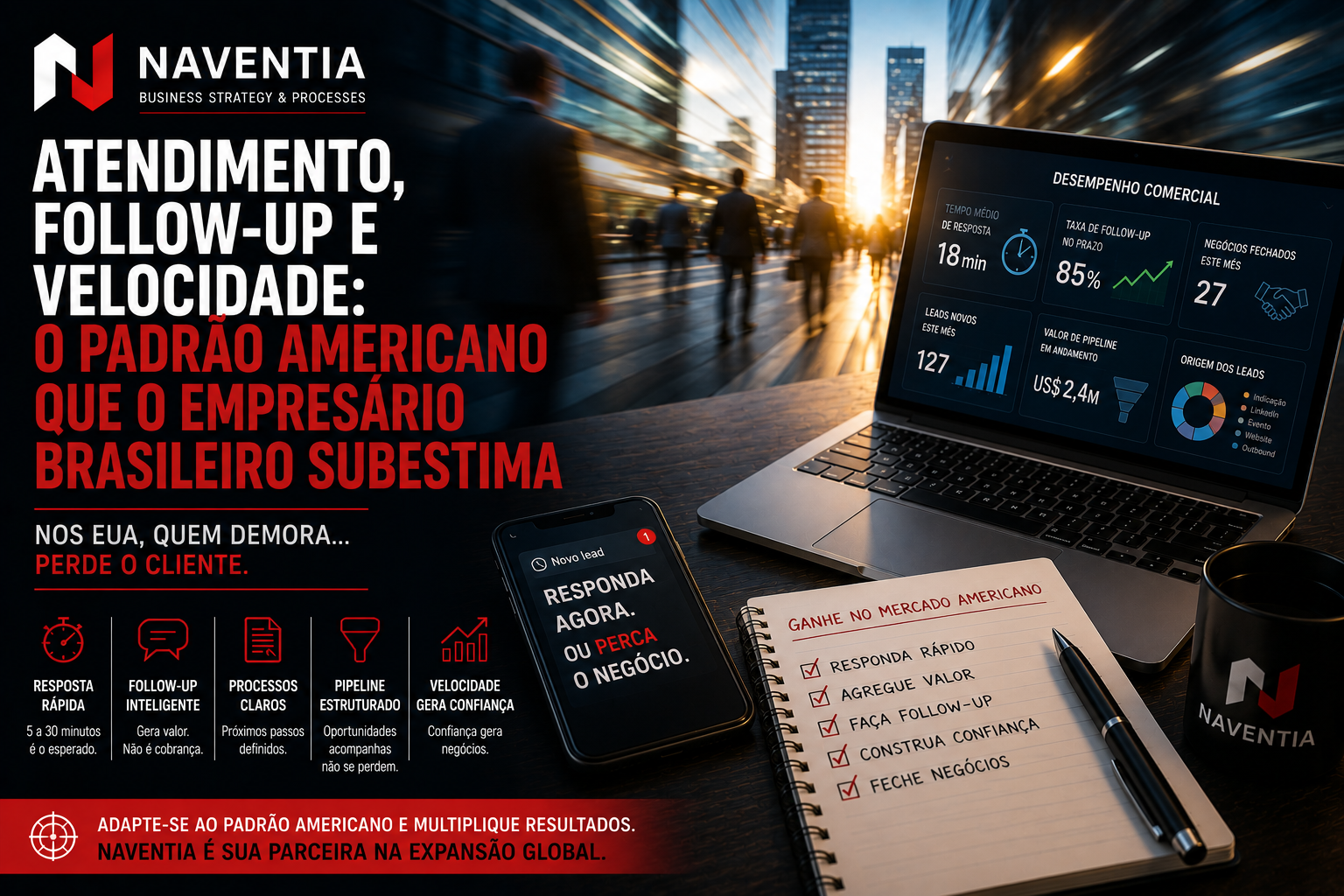
Customer service in the USA This is one of the most decisive factors for Brazilian companies that want to grow in the American market.
Many business owners believe that the biggest challenges of internationalization lie in:
- open a company in the United States
- structuring international taxation
- hire local staff
- understanding compliance
All of this really matters.
But there is an operational variable that destroys more business opportunities than most people realize:
Response speed.
In the United States, speed is not a differentiating factor.
Speed is expectation.
And it is precisely here that many Brazilian companies begin to lose market share even before presenting a proposal.
The invisible error that is killing sales in the US.
In Brazil, many business owners still believe in a common logic:
“"If the lead is truly interested, they will wait."”
In the United States, this rarely happens.
The behavior of the American buyer is different.
He usually:
- Search for suppliers quickly
- Compare offers quickly.
- schedule meetings in a short amount of time
- to make business decisions more objectively
And most importantly:
He quickly moves on to the next supplier.
This means that if your company takes too long:
- 4 hours to respond to a lead.
- 24 hours to confirm a meeting
- 2 days to submit a proposal
- several days to follow up
In many sectors…
The opportunity has already been lost.
The American standard of commercial service
Companies that sell well in the United States typically follow three operational pillars.
Quick response
American companies typically operate with a clear commercial SLA.
In many B2B markets, the expected pattern is usually:
Inbound leads
Response between 5 and 30 minutes
Commercial proposals
Delivery between 24 and 48 hours
Post-meeting follow-up
Contact us on the same day.
Customer perception is usually simple:
Those who respond quickly are more likely to perform better.
This behavior is directly connected to:
How to set up a business process in the US without inflating the structure too early.
https://naventia.com/processo-comercial-nos-eua/
Structured follow-up
Another critical point is the follow-up.
In Brazil, many companies still engage in emotional follow-up.
Messages such as:
- “"Just checking in to find out..."”
- “"Did you have time to analyze it?"”
- “"I'll be waiting."”
In the United States, follow-up needs to generate value.
More mature companies typically use follow-up actions that include:
- relevant cases
- industry benchmarks
- market insights
- anticipation of objections
- strategic materials
In the American market, follow-up is not pursued.
Follow-up leads.
Operational clarity
The American customer wants predictability.
He hopes to know clearly:
- next steps
- timeline
- responsible
- deliverables
- risks involved
Companies that fail to communicate this convey insecurity.
Even when they have a great product or service.
Where Brazilian companies most often fail.
The most common errors we observe are:
Answer slowly
Many companies still believe that relationships compensate for slowness.
In the US, it's usually not worth it.
Follow-up without a strategy.
Generic messages often generate silence.
Inconsistent business process
Each salesperson works in their own way.
Each proposal follows a different pattern.
Lack of CRM
Leads are spread across:
- spreadsheets
- personal notes
And opportunities disappear.
Weak post-meeting
No summary.
No further steps needed.
No sense of urgency.
This topic also relates to:
Strategic planning for entering the US: what needs to exist before the operation.
https://naventia.com/planejamento-estrategico-entrar-nos-eua/
The financial impact of the slowdown
In the United States, slow service is costly because customer acquisition costs are usually high—and slower sales service in the US than the competition means lost leads.
When your company generates leads through:
Investing in lead generation without investing in sales support in the US is wasting your marketing budget.
- events
- networking
- LinkedIn outbound
- paid media campaigns
- strategic partnerships
…and loses opportunities due to operational failures…
You're not just losing sales.
You're burning CAC.
And companies that make unpredictable acquisitions quickly lose competitiveness.
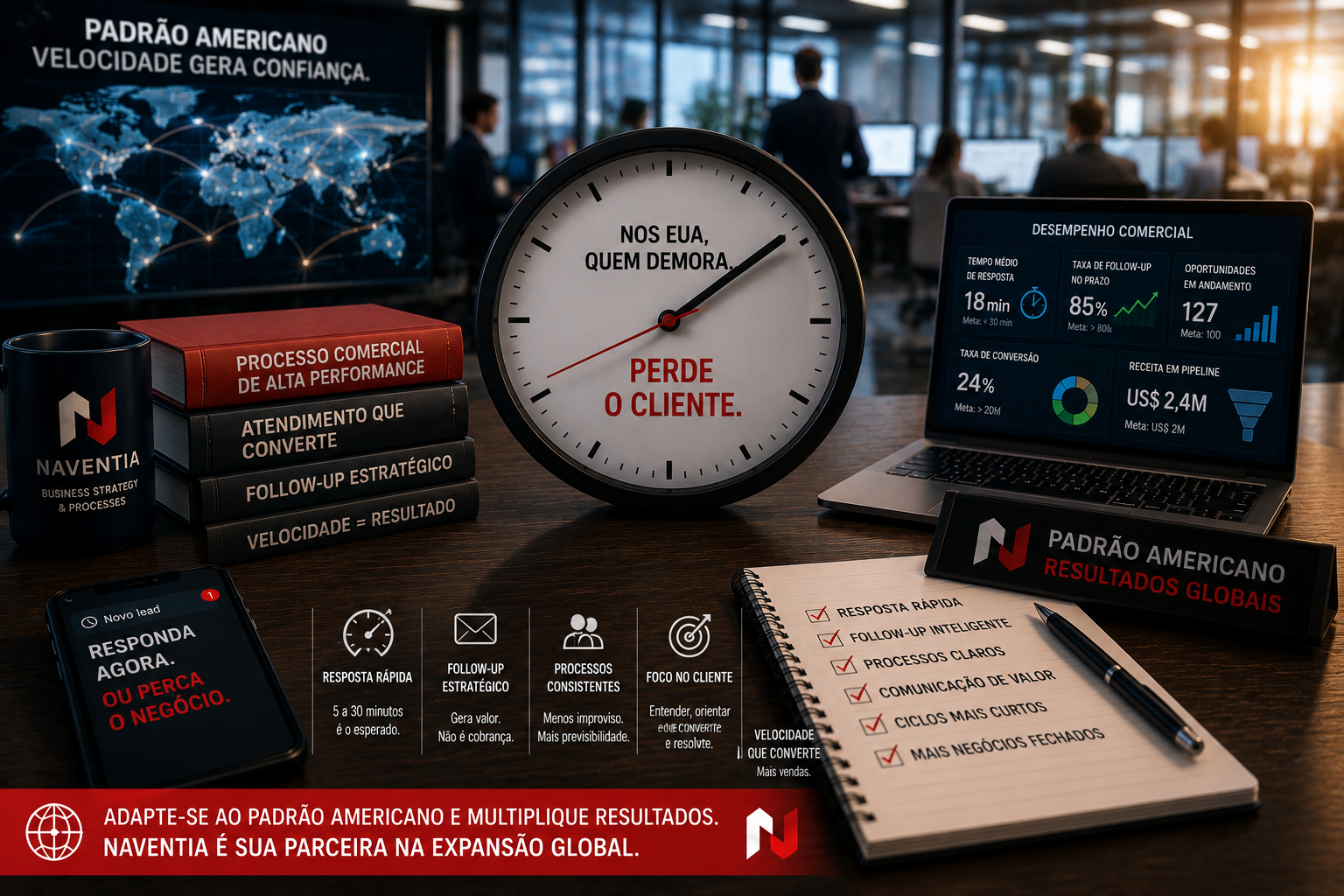
How to structure a sales service in the USA in 4 steps.
Building a truly competitive sales service in the US requires more than just good intentions. It requires process.
- Define a response SLA. Companies that provide good customer service in the US respond in minutes, not days.
- Automate the initial contact. An automated email or message shows that your company's US sales support is active even outside of Brazilian business hours.
- Standardize follow-ups. Without a structured sequence, customer service in the US becomes dependent on individual memory.
- Measure the response time. What isn't measured doesn't improve — and that's especially true for customer service in the US.
Brazilian companies that apply these four steps report shorter sales cycles and higher conversion rates in the American market.
What mature companies do differently
Companies that consistently sell in the US typically implement:
- Commercial SLA
- Structured CRM
- automated sequences
- business templates
- consultative follow-up
- predictable forecast
They don't let opportunities depend on memory.
According to the marketing and sales guide of US Small Business Administration (SBA), In the US market, post-sales support and customer experience are crucial factors for customer loyalty—reinforcing why sales support in the US needs to be treated as a process, not as improvisation.
They depend on the process.
What changes when your company adapts?
When Brazilian companies adopt the American standard of speed, they typically notice:
- shorter business cycles
- higher response rate
- more meetings converted
- premium perception
- commercial predictability
Because in the American market…
Speed communicates competence.
Conclusion
Your product could be excellent.
Your strategy may be correct.
Your legal structure may already be in place.
But if your sales support in the US isn't keeping pace with the speed of the market…
The customer will never find out.
In the United States:
Those who delay, don't compete.
Talk to Naventia
At Naventia, we help Brazilian entrepreneurs structure international business operations with processes, predictability, and sustainable growth.
Naventia works alongside companies that want to expand with strategy, security, and a global vision.
If this is your moment, perhaps it's time to give it a try. next step — with those who already understand the way.