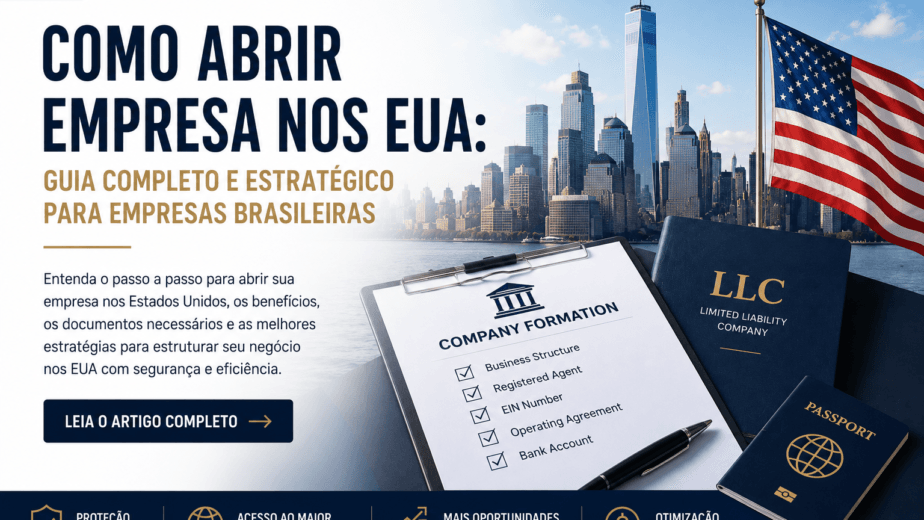


Asset Protection for Brazilian Entrepreneurs: Separating Business Risk in the U.S.
The most common question Brazilian business owners ask when considering establishing a business in the United States is usually straightforward:
“"Should I open an LLC or a Corporation?"”
That's a legitimate question.
But in most cases, it starts in the wrong place.
When the objective involves asset protection, international estate planning, or segregation of assets between jurisdictions, the discussion about the type of company ceases to be the central focus of the analysis.
The real question then becomes another:
What role should this American structure play within the businessman's global portfolio?
This shift in perspective is what separates a typical corporate opening from a truly effective international strategy.
In fact, many business owners start with the operational structure before understanding the tax and asset impact of the decision.
This topic was explored in more detail in:
LLC, Corporation, or other structure: how to choose without compromising the future of your business.
https://naventia.com/llc-corporation-ou-outra-estrutura-como-escolher-sem-comprometer-o-futuro-do-negocio/
LLC is not a holding company. LLC is a vehicle.
An LLC (Limited Liability Company) can be an excellent business structure.
In the United States, this model offers significant advantages, such as:
- management flexibility
- civil liability protection
- operational efficiency
- pass-through taxation at the American federal level, in certain scenarios
Therefore, for entrepreneurs who wish to operate commercially in the American market, the LLC often appears as one of the most efficient structures.
But here's a recurring mistake:
An LLC is not automatically an international asset holding company.
A holding company serves a different purpose.
It exists for:
- hold assets
- protect assets
- organizing international succession
- Separating risks between individuals, companies, and jurisdictions
- structuring long-term tax efficiency
I.e:
An LLC can be the vehicle.
But the heritage strategy lies in the architecture.
And this type of architecture requires planning.
What an international asset holding company can solve
When properly structured, an international asset holding company can fulfill multiple strategic functions simultaneously.
Asset protection
One of the most important functions of an international holding company is risk segregation.
Assets held by a US entity may, depending on the structure adopted, be protected from personal or business contingencies of the partner in Brazil.
This can include situations such as:
- corporate disputes
- tax enforcement
- business litigation
- marital and estate planning
- property exposure resulting from the local operation
Naturally, the effectiveness of this protection depends on how the structure is built and the applicable legislation in each jurisdiction.
International succession planning
Another point frequently overlooked by Brazilian business owners is the succession impact on assets held directly in the United States.
Real estate, investments, or equity interests held directly by a foreign individual may be subject to... American estate tax.
In many cases, the limit applicable to foreigners is significantly lower than the limit granted to American residents.
This can lead to significant asset exposure in inheritance events.
Using an appropriate international corporate structure can contribute to:
- succession planning
- heritage preservation
- reduction of tax exposure
- predictability for heirs
International tax efficiency
A holding company can also play a strategic role in the international movement of capital.
Depending on the structure adopted, it can organize:
- dividend distribution
- receipt of royalties
- intercompany interest transactions
- international asset consolidation
When operations occur in multiple jurisdictions, this can directly impact:
- global tax burden
- financial predictability
- international tax compliance
- expansion efficiency
This topic directly relates to another critical point:
Tax mistakes when opening a business in the USA: what foreigners do wrong.
https://naventia.com/erros-tributarios-ao-abrir-empresa-nos-eua-o-que-estrangeiros-fazem-errado/
The risk of opening a structure without planning.
Many entrepreneurs open an LLC in the United States in their own name, believing they are automatically protected.
In practice, without prior planning, the effect can be exactly the opposite.
A poorly designed structure can lead to:
- complex reporting obligations
- bilateral tax exposure
- succession inefficiency
- risks of tax reclassification
- unnecessary operating costs
Depending on the case, relevant ancillary obligations to US authorities may also arise, including:
- FBAR
- FATCA
- tax returns filed with the IRS
- international corporate reporting
Without a clear strategic function, the company becomes merely an additional obligation.
Not a solution.

The role of international legal planning
Registering a company, obtaining an EIN, and opening a bank account are relatively simple steps.
The complex—and truly strategic—part happens before that.
This is when decisions such as the following need to be made:
- What will be the function of the structure?
- Which jurisdiction makes more sense?
- who will own the assets
- how will the succession be handled
- how will the profits be distributed
- What obligations will exist in Brazil and the USA?
The choice of state can also directly impact the efficiency of the operation.
States such as:
- Delaware
- Wyoming
- Florida
They have quite distinct legal, tax, and corporate characteristics.
Therefore, the decision cannot be based solely on startup costs.
This reasoning also connects to:
How much does it really cost to structure a serious entry into the American market?
https://naventia.com/quanto-custa-entrar-nos-eua-entenda-o-investimento-real-para-empresas-brasileiras/
What do more prepared entrepreneurs do differently?
Business leaders who build efficient international structures typically don't start by asking:
“LLC or Corporation?”
They begin by asking:
- What does this structure need to protect?
- What assets are being internationalized?
- What is the goal for the next five or ten years?
- Is succession involved?
- Is international growth projected?
- Is there cross-jurisdictional tax risk?
These answers define the structure.
Not the other way around.
According to IRS guide for international business, Cross-border structures require specific reporting and tax planning obligations. That's why a international asset holding A well-structured plan avoids tax surprises and protects assets in the long term.
Conclusion
Opening an LLC in the United States can be simple.
Structuring an efficient international asset holding company is another story altogether.
This process involves:
- legal planning
- tax strategy
- succession planning
- asset governance
- international alignment
For Brazilian entrepreneurs with significant assets or expanding operations, the most important question is not:
“LLC or Corporation?”
The correct question is:
What does this structure need to do for my assets over the next ten years?
The answer to that question determines everything that comes after.
Talk to Naventia
If your company is evaluating international structures for asset protection, business expansion, or global planning, the decision needs to begin with strategy.
At Naventia, we help Brazilian entrepreneurs structure international operations with a legal, tax, and long-term perspective.
Naventia works alongside companies that want to expand with strategy, security, and a global vision.
If this is your moment, perhaps it's time to give it a try. next step — with those who already understand the way.
Naventia conducts the strategic diagnosis and provides all the necessary structuring for your company to enter the US market safely.
Discover our services.
https://naventia.com/servicos/