


In most cases, it doesn't make sense: an S-Corp doesn't accept nonresident alien shareholders, and that rule decides everything. Brazilians can only be partners in an S-Corp if they are tax residents in the United States, with a green card or through the Substantial Presence Test. Outside of these conditions, LLCs and C-Corps are the structures that actually work. Before registering anything, it's worth talking to an international tax specialist.
In summary:
- Brazilians can only be partners in an S-Corp if they are tax residents in the US, with a green card or through the Substantial Presence Test; otherwise, LLC or C-Corp are the viable options.
- The S election requires a maximum of 100 shareholders, a single class of shares, and strict restrictions that prevent non-resident shareholders.
- Companies structured as LLCs remain the most common choice for Brazilians due to their flexibility in accepting foreign partners and varied tax options.
- To opt for an S-Corp, it is necessary to file Form 2553, obtain an ITIN or SSN, and consider tax risks associated with trusts and foreign ownership.
- Institutional investors, preferred stock issuance, and venture capital raising make C-Corp the most suitable structure for growth and fundraising.
Naventia
Structure your entry into the US with clarity.
Naventia connects Brazilian companies with experts in the US to guide tax, legal, and operational decisions with less risk.
Meet Naventia
Index
- What is an S-Corp and how does it differ from a C-Corp?
- Eligibility rules and crucial pitfalls for Brazilians
- Tax and operational advantages and disadvantages for Brazilian entrepreneurs.
- Practical alternatives for Brazilians: when to prefer LLC or C-Corp
- Decision checklist: practical questions every Brazilian should answer
- Practical steps and tax obligations for Brazilians who choose to become an S-Corp.
- Naventia Perspective: How we evaluate real-life cases of Brazilians.
- How Naventia can help structure your company in the US.
- Sources
- Frequently Asked Questions
What is an S-Corp and how does it differ from a C-Corp?
S-Corp is not a type of company, it's a tax choice. A corporation (usually already incorporated as a C-Corp in some US state) asks the Internal Revenue Service (IRS) to be taxed under Subchapter S, using the Form 2553. The practical effect is pass-through taxation: the company files Form 1120S and distributes income to shareholders through Schedule K-1, without paying corporate income tax. The C-Corp, on the other hand, suffers double taxation—it pays tax on the company's profit, and the shareholder pays again when receiving dividends.
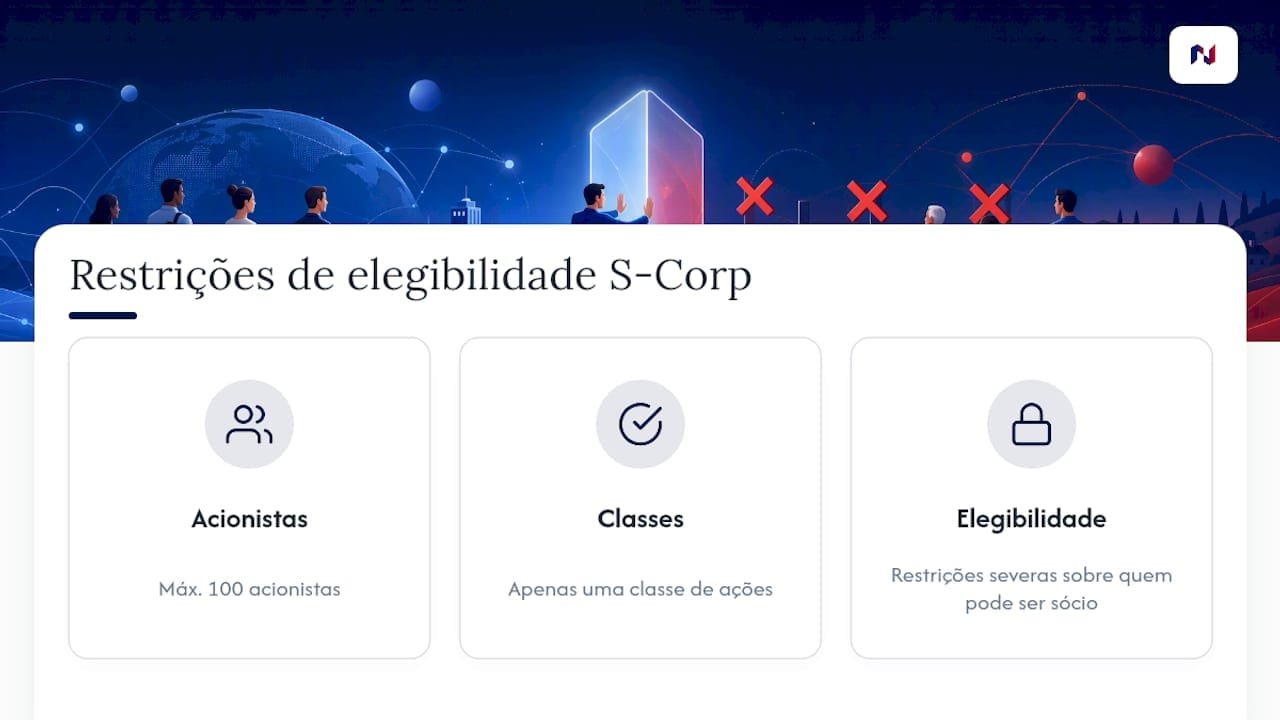
The S-class election comes with strict constraints: a maximum of 100 shareholders, a single class of shares, and severe restrictions on who can be a shareholder. It is precisely this last constraint that most Brazilians stumble over.
Eligibility rules and crucial pitfalls for Brazilians
Federal law, in code dealing with S corporations, The law prohibits a nonresident alien from being a shareholder. A single shareholder in this capacity is sufficient to invalidate the entire election, retroactively, for the whole company.
The point that confuses most Brazilians is thinking that the rule deals with nationality. In fact, it deals with tax residency. You can be shareholder if the Substantial Presence Test is met (Basically, counting days of stay in the US in a specific calculation over the last three years) or if you have a green card. Without one of these two conditions, you are a nonresident alien for tax purposes, even if you have lived in the country for months.
Real-world risk scenarios:
- A partner who was a tax resident moves back to Brazil and loses their resident status without notifying the other partners.
- Shares are transferred, through inheritance or sale, to a relative who lives in Brazil and has never set foot in the U.S. long enough to pass the presence test.
- The company is structured with a trust as the shareholder, and this trust has non-resident beneficiaries.
Regarding the last point: changes brought about by the 2017 tax reform (TCJA) and specific ESBT (eligible small business trust) rules prevent, in some cases, the election from automatically concluding when a trust with a nonresident alien beneficiary is a shareholder. But this exception comes at a cost. According to a technical analysis published bythe Tax Adviser, The income attributed to this beneficiary is then taxed at the trust level, with much higher rates than those applied to an individual. It's a technical solution, not necessarily a cost saving.
Tax and operational advantages and disadvantages for Brazilian entrepreneurs.
When election S applies to your case, the gains are real:
- Pass-through taxationYou avoid the double taxation that penalizes C-Corp.
- QBI Deduction (Section 199A)Pass-through entities, including S-Corps, may benefit from this deduction within certain income limits. which improves the tax advantage for many owners.
- Pension economicsPart of the profit can be distributed as dividends instead of salary, reducing the base subject to payroll taxes.
On the downside, the list is burdensome for those considering growth with international partners:
- Total ban on non-resident alien partners.
- A limit of 100 shareholders and a single class of shares complicates any negotiations with institutional investors.
- Virtually unfeasible for raising venture capital, which typically requires preferred stock.
Pro tip: Before electing S status, simulate the impact of state tax on profit distribution. Some states treat pass-through income differently than federal tax, and this calculation changes the final outcome of your planning.
Practical alternatives for Brazilians: when to prefer LLC or C-Corp
An LLC remains the most commonly used structure by Brazilians opening businesses in the US, precisely because it accepts foreign partners without tax residency restrictions. It also offers tax flexibility: it can be treated as a disregarded entity, as a partnership, or elect C-Corp taxation, depending on what makes the most sense for the group of partners.
C-Corp, in turn, is the natural vehicle for those who want to:
- To raise investment from venture capital funds or institutional angel investors.
- To issue multiple classes of shares, including preferred shares for investors.
- Take advantage of the QSBS (Qualified Small Business Stock) benefit in the event of a sale of the company.
In practice, many Brazilian entrepreneurs opt for an LLC in the early years and migrate to a C-Corp when the investment round approaches. S-Corp tends to appear more in smaller family operations, with partners who are already tax residents in the US.
Decision checklist: practical questions every Brazilian should answer
Before deciding on any structure, answer these four questions in this order:
- Are all current and future partners tax residents in the U.S.? If the answer is no to any of them, S-Corp is already out of the question.
- Are there plans to bring in foreign investors or issue preferred shares? If so, C-Corp tends to be the most realistic path.
- Will the company distribute profits regularly or retain earnings for reinvestment? Regular distribution favors S-Corp (when eligible); retention for growth favors C-Corp.
- Are there trusts, holding companies, or other asset structures involved in the ownership of the company? If so, the assessment requires a technical perspective before any election.
Practical steps and tax obligations for Brazilians who choose to become an S-Corp.
When the scenario actually allows for election S, the minimum flow goes through:
- Establish the corporation in the chosen state, following local registration rules and annual fees, according to specialized guidelines in... limited liability company (GmbH-kauf).
- File Form 2553 with the IRS within the applicable deadline, usually within the applicable election filing deadline.
- Obtain an ITIN or SSN for each individual partner; this document is essential for declaring individual income.
- Complete the company's Form 1120S annually and distribute Schedule K-1 to each partner.
- Each partner declares their share via Form 1040 (resident) or, if the situation changes, via 1040-NR.
A little-discussed warning: even within an eligible structure, companies with significant foreign ownership may need to file Form 5472, and there is withholding tax on certain payments to non-residents. Add to that the risk of estate tax: shares in American companies count as assets located in the US for inheritance tax purposes, with a much lower exemption limit for non-residents than for US citizens. This changes the estate planning of any Brazilian partner still living in Brazil.
Naventia Perspective: How we evaluate real-life cases of Brazilians.
In consulting practice, the first filter is never "S-Corp or C-Corp": it's the tax status of each partner, both today and in the coming years. We've seen families with one partner residing in Brazil and another in Brazil, where the ideal structure changes depending on a single presence test. We recommend considering visa history, days of stay in the US, and any existing trusts or holding companies in the initial assessment. This data, not personal preference for the structure, determines the path forward.
— Flavio Inacarato
How Naventia can help structure your company in the US.
There are specialized services that help decide this without needing to read English-language forums: teams that live in the United States and closely monitor the tax residency, state, and immigration rules that change the outcome of an election for Brazilians.

Each S-Corp case for Brazilian residents or reorganization between LLC and C-Corp begins with a tax residency and investment objective assessment. From there, we take care of the... corporate, tax and operational planning This is necessary to open or reorganize your company without surprises from the IRS. If you already have partners with mixed tax status or intend to attract investors in the coming years, Contact us to schedule an initial assessment. And bring your visa history and presence in the U.S. into the conversation.
Sources
For direct verification, consult Form 2553 and its instructions from the IRS, the analysis on ESBTs in Tax Adviser, and LegalClarity's guide on foreign partners. To delve deeper into alternative structures, see Naventia's content on Brazil-US double taxation.
This article provides general information and is not a substitute for the advice of a qualified financial advisor. Consult a qualified financial professional about your specific situation before acting on this information.
- Can a Foreign Person Own an S Corp? Key Rules – LegalClarity
- New rule on nonresident aliens in an S corporation — The Tax Adviser
- S‑Corp vs C‑Corp differences and benefits — Wolters Kluwer
- S‑Corp vs C‑Corp tax comparison — SD O'CPA
Frequently Asked Questions
Can a Brazilian be a partner in an S-Corp in the USA?
Only those who are tax residents in the US, either by green card or through the Substantial Presence Test, are eligible. Nonresident aliens are prohibited by law from being shareholders of S-Corp.
What is the difference between LLC and S-Corp for Brazilians?
LLCs accept foreign partners without tax residency restrictions and allow them to choose their tax regime; S-Corp is a tax option that excludes nonresident aliens altogether.
Is having American citizenship enough to open an S-Corp?
It's not citizenship that matters, it's tax residency. A Brazilian without citizenship, but with a green card or substantial presence in the US, can be a partner in an S-Corp.
What documents does a Brazilian citizen need to vote for S-Corp?
You will need an ITIN or SSN, proof of tax residency (green card or Substantial Presence Test day count), and Form 2553 filed on time with the IRS.
When should a Brazilian choose C-Corp instead of S-Corp?
When the goal is to attract institutional investors, issue preferred stock, or when the company has partners who are not tax residents in the U.S., the "S" classification simply does not apply.