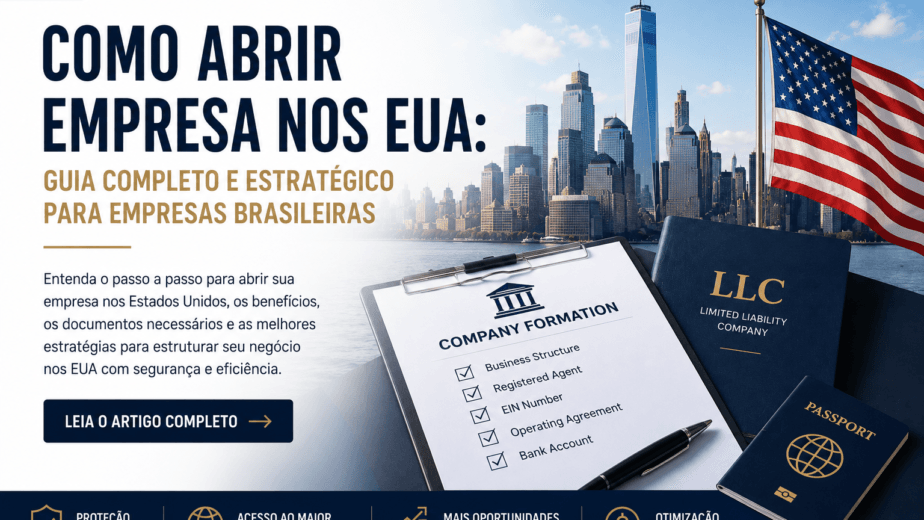


Yes, it is possible to open a company in Delaware without residing in the United States, and the entire process can be conducted remotely.
The essential steps are choosing between LLC and C-Corp, hiring a registered agent, filing the certificate of incorporation, obtaining an EIN from the IRS, and organizing internal documents before opening a bank account.
Tax planning between Brazil and the US, as well as good corporate governance, however, require specialized monitoring.
In summary:
- The choice between LLC and C-Corp impacts taxation, investment raising, and profit distribution, making it essential to simulate scenarios with a specialist.
- To open a company, you need to hire a registered agent, file the certificate, obtain the EIN, and organize internal documents, always following a logical order.
- Costs vary between fixed annual fees for LLCs and franchises calculated per share for C-Corp, in addition to extra fees for expedited services or private agents.
- In Brazil, income tax returns must take into account profit distribution, which can lead to double taxation, requiring prior tax planning.
- Seeking specialized advice is recommended for decisions regarding governance, capital structure, tax planning, and the preparation of essential documents.
Index
- How to open a business in Delaware: the complete step-by-step guide.
- LLC or C-Corp: Which structure to choose when opening a company in Delaware?
- What documents do you need to open a business in Delaware?
- How much does it cost and what are the expected timeframes?
- What changes in your tax return in Brazil?
- Final checklist before filing the documents.
- When is it worth hiring consulting services to open a business in Delaware?
- What most Delaware guidebooks hide
- How Naventia accelerates your company opening in Delaware.
- Sources
How to open a business in Delaware: the complete step-by-step guide.
The process of formation follows a logical sequence recognized by the entity itself. Delaware Corporations Division, which confirms that there is no requirement to reside in the state to form the entity.
Each step has a natural person responsible for it, whether it's the business owner, the registered agent, or an accountant.
- Choosing the structure. Decide between LLC and C-Corp before any filing. This choice defines taxation, fundraising methods, and governance complexity in the years to come.
- Name verification and reservation. The name must be available in the Corporations Division system and include a mandatory suffix (LLC, Inc., or Corp., depending on the chosen type).
- Hiring a registered agent. Delaware requires an agent with a physical address in the state to receive court notices and official correspondence.
- Certificate of Formation (LLC) or Certificate of Incorporation (C-Corp) protocol. This is the document that officially establishes the company before the state.
- Drafting internal documents. Operating Agreements for LLCs, Bylaws for C-Corps: they are not filed with the state, but banks and partners will require them.
- EIN application to the IRS. A tax identification number is essential even for those who don't have employees in the U.S.
- Opening a business bank account. The final practical step, usually the most bureaucratic for those living in Brazil.
American banks typically request a specific set of documents before opening a business account:
- Certificate of Formation or Incorporation already approved by the state.
- EIN issued by the IRS.
- Operating Agreement or signed Bylaws.
- Proof of address of the registered agent.
- Identification of partners or ultimate beneficiary (passport, in general).
The training process can be conducted entirely remotely, but the order of the steps matters: trying to open an account before having the Operating Agreement ready is the most common mistake among Brazilian entrepreneurs at this stage.
LLC or C-Corp: Which structure to choose when opening a company in Delaware?
The choice between LLC and C-Corp is rarely just a matter of preference. It shapes how you pay taxes, raise investment, and report to companies in Brazil.
A LLC It functions as a pass-through tax entity: profits are directly attributed to the partners, without federal corporate income tax being levied on the entity itself.
This simplifies the lives of those who operate a digital business, provide international services, or generate revenue independently without plans to seek venture capital funding.
The comparison between LLC, Corporation, and holding company shows in detail where this flexibility pays off and where it becomes a limitation.
Already C-Corp It is the standard structure required by most American investment funds because it allows for the issuance of shares, different classes of shareholders, and a predictable corporate history for the diligent investor.
The catch: this robustness comes at a price, a second level of taxation on distributed dividends, the so-called double taxation.
- For a digital business with no intention of raising investment, an LLC is usually sufficient and simpler to maintain.
- Startup seeking funding rounds with American funds: C-Corp is almost always a prerequisite.
- A company that intends to reinvest profits in the US without distributing them: C-Corp could be advantageous in the medium term.
- A structure that will generate income distributed regularly to Brazil: LLC tends to facilitate Brazilian tax analysis.
Pro tip: Before filing any documents, simulate both scenarios with an accountant who understands both American and Brazilian taxation. A wrong decision at this stage is much more costly to correct later than it would be to plan for beforehand.
Four simple questions help filter out the right choice before committing. future of the businessWill you be seeking investment? Will you distribute profits regularly? Do you need multiple classes of partners? Will you operate alone or with a team in the US?
What documents do you need to open a business in Delaware?
Each document has a specific purpose, and errors in completing it at this stage can lead to delays or, worse, bank account freezes months later.
Registered agent. A Delaware law requires a physical address in the state. to receive court summons and official communications. This data is public, so it's worth choosing a provider that offers adequate privacy to the end user.
Certificate of Formation/Incorporation. The formal document must contain the exact name of the entity (with the correct suffix), the name and address of the registered agent, and, in the case of a C-Corp, the number of authorized shares. Common errors: name without suffix, outdated agent address, or omission of the number of shares when required.
Operating Agreement (LLC) and Bylaws (C-Corp). They don't go to the state, but they are the document that financial institutions and future partners will require to confirm who controls the company and how decisions are made. A poorly drafted Operating Agreement is, in practice, the most silent cause of bank refusal: without it, it becomes difficult to prove who the ultimate beneficiary of the account is.
EIN through the IRS. Foreign nationals without a Social Security number can apply for an EIN using form SS-4, usually by fax or phone, as the IRS online channel requires an SSN. The typical processing time for those without an SSN ranges from a few weeks to over a month, depending on the IRS's processing volume.
Documents that are often missing on the first attempt:
- Legalized copy of the ultimate beneficiary's passport.
- Proof of address in Brazil, translated.
- Operating Agreement signed by all partners.
- Confirmation of good standing issued by the state.
The Corporations Division's guide on incorporation emphasizes that the law does not require a lawyer to open the entity, but recommends specialized consultation specifically for governance and capital structure decisions.
How much does it cost and what are the expected timeframes?
Opening fees vary depending on the chosen structure and the number of authorized shares, in the case of C-Corp. LLCs pay a fixed annual fee, while corporations face a franchise tax calculation that can vary considerably depending on declared capital and issued shares.
The Corporations Division confirms that LLCs pay a flat annual fee, while corporations have a franchise tax calculated based on the number of shares and declared value, requiring proper financial planning.
In addition to the state tax, add the cost of the registered agent (charged annually by private providers) and, if you choose to expedite the protocol, an extra fee for express processing. Standard processing can take days to weeks; express processing reduces this timeframe but costs more.
The maintenance schedule also varies by structure: LLCs generally have a fixed annual payment date, while corporations face franchise tax due dates at different times, with penalties and interest for late payments.
Missing this deadline is the quickest way to lose your status. good standing and to block renewals of bank accounts or visas linked to the company.
What changes in your tax return in Brazil?
Delaware does not levy state income tax on business conducted outside the state, but this does not exempt the company from US federal obligations or from filing a tax return in Brazil.
There are two distinct tax layers: the American federal tax (IRS) and the state tax (Delaware), and neither of them replaces the Brazilian obligation of the partner.
For Brazilian partners, the central issue is how the income distributed by the LLC or C-Corp is declared on the Brazilian income tax return.
Taxation rules based on a worldwide basis can lead to double taxation if there is no prior planning, especially when the company distributes profits on a recurring basis.
Some American tax documents frequently appear in this process:
- Schedule K-1: LLC profit sharing report, used to report income distributed to partners.
- Form 1099: declares payments received from service providers.
- Form 1120: Federal corporate tax return for C-Corps.
Pro tip: Don't wait until the first fiscal year is over to understand these obligations. Bring the issue of double taxation to the planning table even before filing your tax return, because the structure you choose today will define the complexity of your tax return in Brazil for years to come. The material on double taxation between Brazil and the USA details the points that generate the most questions among LLC partners.
Final checklist before filing the documents.
Before submitting any documents to the Corporations Division, it's worth reviewing a simple checklist that avoids most practical problems.
- Company name available with correct suffix (LLC, Inc., or Corp.).
- Registered agent hired and address confirmed.
- Operating Agreements or Bylaws drafted and signed by all partners.
- EIN requested or already issued by the IRS.
- Final beneficiary documentation ready, with translation and legalization when required by the chosen bank.
Failures in this checklist are the most frequent cause of bank account freezes. Banks and financial services require an Operating Agreement and proof of good standing. to unlock an account, and the absence of these documents is the most common reason for refusal.
Pro tip: If something fails during the process (name rejected, agent unresponsive, delayed EIN), correct it in reverse order of bank urgency: first resolve what is blocking the state protocol, then what is blocking the bank. Trying to resolve everything at once usually generates rework. For those who will need a checking account in the US, the guide on Documents needed to open a bank account as a foreigner. complements this checklist.
When is it worth hiring consulting services to open a business in Delaware?
The Corporations Division doesn't make the incorporation process itself complicated. What requires professional guidance is everything that comes after: governance decisions, capital structure, tax planning, and setting up the operational ecosystem that supports the company on a daily basis.
Naventia works by connecting Brazilian businesses to the American market with planning that covers the fiscal, legal, and operational aspects of incorporation.
The company has specialists living in the United States to provide guidance tailored to each case, according to... own company.
This local presence often makes a difference precisely in the areas where Brazilian entrepreneurs are most exposed: choosing between LLC and C-Corp, drafting the Operating Agreement, specific banking requirements, and the correct sequence for obtaining an EIN without an SSN.
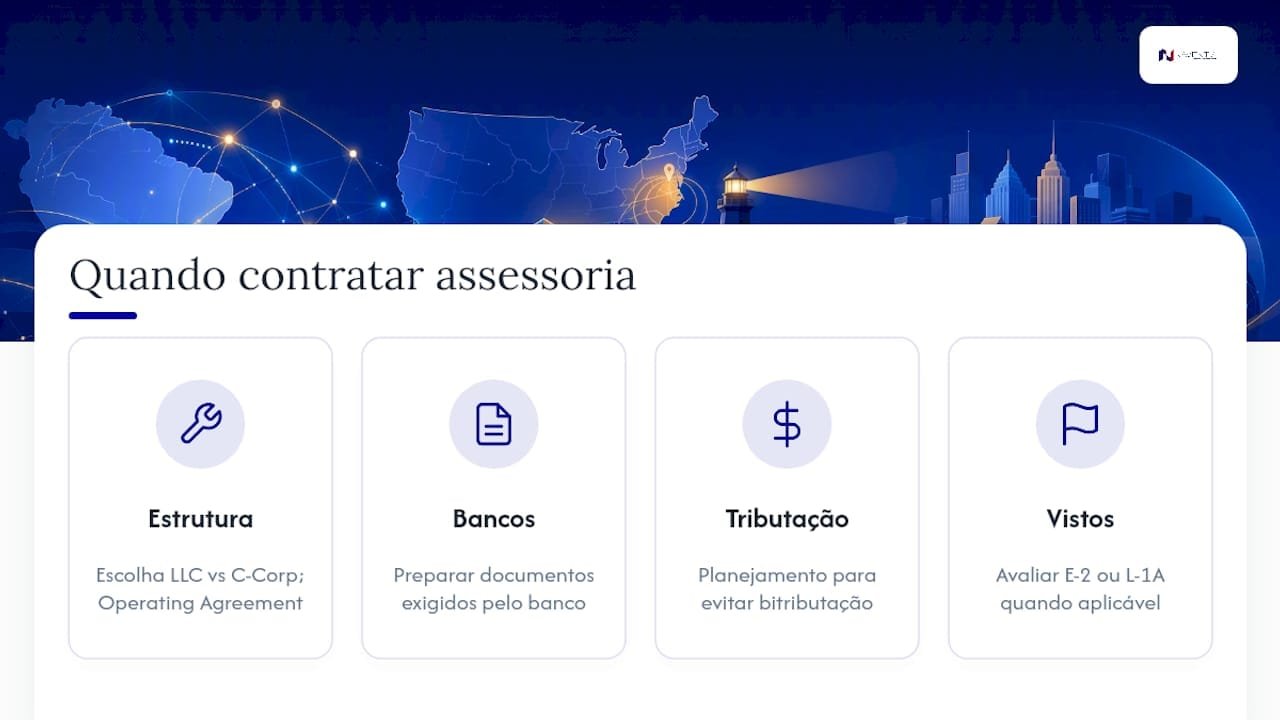
Seeking this type of support makes the most sense at four points: when defining the company's corporate structure (before filing) and when preparing the documents that the bank will require.
It is also worthwhile in tax planning to avoid double taxation and, when applicable, in the assessment of visas related to the operation, such as E-2 or L-1A.
Naventia describes its approach as focused on reducing the complexity of international expansion, from opening to positioning in the American market.
What most Delaware guidebooks hide
Most of the available content treats opening a company in Delaware as a one-time event: you file, receive the certificate, and you're done. This view is incomplete and, for Brazilians, can be costly.
The real work of opening a company in Delaware begins after the certificate is issued. Delaware offers legal predictability and a judicial system specialized in corporate disputes, but it's not necessarily the cheapest option.
Those who choose a state solely for its prestige, without understanding this detail, are often disappointed by recurring costs they did not foresee.
My practical recommendation: treat the choice of structure as the most expensive decision in the process, not as a bureaucratic detail. The right document, signed correctly, is worth more than any "quick opening" shortcut advertised out there.
Flavio
How Naventia accelerates your company opening in Delaware.
There are alternatives to assembling this process with specialized support, which includes experts in the United States to provide guidance tailored to your specific case, and not a generic script copied from an American blog.

The process of opening a company in Delaware can cover corporate structure, certificate filing, hiring a registered agent, obtaining an EIN, opening a bank account, and tax planning to avoid double taxation between Brazil and the USA.
This combination can reduce the risk of errors that freeze bank accounts or generate fines for forgotten franchise taxes, and speed up steps that, done without experience, often drag on for months.
If you've already decided to open a business in Delaware and want to avoid rework, learn about the... Naventia's internationalization services or Schedule an initial conversation. to map out the ideal structure before filing any document.
This article provides general information and is not a substitute for the advice of a qualified financial advisor. Consult a qualified financial professional about your specific situation before acting on this information.
Sources
- How to Form a New Business Entity – Division of Corporations – State of Delaware
- Incorporating a Company in Delaware
- How to open a business in Delaware | Stripe