
For an external reference on governance and organizational performance, please consult the OECD Principles of Corporate Governance.
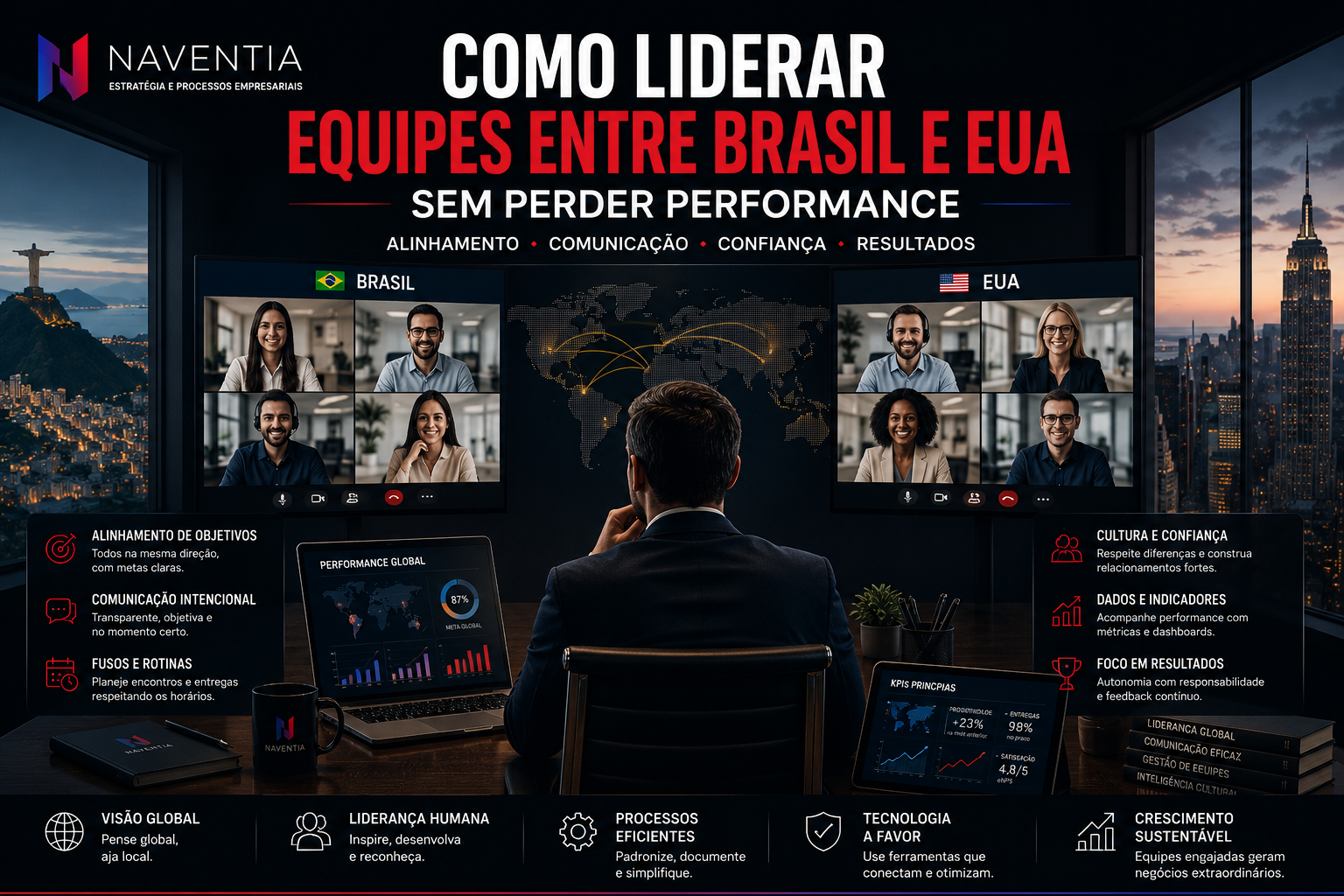
Leading teams between Brazil and the US is one of the main challenges of international expansion. Expanding a company to the United States is often treated as a market challenge. Entrepreneurs focus their attention on opening the company, the tax structure, the commercial strategy, and acquiring the first customers. All these decisions are important and, in many cases, determine the speed at which the operation will begin to generate results.
But there is a challenge that rarely appears in the business plan and that, paradoxically, often defines the success of expansion in the medium term: the ability to lead people who work in different cultures.
This problem typically doesn't appear on the first day of operation. It arises when the company starts hiring American professionals, when part of the team remains in Brazil and another part begins working in the United States. It is at this point that many entrepreneurs realize that internationalizing a business doesn't just mean selling in another country. It means learning a new way of leading.
Most people believe the main difficulty will be the language or the time zone. Experience shows exactly the opposite. Tools solve communication problems. Calendars resolve time differences. What no technology solves is the difference in expectations that Brazilians and Americans have regarding leadership, autonomy, and responsibility.
This change of perspective is part of the process itself. https://naventia.com/internacionalizacao-para-os-eua/. The company is no longer just competing in a new market; it is now managing people who have been trained in completely different corporate cultures.
The mistake of exporting the parent company's culture.
There is a scene that frequently repeats itself among Brazilian companies that begin operating in the United States.
The business is growing in Brazil using a management model that closely involves leadership. The founder participates in key negotiations, monitors strategic clients, approves relevant decisions, and maintains frequent contact with the entire team. For years, this model has produced excellent results and created a sense of control over operations.
Naturally, the company tries to replicate this same format when it begins its international expansion.
That's precisely where the first signs of wear and tear appear.
In the United States, skilled professionals often expect something different from leadership. They want clarity about objectives, well-defined indicators, and autonomy to execute. The manager remains a point of reference, but their role is not to monitor every step of the work. Their role is to create the conditions for the work to happen.
When Brazilian companies bring an excessively centralized culture to the American market, the effect is usually the opposite of what is expected. The manager believes they are offering support. The team perceives a lack of trust.
This type of situation is usually related to the same problem discussed in the article. https://naventia.com/fundador-na-internacionalizacao/. The more dependent a company is on the decisions of a single person, the more difficult it becomes to build international operations capable of growing rapidly.
Autonomy does not mean absence of leadership.
One of the most striking differences between Brazilian and American companies lies in how autonomy is interpreted.
In Brazil, many organizations still associate proximity with good management. Frequent meetings, constant validation, and active participation from leaders are often seen as demonstrations of commitment.
In the United States, autonomy is part of professional responsibility. Managers are expected to set clear objectives, define priorities, and monitor indicators. Execution, however, belongs to the team.
This difference completely alters the dynamics of the operation.
While a Brazilian manager might believe they are simply monitoring the progress of a project, an American professional might interpret the same action as micromanagement.
Neither of them is necessarily wrong.
They simply learned to work in different environments.
Therefore, companies that want to grow internationally need to develop their own organizational culture, instead of simply exporting the habits of their parent company.
Communication goes far beyond language.
Another common misconception is believing that simply translating documents and conducting meetings in English is enough for communication to work.
In practice, corporate communication involves expectations, context, and behavior.
Brazilian businesspeople typically build business relationships through proximity. It's common for them to contextualize decisions, soften criticism, and seek consensus before implementing significant changes.
The American corporate environment tends to be more direct. Objective feedback is not seen as rude. Quick decisions are not considered disrespectful. In many cases, this objectivity conveys professionalism.
When these two cultures begin to work together without adequate preparation, misinterpretations arise.
Brazilians may perceive coldness.
Americans may perceive a lack of objectivity.
These small noises, when accumulated, affect productivity, confidence, and speed of execution. These are precisely the challenges analyzed in... https://naventia.com/choques-culturais-na-expansao-internacional/, a topic that is often underestimated during expansion planning.
International leadership depends less on control and more on processes.
Companies that manage to operate efficiently between Brazil and the United States typically do not have overly controlling leaders.
They have better processes.
When responsibilities are clearly defined, indicators are shared by the entire team, and decision criteria are known, the need for constant supervision naturally decreases.
Trust no longer depends on the physical presence of leadership.
It then depends on the predictability of the operation.
This is perhaps the greatest lesson learned by companies that manage to scale internationally. They don't build businesses based on indispensable people. They build organizations capable of maintaining the same quality standard regardless of the country where the team is working.
That is why the https://naventia.com/planejamento-estrategico-para-entrar-nos-eua/It needs to encompass much more than just legal or tax issues. Governance, organizational culture, and leadership development are equally important elements to ensure that the operation continues to grow sustainably.
Culture becomes the main competitive advantage.
As a company expands its international presence, its culture ceases to be merely a set of values written in a corporate presentation.
It becomes an operating system.
Culture determines how decisions are made, how conflicts are resolved, how priorities are set, and how people collaborate with each other.
When these principles are clear, geographical location loses importance. Brazilian and American professionals stop working as two different teams and become part of the same organization.
This transition takes time.
It requires leadership.
It requires a method.
But above all, it requires understanding that internationalization doesn't just mean opening a company in another country.
It means building a company capable of operating across borders.
Conclusion
Companies expanding into the United States typically dedicate months to studying the legislation, corporate structure, and business opportunities.
All of this is part of the process.
But experience shows that the true competitive advantage emerges when an organization manages to develop leadership prepared to integrate different cultures without losing speed, alignment, or quality.
Ultimately, international business is not built solely on strategy, capital, or technology.
They are built by people.
And companies that learn to lead people in different cultural contexts not only grow faster.
They build organizations prepared to compete in any market.
Naventia works alongside companies that want to expand with strategy, security, and a global vision.
If this is your moment, perhaps it's time to give it a try. next step — with those who already understand the way.