

For further information on governance and decision-making structures, please refer to... OECD Principles of Corporate Governance.
The founder in internationalization It's a topic that receives less attention than it should. When Brazilian entrepreneurs begin to consider the United States as their next step for growth, concerns typically focus on issues such as corporate structure, taxation, hiring staff, and adapting to the American market.
There is a widespread idea among Brazilian entrepreneurs that they are beginning to consider the United States as their next step for growth. The belief is that the biggest challenges of international expansion lie outside the company: opening an LLC, understanding American taxation, hiring a local team, finding clients, or adapting communication to another language.
All of this really matters. But, after following different internationalization processes, one conclusion frequently emerges, which is unsettling: the problems that most compromise expansion are rarely found in the American market. They already existed before the company even considered crossing borders.
The difference is that, in Brazil, these problems are usually manageable. In the United States, they become obvious. Among them all, there is a pattern that repeats itself strikingly: excessive dependence on the founder.
It is precisely at this point that the role of founder in internationalization It becomes crucial. In many cases, expansion is not limited by the market, but by the company's ability to operate without continuously depending on its founders.
For a long time, this dependence seemed like a competitive advantage. After all, it was precisely what helped the company get to where it is today. The founder knows the customers better than anyone, masters the product, understands the operation, resolves conflicts quickly, and is usually the person who closes the most important deals. In many Brazilian companies, especially medium-sized ones, growth happens because there is someone centralizing decisions and ensuring that everything works.
The problem is that there's a crucial difference between growing and scaling. Growing means increasing revenue, customers, and operations. Scaling means doing all of that without proportionally increasing dependence on a single person. It's precisely at this point that many companies discover that internationalization isn't revealing opportunities; it's revealing limitations.
This is one of the reasons why the strategic planning for entering the USA This needs to begin before the company is even officially launched. The question shouldn't just be what kind of business structure to establish, but whether the company is mature enough to operate in another market without constantly depending on the founder.
Recently, in a conversation with a businessman who was evaluating his entry into the United States, the company seemed ready. It had relevant clients, a good reputation, an established team, and clear expansion plans. But when we started looking at the operation, the real problem emerged. Who approved the commercial proposals? The founder. Who participated in strategic negotiations? The founder. Who defined discounts, resolved important conflicts, and made the main commercial decisions? The founder.
At that moment, it became clear that the challenge wasn't in the United States. It was in the company's internal structure. The business had grown, but it still operated like a smaller organization, where important decisions depended on the same person. That works up to a point. After that, it becomes a limit.
The American market tends to accelerate this perception because it demands speed, clarity, and predictability. Clients expect quick answers. Partners expect clear processes. Business opportunities don't sit idle waiting for the founder's schedule to open. In more competitive markets, operational delays translate into lost opportunities. This point becomes even more evident when we analyze the impact of... commercial customer service in the USA Regarding sales, follow-up, and perception of professionalism.
There's a common saying among entrepreneurs: "Nobody does it as well as I do." In many cases, this is true. The founder really does sell better, negotiate better, and make decisions with more context. But this statement also reveals a weakness. If nobody can execute well without him, perhaps the problem isn't just with the people. Perhaps it's a lack of processes, training, autonomy, and knowledge transfer.
Mature companies are not those where the founder knows everything. They are those where knowledge ceases to depend exclusively on him. The difference is subtle, but decisive. In a dependent company, the founder is the system. In a scalable company, the founder builds the system.
That's why internationalization to the US can't be treated solely as a market decision. It's also a test of organizational maturity. A company that relies on the founder to sell, approve, review, negotiate, and resolve everything might manage to open an operation in the United States, but it will hardly be able to scale consistently. This is one of the central points of... internationalization to the USAThe country doesn't transform unprepared companies into global companies. It simply reveals more quickly which companies were already ready.
When we observe organizations that have managed to grow outside of Brazil, a clear pattern emerges. The founder remains important, but their role changes. They cease to be the center of execution and become the architect of the organization. Instead of approving every decision, they create criteria for others to decide upon. Instead of solving every problem, they build processes for the company to solve. Instead of concentrating knowledge, they transform individual experience into methodology.
This transition is difficult because it requires relinquishing control. And relinquishing control is especially challenging for those who built a company from scratch. But internationalization demands exactly that. Not because the founder ceases to be relevant, but because the company needs to become bigger than him.

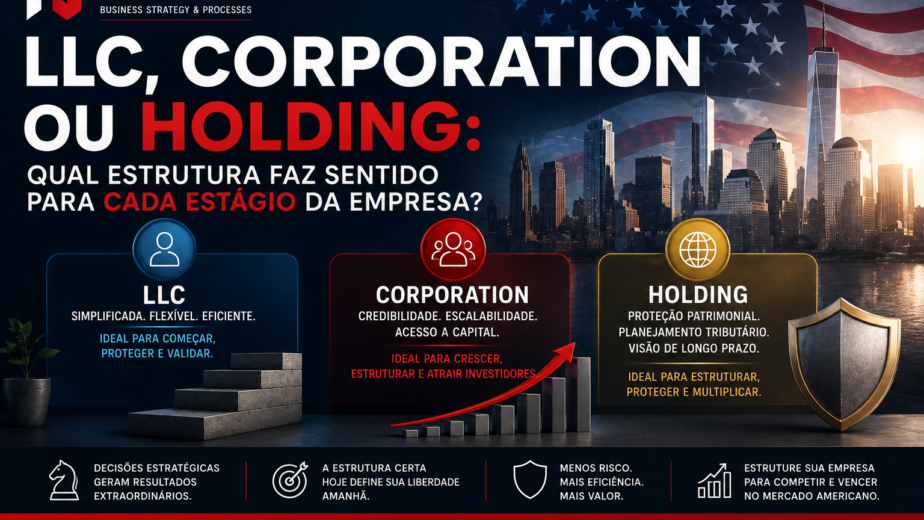
Before discussing LLC, Corporation, Holding, taxation, or operational structure, there is a more important question: if the founder steps away from operations for thirty days, does the company continue to function? Do sales continue to happen? Do decisions continue to be made? Do customers continue to be served to the same standard? Do projects continue to move forward?
If the answer is no, perhaps the main challenge to expansion is not yet in the United States. Perhaps it lies within the company itself.
When we analyze companies that manage to grow consistently outside of Brazil, it becomes clear that the challenge of founder in internationalization It's not about participating less in the business, but about building an organization capable of functioning without your constant intervention.
Ultimately, internationalization isn't just about taking a business to another country. It's about building an organization capable of growing without depending exclusively on the person who founded it. And it's precisely at this point that many entrepreneurs discover that the biggest bottleneck in internationalization has never been the American market.
It was the structure they hadn't yet built.
Talk to Naventia
At Naventia, we help Brazilian companies structure their international expansion with strategy, processes, and a vision for sustainable growth.
Do you want to assess if your company is ready for the United States?
Learn how Naventia structures its entry, operation, and growth in the American market.
Naventia works alongside companies that want to expand with strategy, security, and a global vision.
If this is your moment, perhaps it's time to give it a try. next step — with those who already understand the way.