


If your LLC or C-Corp formed in the US already has an office, employees, or ongoing contracts in another state, you likely need foreign qualification. The process issues a Certificate of Authority, a document that authorizes the company to legally operate in that state and access its judicial system. Without it, the company operates at legal and tax risk, even if it is already a legally constituted entity in the US.
In summary:
- Brazilian business owners operating in various U.S. states need to regularize their situation through foreign qualification, avoiding legal and tax risks.
- The process requires appointing a registered agent, obtaining a Certificate of Good Standing, and filing an Application for Authority, with fees varying by state.
- Activities such as owning an office, hiring employees, or storing products constitute "doing business" and require qualification in each corresponding state.
- Qualifying the company ensures access to the local judicial system and avoids legal impediments to lawsuits, contracts, and opening business accounts.
- The decision between LLC and C-Corp influences details of the qualification procedure, including documentation requirements and subsequent compliance obligations.
Index
- What is a foreign qualification and what concepts do you need to master?
- What activities require your company to obtain certification in another state?
- How to obtain a foreign qualification step by step.
- How much does it cost to qualify your company and what changes in your taxation?
- Common mistakes made by Brazilian companies and a checklist before filing.
- LLC or C-Corp: does the qualification process change?
- When your company is exempt from qualifying in another state.
- How qualifications affect your contracts and legal obligations.
- Where does Naventia fit into this process?
- How to take the next step in your US expansion.
- Where to confirm the rules for your state.
- Sources
What is a foreign qualification and what concepts do you need to master?
In the United States, every entity is "domestic" in the state where it was formed and "foreign" in any other state where it wishes to operate. An LLC incorporated in Delaware, for example, is domestic there and foreign in Texas, Florida, or New York. This detail confuses many Brazilian entrepreneurs, who assume that "foreign" refers to nationality, when in fact it only describes the state of formation relative to the state of operation.
The process by which you regularize this situation is called foreign qualification, and it results in the issuance of a Certificate of Authority, sometimes called Application for Authority depending on the state. Three elements appear in virtually all state processes:
- Registered agent: an individual or company with a physical address in the target state, responsible for receiving legal notices and official correspondence on behalf of your company.
- Certificate of Good Standing: document issued by the state where the company was originally formed, proving that it is in good standing (taxes and reports up to date).
- Name availableThe target state checks if your company name is already in use; if it is, you need to register an alternate name (DBA) to operate there.
States require this registration to know who is doing business in their territory, to enforce tax obligations, and to ensure a reliable channel for legal notification, as Wolters Kluwer points out.
Pro tip: Keep your Certificate of Good Standing safe as soon as it is issued. Many states only accept the document for 30 to 90 days, and requesting a duplicate due to processing delays costs extra time and money.
What activities require your company to obtain certification in another state?
There is no single federal "doing business" list, but the established practice in almost all states revolves around four triggers:
- Office or physical presence — renting or owning a business address in the state, even if it is a shared space.
- State employees — hire someone who works physically there, including remotely.
- Property — owning real estate, equipment, or physical inventory stored in the state.
- Licenses and permits — regulated activities (construction, health, food) that require a specific state license.
On the other hand, some activities are usually excluded from the obligation, with important exceptions. Opening a bank account in the state, selling products sporadically, or participating in a single commercial event does not normally constitute "doing business," according to the analysis of... Stripe Regarding the topic, the key word is "normally": each state interprets these limits in its own way, and what goes unnoticed in Florida can trigger an obligation in New York.
For Brazilian companies, the most common scenarios are as follows: hiring a remote salesperson who lives in Texas when their LLC was formed in Delaware; closing a contract with a client for on-site equipment installation in California; or renting a warehouse in New Jersey to centralize e-commerce logistics. In all three examples, qualification ceases to be optional.
How to obtain a foreign qualification step by step.
The process follows a well-defined sequence in most states, although deadlines and forms vary. Check out the five key steps that any Brazilian company needs to go through:
- Verify the name in the Secretary of State's database for the target state. If your LLC or C-Corp name is already in use, you will need to register a fictitious name (DBA) to operate under that name.
- Obtain the Certificate of Good Standing in the state where your company was originally formed. This document proves that you are up-to-date with your taxes and annual reports.
- Appoint a registered agent. in the target state. You can designate an individual residing there or hire a specialized commercial service, a more common option among foreign companies without a constant local presence.
- Complete and submit the Application for Authority form. (or Certificate of Authority, depending on the state). The form typically asks for the company name, date and state of formation, principal address, name and address of the registered agent, and the signature of a partner, director, or authorized representative.
- Pay the state taxes. and follow the process until you receive the final Certificate of Authority.
Some points require extra attention:
- The person signing the form must have formal authority within the company—a managing member in the LLC, or an officer in the C-Corp.
- The Certificate of Good Standing usually has a short validity period; some states issue versions that expire within a few months of the issue date.
- The average time between filing and receiving the Certificate of Authority varies from a few days (in states with efficient electronic systems) to several weeks with manual processing.
Pro tip: Request the Certificate of Good Standing only after confirming the availability of the name in the target state. Doing it in the wrong order means risking the document expiring before the rest of the paperwork is ready.
Companies that operate in multiple states simultaneously often centralize their registered agent with a single commercial provider, which simplifies the monitoring of annual reports and reduces the risk of losing good standing status due to oversight.
How much does it cost to qualify your company and what changes in your taxation?
Filing fees vary considerably by state, and the cost of a registered commercial agent typically adds a recurring annual expense to the bill, in addition to state taxes. Before budgeting for the process, it's necessary to distinguish between two concepts that are often confused by many business owners: qualifying the company is not the same as establishing a tax link.
Qualification does not automatically create a tax obligation, but the same activities that require registration—office, employees, recurring sales—often generate state tax obligations such as sales tax, income tax, or franchise tax.
In practice, this means that as soon as you qualify your company in a new state, you almost always also need to:
- Register with your local Department of Revenue to collect and declare sales tax, if applicable to your product or service.
- Assess exposure to state income tax or franchise tax, which is levied on income or capital attributed to that state.
- Set up payroll tax withholding if you have employees residing there.
This extra layer of complexity is why coordination between an American accountant, familiar with state regulations, and an accountant in Brazil, who understands the impact on your profit repatriation structure, becomes crucial. Ignoring this step usually leads to problems. tax surprises months later, when the liability has already accumulated fines and interest.
Common mistakes made by Brazilian companies and a checklist before filing.
The most frequent mistake is delaying qualification until it becomes obvious, usually when a client or partner requests the Certificate of Authority as a contractual condition. The third is forgetting the annual reports after qualification, which leads to the silent loss of good standing.
Before submitting your application, please review this checklist:
- Registered agent appointed and contracted in the target state.
- Certificate of Good Standing issued within the validity period required by the state.
- Application for Authority form completed and signed by a representative with formal authority.
- State taxes calculated and allocated in the budget.
- Tax records have already been mapped at the Department of Revenue, even if they are only needed later.
In some cases, it's worth considering forming a new entity in the target state instead of requalifying the existing one, especially when the local operation will have its own life, different partners, or risk exposure that you prefer to isolate from the parent company.
Pro tip: If your US operation has grown to the point where you need qualifications in three or more states, compare the aggregate cost of maintaining a single "umbrella" LLC versus structuring a larger one. separate holdings By region. The obvious answer isn't always the cheapest in the medium term.
LLC or C-Corp: does the qualification process change?
The formal foreign qualification procedure is virtually identical for LLCs and C-Corps: both file an Application for Authority, appoint a registered agent, and present a Certificate of Good Standing. The real difference lies in the details surrounding this process.
C-Corps often face additional governance documentation requirements. Many states require the qualification form to be signed by a designated officer (president, secretary, or treasurer), and some require copies of the articles of incorporation already authenticated in the state of origin. LLCs, on the other hand, generally allow any managing member or manager to sign, with less requirement for formal corporate documentation.
State tax rates also tend to differ between the two types of entities within the same state, as many secretaries of state charge different rates for LLCs and corporations, reflecting the capital structure and the volume of shares issued in the case of C-Corps.
After qualification, the obligation to file annual reports also varies: C-Corps typically need to declare information about their board of directors, number of authorized shares, and capital, while LLCs report simpler data, generally limited to members and the address of the registered agent. For a Brazilian company that has already decided between LLC and C-Corp during its initial formation, this difference usually doesn't change the choice, but it does affect compliance routines after expanding to multiple states.
When your company is exempt from qualifying in another state.
Not all activities that cross state borders trigger the qualification requirement. The most recognized exemptions revolve around what states classify as isolated interstate commerce or support activities that do not constitute a continuous commercial presence.
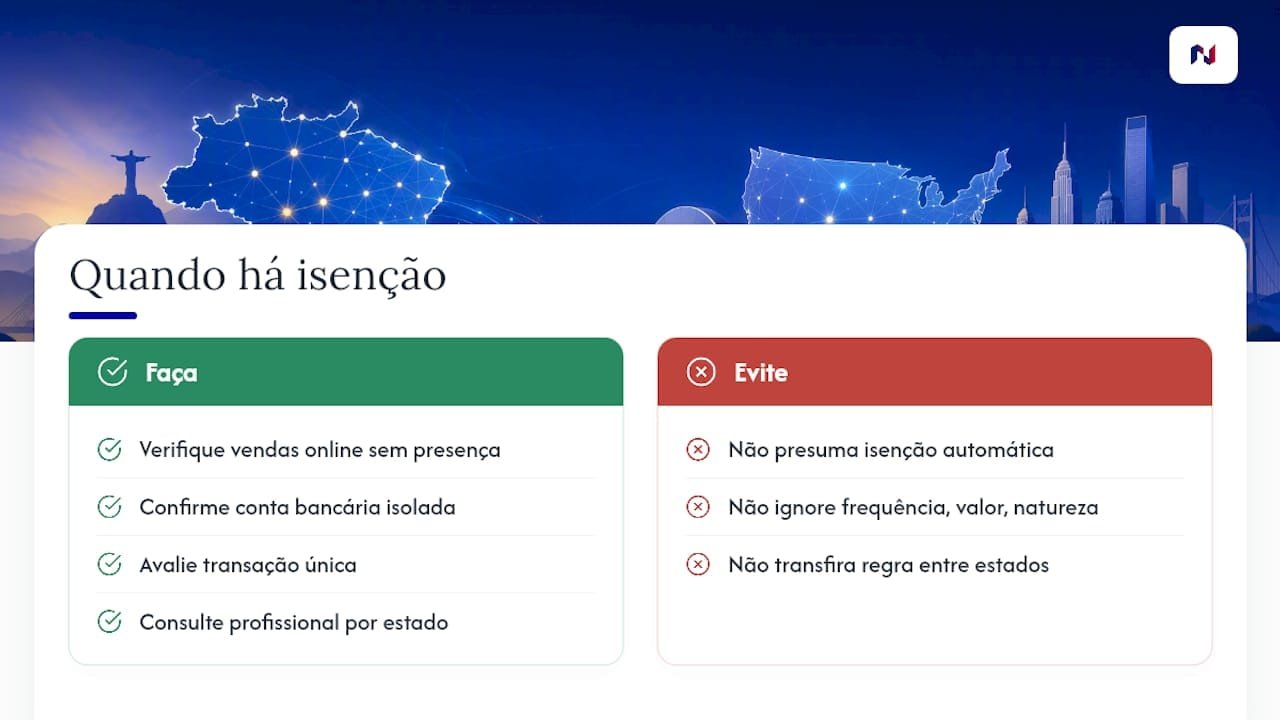
Selling products online to customers in another state, without a warehouse, employee, or office there, usually does not require qualification, even if it generates a significant sales volume. Maintaining a bank account in another state is also usually exempt from this requirement, since this isolated activity does not constitute "doing business" in the sense that states monitor it.
Participating in a legal process as a party or witness, collecting isolated debts, or carrying out a single, one-off business transaction (such as closing a specific contract without repetition) also tend to fall outside the scope, according to Stripe's analysis of the limits of the "doing business" concept.
One caveat that no Brazilian company should ignore: each state defines these limits independently, and the line between "isolated activity" and "commercial presence" can depend on frequency, transaction value, and the nature of the product sold. A one-off sale of US$$ 500 probably won't move the needle; a recurring six-month service contract, even without a physical office, might. When in doubt, the safest approach is to evaluate each case individually with a professional familiar with the specific rules of the state involved, rather than assuming that an exemption that applied in one state will be replicated in another.
How qualifications affect your contracts and legal obligations.
The most direct impact of foreign qualification appears in access to the state judicial system. A company operating without qualification in a state where it should be registered generally loses the right to file a lawsuit in that state until it regularizes its situation, as detailed by Wolters Kluwer. In practice, this means that if a client fails to pay or a partner breaches a contract, your company may be prevented from suing until it corrects its registration, even if it is in the right on the merits of the dispute.
This detail changes how commercial contracts should be drafted. Many American partners, especially in regulated sectors or higher-value contracts, require a Certificate of Authority as a prerequisite for signing, precisely to protect themselves from dealing with an entity that cannot be sued or prosecuted locally. Banks and financial institutions also often request the document when... open a business account, This creates a ripple effect: without qualification, the Brazilian company faces additional difficulties even in moving capital within the state where it operates.
In addition to access to justice, the qualification also formalizes the company's legal responsibility to suppliers, employees, and local regulatory bodies. Commercial lease agreements, employment contracts, and industry licenses often require proof that the entity is properly registered with the state, making the Certificate of Authority a recurring document in due diligence by partners and investors.

Where does Naventia fit into this process?
Deciding which state to qualify in, assembling the correct documentation, and coordinating with a reliable registered agent requires knowledge that varies from state to state. Specialized consulting firms exist that help Brazilian companies map the real "doing business" triggers for each client's specific operation, avoiding both excessive caution (qualifying where it's not necessary) and the risk of operating illegally.
This type of consulting work can include initial diagnosis, qualification process, and coordination with local agents, all the way to ongoing monitoring of tax and corporate obligations. When expansion involves the relocation of partners or executives to the U.S., guidance may be provided on visas such as E-2 and L-1A, integrating the immigration strategy into corporate planning, as explained by [reference to source]. Legal Workshop.
— Flavio Inacarato
How to take the next step in your US expansion.
Qualifying your company in a new state is just one piece of the expansion puzzle. Before filing any forms, it's worth consulting with experts to determine if the chosen state truly aligns with your medium-term strategy, or if it makes more sense to reorganize your corporate structure before expanding geographically.

This type of consulting can structure end-to-end processes: LLC or C-Corp formation, foreign qualification in the necessary states, tax planning between Brazil and the USA, opening an American bank account, and support for business visas when the project requires the physical presence of partners or executives. Before the consultation, gather basic information: the company's current state of formation, where you intend to have an office or employees, and the estimated volume of operations in the new state. This data speeds up the diagnosis and avoids generic recommendations. Learn about the complete approach of [Company Name/Service Name]. expansion into the United States Contact Naventia and schedule a conversation to assess whether your company is ready to qualify in a new state or if the current situation calls for a different type of structure first.
Where to confirm the rules for your state.
To check specific details before filing, consult primary sources and specialized guides:
- Wolters Kluwer Guide to Foreign Qualifications, with a practical explanation of the process and the legal protections involved.
- Stripe's summary of "doing business" triggers“ and fiscal nexus.
- The websites of the Secretary of State and the Department of Revenue of the target state can be found to confirm applicable rates, forms, and deadlines.
Sources
- A Guide for Foreign Qualification | Wolters Kluwer
- What Is Foreign Qualification? Here's How It Works | Stripe