


An ITIN for aliens is a tax identification number issued by the IRS to those who need to file taxes in the United States and are not eligible for a Social Security Number (SSN). It applies to nonresidents with tax obligations, dependents, spouses, and some beneficiaries of international treaties. The document does not authorize work or alter immigration status; it serves exclusively for tax purposes.
In summary:
- Anyone needing an ITIN should check if it's mandatory, since those eligible for an SSN must apply for it first, including presenting a denial of eligibility, if applicable.
- To apply for an ITIN outside of the United States, you must complete Form W-7, attach certified documentation, and submit it by mail, through a CAA, or in person at a service center.
- Accepted documents mainly include a passport, or a combination of identity and proof of foreign status certified by an authorized agency or consulate, to avoid returns.
- ITIN processing typically takes a few weeks outside of the filing season, with costs associated with certification and shipping, and no specific online tracking.
- The ITIN does not authorize work or change immigration status; it is used exclusively for tax purposes, and its validity expires after three years without being used in a tax return.
Index
- ITIN for foreigners: what it is and what it's for.
- ITIN for foreigners: who needs it and what categories exist.
- How to apply for an ITIN for a foreigner outside the United States
- Required documents and how to authenticate them
- Deadlines, costs, and what to expect after shipment.
- Validity, renewal, and common reasons for rejection.
- Limitations of the ITIN and practical difference from the SSN.
- How does expert consulting help in the process?
- Practical option: specialized support to organize the application and tax obligations.
- A practical perspective on international tax obligations.
- Sources
- Frequently Asked Questions
What is ITIN and what is it used for?
The ITIN (Individual Taxpayer Identification Number) is a nine-digit number issued by the IRS through the W-7 Form, This service is designed for people who need to fulfill American tax obligations without being eligible for a Social Security Number. It exists to process tax returns, not to grant benefits or permissions.
In practice, the number appears in concrete situations:
- Declaring income from a US source, such as rental income from real estate or equity stakes.
- Request a refund of taxes improperly withheld on payments received in the U.S.
- To be included as a dependent or spouse on another taxpayer's tax return.
- Claim benefits stipulated in a tax treaty between the country of residence and the USA.
Without this number, the IRS will not process the tax return or release any potential refund.
Who needs an ITIN and what categories exist?
The instructions on Form W-7 define specific eligibility categories, and you must meet one of them to justify your request:
- Non-residents required to file tax returns in the U.S.
- Residents with a substantial presence who do not yet have a Social Security Number (SSN).
- Dependents or spouses of U.S. citizens, whether residents or non-residents.
- Beneficiaries of tax treaties that reduce withholding tax on pensions, royalties, or other income.
- Students, professors, or researchers who receive scholarships or remuneration subject to taxation.
There is a principle that precedes all of this: those eligible for an SSN should apply for it, never an ITIN. The same instructions and IRS Publication 1915 make it clear that if the Social Security Administration denies the SSN application, the denial letter must accompany the W-7 as proof that the correct procedure was attempted first.
How to apply for an ITIN while outside the United States
Those living outside the U.S., including those in Brazil, do not need to travel to apply for an ITIN. The process follows a simple logic, provided each step is completed in the correct order.
- Confirm that you actually need an ITIN and not an SSN by verifying your immigration and employment status.
- Complete Form W-7 (or its Spanish version, W-7(SP)) paying particular attention to the reason for the request, indicated by a category letter.
- Attach the tax return corresponding to the application, or indicate the applicable exception if there is no return to file.
- Choose how to send the package: by mail to the address indicated by the IRS, through a Certifying Acceptance Agent (CAA), or in person at a Taxpayer Assistance Center, when available.
The official IRS page on how to apply for an ITIN details these three pathways and the role of each in the processing.
For those outside the United States, the safest route usually involves a CAA: these certified agents can authenticate most documents, avoiding the need to send the original passport via international mail. Another option is to obtain certified copies from a consulate or embassy before sending them. Keep proof of postage, scanned copies of everything sent, and the tracking number until you receive confirmation from the IRS.
Pro tip: Always send your passport via a service with international tracking, and never ship your original passport without first confirming that a CAA (Certificate of Authentication and Access) can authenticate it for you.
Required documents and how to authenticate them
The passport is the only document that the IRS accepts on its own, without needing to combine it with another. In its absence, a combination of documents proving identity and foreign status is required, such as a national identity card along with a birth certificate.
- Copies must be certified by the issuing agency of the original document, by a consulate, or by an authorized CAA.
- The official IRS FAQ on ITIN documentation confirms that consular services can certify copies for this purpose.
- Dependents must provide proof of entry date into the U.S. when applicable; those who have never entered the country must follow the specific instructions in Publication 1915 for that situation.
Skipping this step or sending simple copies is one of the most common reasons for order returns.
Deadlines, costs, and what to expect after shipment.
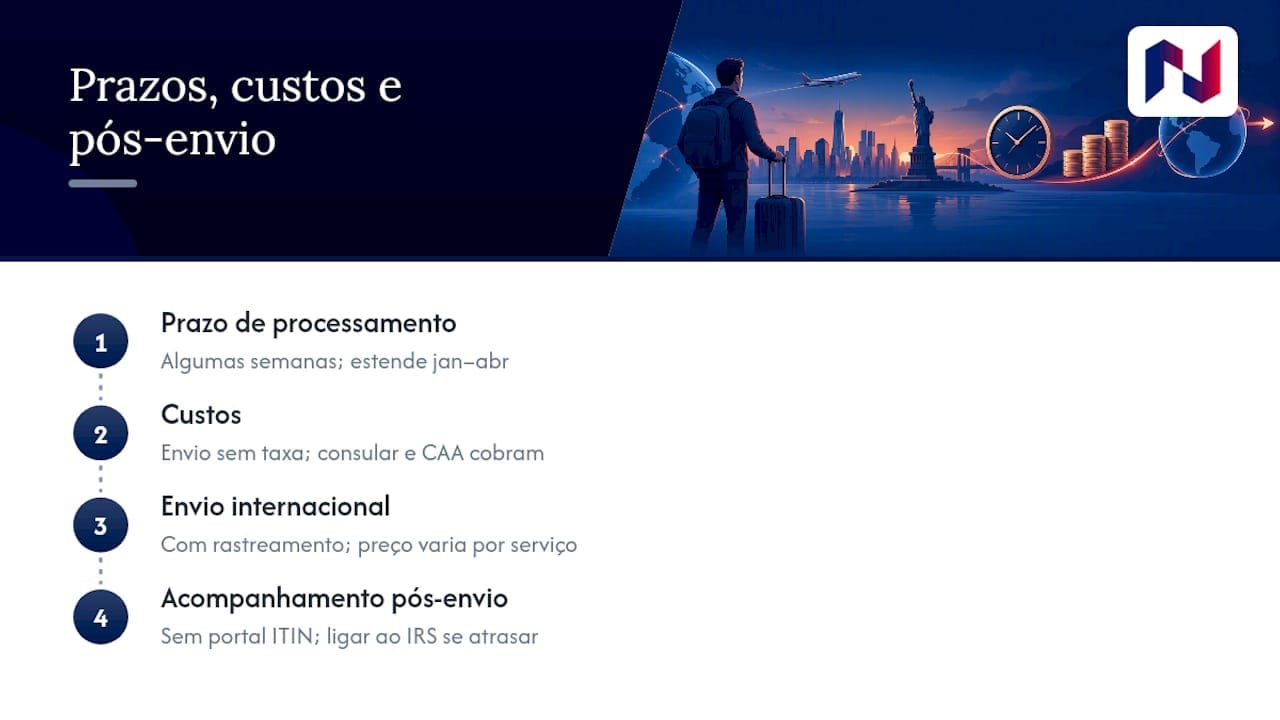
Processing times vary by time of year. According to the IRS page on how to apply for an ITIN, The typical timeframe is a few weeks., However, it extends throughout the tax filing season, generally between January and April.
Costs vary depending on the chosen method: sending documents directly to the IRS by mail has no official fee, but consular certification of documents usually has its own cost, as do the fees charged by a CAA to review and authenticate the documentation. Add to that the cost of international tracking, which also varies depending on the postal service.
After submission, tracking is limited: there is no specific online tracking portal for the ITIN. If the deadline passes without a response, the recommended course of action is to contact the IRS directly using the phone numbers provided in the W-7 instructions.
Validity, renewal, and common reasons for rejection.
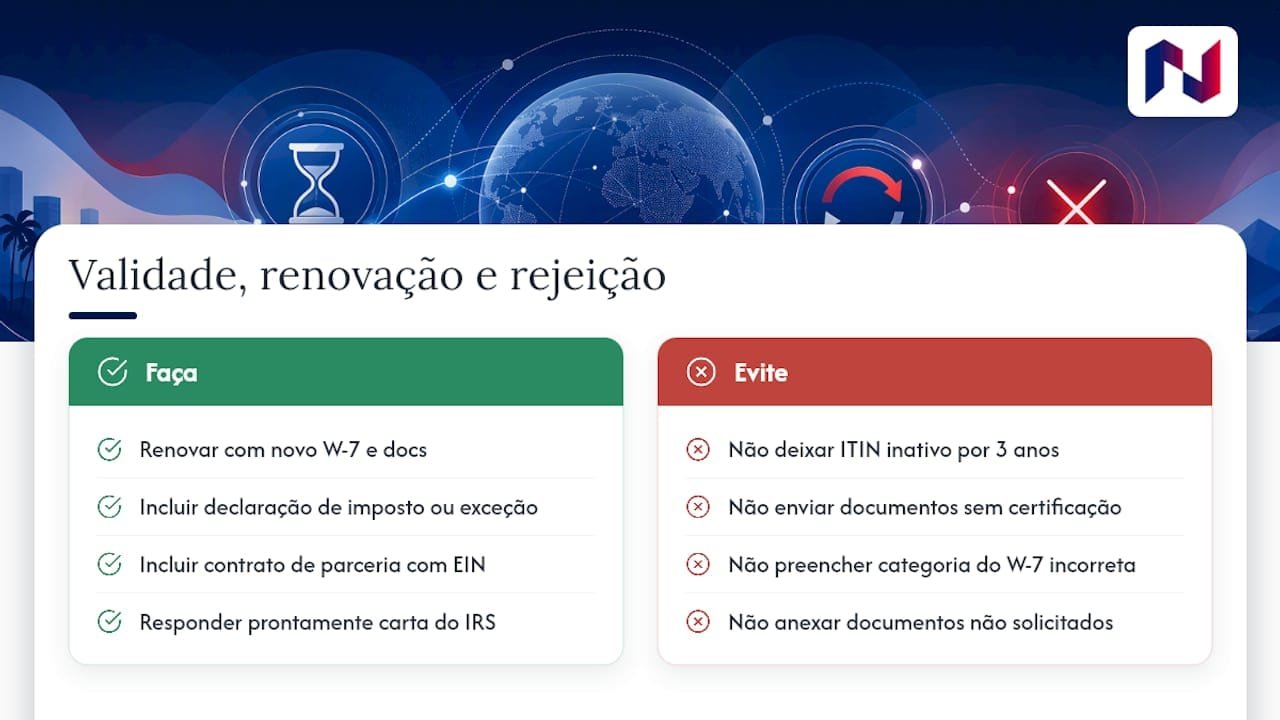
An ITIN that is not used on any tax return for three consecutive years automatically expires. Renewal follows the same process as the original application: new W-7, same identity documentation, and alien status.
Among the most frequent reasons for rejection are documents without proper certification, absence of the required tax return without indication of a valid exception, and incorrectly filled-out application category on the form. Applications based on company income under an exception, for example, require a copy of the partnership agreement showing the EIN and the signature of the responsible party, and the omission of this attachment usually results in rejection.
If the IRS sends a letter requesting additional information, the response time is short, and you should reply with the exact documentation requested, without adding any items that were not asked for.
Limitations of the ITIN and practical difference from the SSN.
An ITIN does not authorize work in the United States, does not grant access to Social Security, and does not alter immigration status in any way. It exists for a single purpose: to allow the IRS to process tax returns for those who are tax-obligated but do not have a Social Security Number (SSN).
Anyone who becomes eligible for an SSN at some point, for example after obtaining a work visa or green card, must apply for an SSN and stop using an ITIN. If the Social Security Administration denies the application, the denial letter becomes a mandatory part of a new ITIN application, according to Publication 1915. This difference matters in practice: banks, employers, and social benefit agencies treat SSNs and ITINs completely differently, and one does not replace the other outside of a tax context.
How does expert consulting help in the process?
Companies and individuals with a corporate structure in the US often encounter more complexity in applying for an ITIN, especially when it connects to opening a bank account or making declarations linked to an LLC or C-Corp.
- Reviewing the documentation before submission reduces the risk of return due to filling out errors or incorrect certification.
- Coordination with Certifying Acceptance Agents to authenticate documents without exposing the original passport to international shipping.
- Integration of the ITIN into the broader tax strategy, when the application is linked to starting a business or to income from a US source.
A specialized consulting firm does not replace the IRS nor guarantee approval: its role is to reduce errors and align the application with the rest of the applicant's tax and corporate planning.
Practical option: specialized support to organize the application and tax obligations.
When an ITIN is tied to opening a company in the US, a tight filing deadline, or a more complex corporate structure, delegating the process avoids rework. A specialized consultancy can offer guidance based on local knowledge instead of generic instructions.

A typical support project in this context usually includes:
- Diagnosis of the tax situation and confirmation of which document (ITIN or SSN) applies to the case.
- Preparation and review of Form W-7 and supporting documentation before submission.
- Coordination with Acceptance Agents and follow-up until IRS confirmation.
Anyone structuring a company in the United States and needing to align their ITIN with the rest of their tax planning can learn about... Naventia's internationalization services and assess the support available for their specific case.
A practical perspective on international tax obligations.
The most common mistake is not being unaware of the ITIN, but treating it as an isolated formality instead of part of a larger tax structure. Those who open a company in the US or receive income from American sources without understanding how the ITIN fits into the rest of their obligations end up correcting problems that could have been avoided from the start.
Three actions resolve most cases: confirming whether the case requires an ITIN or SSN, gathering certified documentation before any submission, and clearly deciding whether it's worthwhile to delegate the process to someone who already handles it routinely.
— Flavio Inacarato
Frequently Asked Questions
How do I get an ITIN (International Taxpayer Identification Number) as a foreigner while in Brazil?
The application can be made without traveling to the United States by mailing Form W-7 to the address provided by the IRS or through a Certifying Acceptance Agent. Documents such as passports require a certified copy from a consulate, embassy, or the authorized agent before submission.
How much does an ITIN cost?
The IRS does not charge a fee for processing Form W-7 submitted directly through the mail. The costs incurred in practice come from consular document certification, Acceptance Agent fees, and international tracking shipping.
What is the ITIN for foreigners in the United States?
It is a tax identification number issued by the IRS to those who need to file US taxes and are not eligible for a Social Security Number. It serves only for tax purposes and does not authorize work or grant immigration status.
ITIN for foreigners: what is a TIN?
TIN is the generic term for Tax Identification Number used by the IRS, and ITIN is the version of that number intended for foreign nationals without the right to a Social Security Number (SSN). Other TINs include the SSN itself and the EIN, the latter used by businesses rather than individuals.