

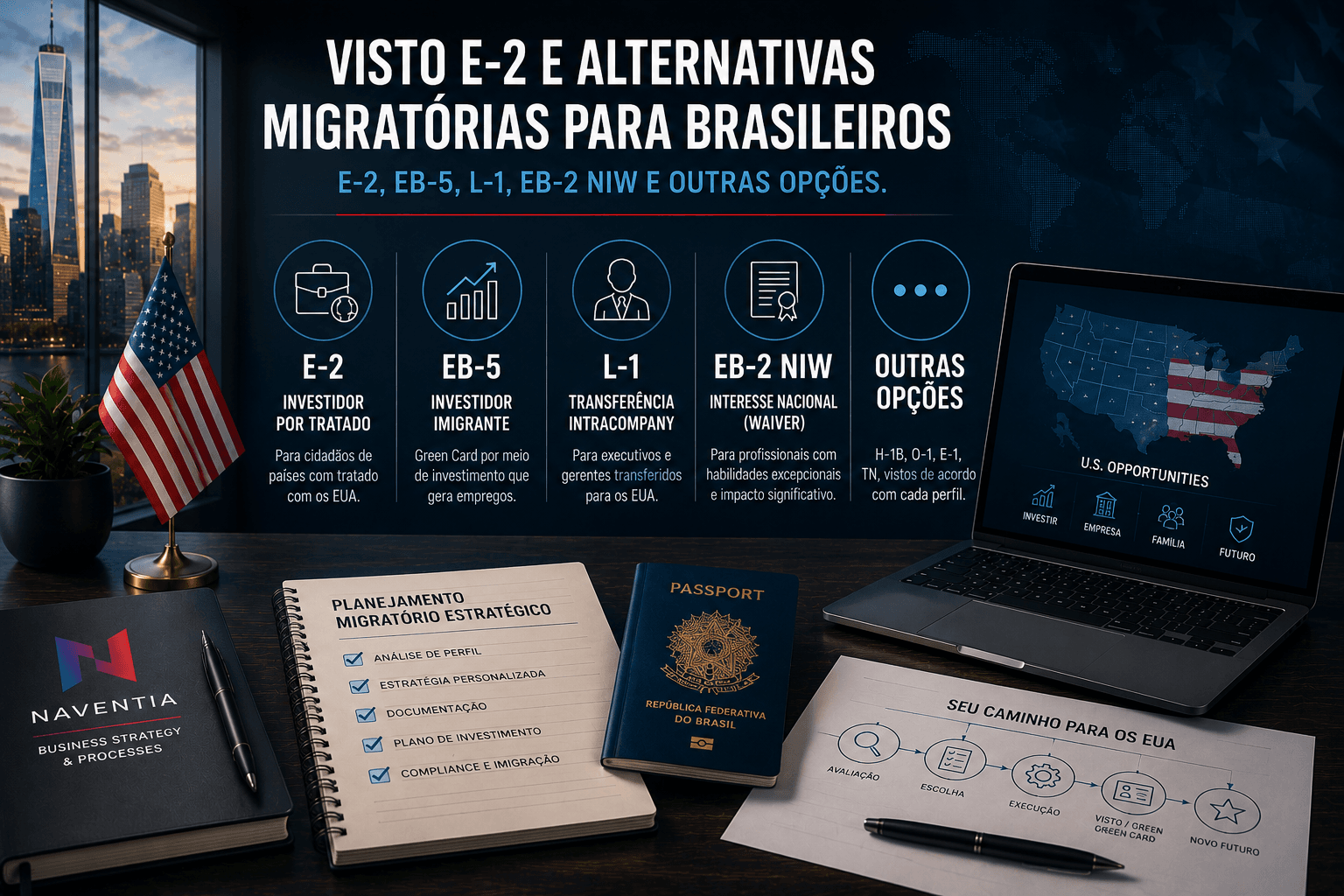
E-2 visa for Brazilians This is one of the most frequent searches among entrepreneurs who want to expand their businesses to the United States. The logic seems simple: open a company, invest in the American economy, and obtain authorization to manage that operation in the country. However, those who begin this process soon discover that the reality is more complex than much of the content available on the internet makes it seem.
The main reason is that Brazilians cannot directly apply for the E-2 visa. This is because Brazil does not have a treaty of commerce and navigation with the United States, an essential requirement for citizens of a country to be eligible for this visa category. This limitation, however, does not mean that doing business in the United States is unfeasible or that there are no legal ways to develop an international operation.
In practice, the biggest mistake many entrepreneurs make is starting their planning by choosing a visa. The correct strategy is precisely the opposite: first define the expansion objectives, structure the business, and only then identify which immigration option makes sense for that specific situation.
Why can't Brazilians apply for the E-2 visa?
The E-2 visa was created to encourage investment from countries that have specific treaties with the United States. Its purpose is to allow citizens of these countries to invest in an American company and manage it directly while the business is in operation.
Since Brazil is not a signatory to this treaty, Brazilian citizens cannot apply for a visa using only their Brazilian nationality.
The official list itself countries with a trade and navigation treaty maintained by the U.S. Department of State confirms Brazil's absence — therefore, migration planning needs to be tied to strategy for entering the American market From the beginning.
This information often surprises many entrepreneurs because various resources on international entrepreneurship present the E-2 visa as a universal solution for those wishing to open a business in the United States. In practice, eligibility depends on the investor's nationality, not just the amount invested or the type of company formed.
This means that opening an LLC or a Corporation does not automatically grant the right to apply for this visa.
Starting a business is different from obtaining a business license.
One of the biggest misunderstandings involving E-2 visa for Brazilians It lies in the relationship between business and immigration.
Incorporating a company in the United States is a corporate procedure. Obtaining authorization to reside or work in the country is an immigration matter.
Although these issues are related, they are governed by different laws.
A Brazilian entrepreneur can open an American company, be a partner in the business, invest resources, and develop international business relationships without necessarily possessing a work visa. What they cannot do is engage in professional activities incompatible with their immigration status.
This distinction is crucial because many business decisions end up being made based on the expectation of obtaining a visa that, in practice, is not available to Brazilian citizens.
Therefore, immigration and corporate structure should be planned together, preventing the company from being organized in a way that does not meet the personal and professional goals of its partners.
When other alternatives might make more sense.
The fact that E-2 visa for Brazilians Not being directly available doesn't mean Brazilian entrepreneurs are without options.
There are other migration categories that may be more suitable depending on the entrepreneur's profile, the company's stage, and the international expansion project.
Among them, one of the best known is the L-1 visa.
This modality allows the transfer of executives, managers, and specialized professionals between related companies, provided that certain legal requirements are met. For Brazilian companies that already have a consolidated operation and intend to establish a physical presence in the United States, this alternative is frequently considered.
Another possibility is the EB-5 program, aimed at investors who make financial contributions within the criteria defined by American legislation. This is a program with specific requirements related to investment and job creation, typically recommended for larger projects.
The EB-2 NIW program follows a different logic. Instead of focusing exclusively on financial investment, this process considers the candidate's professional qualifications and their ability to contribute to areas deemed to be of national interest by the United States. Depending on their professional background, entrepreneurs, executives, and specialists may meet the requirements of this category.
There are also other migratory modalities that can be evaluated according to the activity carried out, the company structure, and the entrepreneur's objectives.
There is no single solution.
There is a most suitable strategy for each case.
The visa should be a consequence of the business strategy.
A very common question among entrepreneurs is: "Which visa do I need to open my business in the United States?"“
Although it seems logical, this is usually the wrong question.
Before discussing immigration, it is necessary to understand what role the American operation will play within the company's planning.
Is the goal to serve international clients?
Create a business structure?
Attracting investors?
Expanding an existing operation?
Produce locally?
These answers directly influence the choice of corporate structure, tax planning, investment method, and, naturally, the migration strategy.
When planning starts from scratch, there is a high risk of creating a company that does not meet the real needs of the business. In many cases, this results in additional costs, corporate reorganizations, and wasted time during the expansion process.
Companies that properly structure their internationalization are able to align growth, governance, taxation, and immigration much more efficiently.
Internationalization requires integrated planning.
Expanding a business to the United States involves much more than simply registering a legal entity.
It is necessary to analyze corporate, tax, regulatory, financial, and operational aspects to build a sustainable structure in the long term.
The choice of company type, the method of profit distribution, the tax residence of the partners, the business strategy, and the migration planning are all part of the same project.
Treating the E-2 visa for Brazilians as an isolated issue, instead of as part of their planning, is one of the most common mistakes among those seeking to start a business in the United States.
When these decisions are made in isolation, the chances of incompatibilities between the company's structure and the entrepreneur's objectives increase.
On the other hand, when there is integrated planning, the company can grow with greater predictability, reduce legal risks, and create a solid foundation for future expansions.
That is precisely why companies that start their internationalization to the USA They usually dedicate time to defining the strategy even before choosing which visa category to use.
Is it worth applying for the E-2 visa for Brazilians?
Even knowing that Brazilians cannot directly request this type of service, the E-2 visa for Brazilians It continues to be one of the most frequently searched terms by those looking to start a business in the United States.
This demonstrates that there is a legitimate interest in understanding which paths can allow for safe international action.
The answer, however, is unlikely to be found in a standardized solution.
Each business project has its own characteristics, involving investment volume, business model, corporate structure, tax planning, and the personal objectives of the partners.
For this reason, migration analysis should be part of a broader planning process, and not treated as an isolated decision.
More important than finding out which visa is available is understanding which strategy will allow the company to grow sustainably and in compliance with Brazilian and American laws.

Conclusion
O E-2 visa for Brazilians It sparks interest because it represents an attractive alternative for investors from eligible countries. However, the inability of Brazilian citizens to apply directly does not prevent entrepreneurs from developing successful operations in the United States.
There are different migration paths that can meet the needs of various types of companies and entrepreneurs, as long as they are analyzed within a consistent strategic plan.
Internationalization doesn't begin with a visa.
It begins with defining the business objectives, choosing the appropriate corporate structure, and integrating tax, business, and immigration aspects.
When these decisions are made in a coordinated manner, the expansion process ceases to be a succession of isolated steps and becomes part of a strategy designed to sustain the company's growth in the American market.
Naventia works alongside companies that want to expand with strategy, security, and a global vision.
If this is your moment, perhaps it's time to take the next step — with someone who already understands the way.
Learn about the business visas and residency pathways that can be evaluated for your project.Discover the migration routes.