


In a comparison of holding companies in the US versus Brazil, in practical terms, a holding company in the United States favors international operations, corporate flexibility, and asset protection outside of Brazil, while a Brazilian holding company tends to simplify compliance with domestic rules and reduce the risk of immediate taxation for those residing here.
A Law No. 14.754/2023 This calculation has changed by requiring annual profit declarations from controlled entities abroad, making case-by-case analysis indispensable before structuring anything.
In summary:
- The new legislation requires Brazilian residents with subsidiaries abroad to calculate profits annually, regardless of dividend distribution.
- Obligations to file tax returns (DIRPF), DCBE (Declaration of Brazilian Capital Abroad), and compliance with US reporting standards increase the risk of penalties for non-compliance.
- Structuring a holding company in the US or Brazil requires detailed planning, proper entity selection, and preparation of documentation before incorporation.
- The risk component increases with diversified financial assets, international beneficiaries, or combinations of holding companies with trusts.
- The decision between an American or Brazilian holding company should take into account the objectives of asset protection, taxation, and succession planning, always analyzing the specific case.
Index
- Holding company overview in the US vs. Brazil: how holding companies work in each country.
- Tax and compliance differences in holding companies in the US vs. Brazil
- Succession in holding companies in the US vs. Brazil: US estate tax and Brazilian probate.
- Checklist for choosing between holding companies in the US vs. Brazil
- Costs and timelines in holding companies in the US vs. Brazil: what increases complexity?
- How Naventia transforms US vs. Brazil holding company analysis into execution.
- When we recommend each holding option in the US vs. Brazil
- Naventia's services to help decide on holding companies in the US vs. Brazil.
- Frequently Asked Questions
- Sources
Overview: What is a holding company and how does it work in each country?
A holding company is, in practice, a company created to concentrate ownership of other assets: real estate, equity stakes, financial investments, or operations. It does not sell products or provide services to the market; it exists to organize property, facilitate governance, and, in many cases, plan succession in a more predictable way.

In the United States, the most common formats for this purpose are the LLC structured as a holding company and, in specific situations, the C-Corp. The LLC tends to be preferred for its contractual flexibility and the possibility of choosing the tax treatment most suited to the owner's profile.
In Brazil, the most common path involves an LTDA (Limited Liability Company), S/A (Corporation), or a so-called family holding company, created specifically to bring together a family's assets under a single corporate umbrella.
The choice between a holding company and other structures, such as trusts or foundations, depends on the owner's actual objective:
- When the focus is on simple asset protection and governance among partners, a traditional holding company is usually sufficient.
- When the objective involves multi-generational succession with beneficiaries in different jurisdictions, a trust can complement a holding company.
- When assets are concentrated in active business operations, an operating holding company in the US tends to make more sense than purely asset-based solutions.
This distinction is important because confusing a holding company with a trust leads to costly decisions: a trust changes the ownership regime of assets, while a holding company only organizes corporate ownership. In Brazil, this confusion often generates problems with the Internal Revenue Service precisely at the point where trusts and offshore companies come under the scrutiny of the new legislation.
Tax and compliance differences between Brazil and the United States.
Law No. 14,754/2023 brought the most significant change in recent years for those who maintain asset structures outside of Brazil. It stipulates that Brazilian residents with controlled entities abroad must calculate the profits of these entities annually, with a cutoff date of December 31, regardless of whether there has been an actual distribution of dividends.
This means that the profit accumulated in the American holding company becomes taxable in Brazil even when it remains retained in the company, except when opting for a tax transparency regime, which treats the offshore assets as if they already belonged directly to the Brazilian owner.
This option simplifies the calculation in certain cases, but it may eliminate the tax deferral that previously made the American holding company more attractive.
Declaratory compliance is not optional: Residents with holding companies abroad need to declare the structure in their Annual Income Tax Return (DIRPF) and in the Declaration of Brazilian Capital Abroad (DCBE), in addition to maintaining the annual reporting required by the new law.
A Brazilian Federal Revenue Service clarifies in official material Offshore companies and trusts controlled by Brazilians are subject to transparency rules, with special attention paid to jurisdictions with preferential tax treatment.
On the American side, foreign entities that control LLCs or corporations in the US also carry reporting obligations, and failure to comply is costly:
- Entities classified as disregarded entities with a foreign partner are usually required to file Form 5472 with the IRS.
- The type of entity chosen in the US (transparent or corporation) directly changes when Brazilian tax is levied on profits.
- Maintaining misaligned DIRPF (Brazilian Individual Income Tax Return), DCBE (Brazilian Declaration of Brazilian Capital Abroad), and US reporting is the main source of risk of double obligation, not double taxation.
The consolidated text of Law No. 14,754/2023, published in the Official Gazette, further details the rules for classifying investment funds abroad, which are relevant for those who also use the holding company as a vehicle for financial investments.
Succession: American estate tax and Brazilian probate in practice
The jurisdiction chosen for the holding company directly affects how the heirs receive the assets, and the two systems operate with very different logics.
In the United States, federal estate tax is levied on the deceased's estate before it is transferred to heirs, and its relevance increases when the family holds physical assets located in the United States, such as real estate or shares in companies incorporated there.
Non-US residents face significantly lower exemption thresholds than US citizens or tax residents, making advance planning crucial for those with Brazilian heirs inheriting US assets.
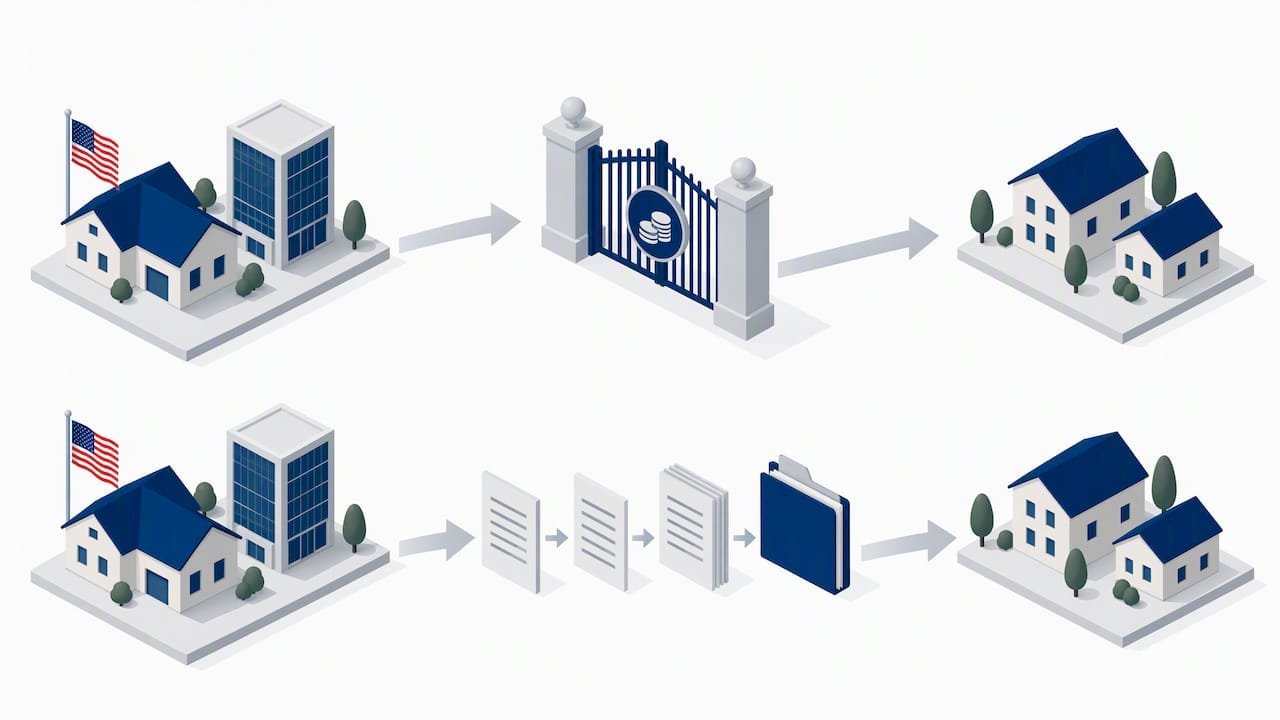
In Brazil, inheritance goes through probate, a judicial or extrajudicial process that can drag on for months when there are assets abroad, since the executor often needs recognized foreign documentation and, in some cases, homologation of acts performed outside the country.
Assets held directly in the name of an individual, without a holding company structure, tend to hinder this process more than organized corporate holdings.
Some practices reduce this friction:
- Bringing international assets together under a holding company avoids the need for separate probate for each asset in different jurisdictions.
- Aligned shareholder agreements and wills between the two countries prevent conflict between the owner's wishes and applicable inheritance law.
- Review the company's ownership structure whenever the list of beneficiaries changes, especially when an heir moves to the United States.
Anyone who wants to better understand exposure to US inheritance tax before structuring something can start by evaluating the... The impact of the estate tax on Brazilian families. In more detail.
Practical checklist for setting up a holding company in each jurisdiction.
Setting up the right structure requires sequencing decisions, not just signing contracts. In the United States, the typical path follows this order:
- Choose the type of entity (LLC or C-Corp) and the state of incorporation, considering cost, confidentiality, and local tax rules.
- Register the entity in the chosen state and obtain the EIN from the IRS, an essential document for any banking or tax transaction.
- Opening an American bank account in the name of the holding company is a step that usually requires proof of address, articles of incorporation, and identification of the partners.
- Formalize intercompany contracts when the American holding company interacts with an operation in Brazil, clearly outlining the flow of capital between the parties.
In Brazil, the sequence changes in nature, but not in its rigor:
- Establish the company (LTDA, S/A or family holding company) and register the articles of incorporation with the Commercial Registry.
- Integrate the assets into the holding company, paying special attention to the valuation of real estate and equity interests.
- Organize governance among partners, including shareholder agreements.
- Maintain current tax compliance, including filing the Individual Income Tax Return (DIRPF) and, where applicable, the Declaration of Brazilian Capital Abroad (DCBE).
In both cases, the minimum team includes a corporate lawyer, an accountant with international experience, and, when there is significant assets outside of Brazil, a risk consultant who understands both sets of legislation simultaneously.
Pro tip: Gather corporate documents, bank statements, and a list of assets before your first meeting with the consultant: this will cut weeks off from the initial diagnosis.
Costs, deadlines, and what really increases complexity.
Recurring costs typically fall into three categories: incorporation and registration fees, annual maintenance fees for accountants and lawyers, and any applicable fees for registered agents in the chosen U.S. state. Saving on incorporation rarely pays off; saving on accounting maintenance, however, often proves costly later in the form of penalties for late or incorrect filings.
Timelines vary considerably: in the United States, registering the entity and obtaining an EIN can take anywhere from a few days to several weeks, depending on the state; opening a bank account is usually the real bottleneck in the timeline. In Brazil, company registration tends to take weeks, and the contribution of real estate assets can extend this period for months.
The complexity increases when the following come into play:
- Diversified financial assets across multiple institutions multiply the work involved in annual reporting.
- Foreign beneficiaries or those residing in more than one country create additional layers of reporting.
- Structures that combine holding companies with trusts, since Law 14.754 imposes specific treatment for this combination.
How Naventia's experience transforms analysis into execution.
We offer support to Brazilian entrepreneurs from the initial diagnosis to the operation of the business structure in the United States, with dedicated follow-up at each stage. A typical project involves diagnosing the current asset and tax situation, structuring the holding company in the most suitable way, organizing tax compliance in both countries, and providing post-opening support.
Before starting any project, we organize with the client:
- A complete inventory of the assets to be included in the holding company, with the value and location of each one.
- The list of beneficiaries and their tax residency status is a key element in estate planning.
- The existing corporate documents in Brazil will need to reflect the new international structure.
When we recommend each jurisdiction
The right question is usually not "USA or Brazil," but what the asset needs to accomplish: operate commercially, protect against risks, or facilitate succession. Each objective calls for a different combination, and applying a generic structure to a specific problem can lead to errors. Evaluating each case individually is recommended before registering any entity.
— Flavio Inacarato
Naventia's services for structuring your international holding company.
If your goal is to organize your assets, start a business, or understand which structure reduces tax and inheritance risk, we offer services such as asset holding company structuring, international tax planning, company formation and structuring, business visas, and ongoing operational support.

Our distinguishing feature is guidance based on local knowledge and decisions built on real risk analysis, not on generic solutions copied from another case. Learn more about our... international structuring and planning services and schedule a technical evaluation of your case.
This article provides general information and is not a substitute for the advice of a qualified financial advisor. Consult a qualified financial professional about your specific situation before acting on this information.
Frequently Asked Questions
Holding companies in the US vs. Brazil: what is a holding company and how does it work?
A holding company is a company created to concentrate ownership of other assets, such as real estate, equity stakes, or investments, instead of selling products or services directly to the market. It exists to organize ownership, facilitate governance among partners, and often simplify estate planning.
What is the time difference between Brazil and the United States?
The difference varies depending on the US state and the time of year, since the US has multiple time zones and observes daylight saving time in parts of the country. For practical purposes, such as meetings with consultants or American institutions, it's always worth confirming the specific time zone of the state involved before scheduling any appointments.
What is the practical difference between holding companies in the US and in Brazil for family holding companies?
There is no publicly established and consolidated definition of what constitutes the largest Brazilian family holding company, as the size of these structures tends to remain outside of official rankings. What is consistent is the growing use of family holding companies by large Brazilian business groups to organize succession and governance among heirs.
How does Law 14.754/2023 change the use of holding companies with trusts?
Law No. 14,754/2023 requires Brazilian residents with controlled entities abroad to calculate profits annually, with a cutoff date of December 31st, which also applies to structures that combine holding companies and trusts. This reduces the tax deferral advantage that previously made some of these combinations more attractive to Brazilians.
Holding companies in the US vs. Brazil: what Brazilian declarations are required for an overseas holding company?
Those who maintain a holding company outside of Brazil are usually required to declare it in their Annual Income Tax Return (DIRPF) and the Declaration of Brazilian Capital Abroad (DCBE), according to guidelines from the Federal Revenue Service regarding offshore companies and Law 14.754. Failure to comply with these obligations usually generates more practical risk than the tax burden of the structure itself.
Sources
- LAW No. 14,754, OF DECEMBER 12, 2023
- Brazilian Federal Revenue Service — Questions and answers about offshore companies, Law 14.754 and RFB Instruction 2.180