

To obtain an L-1B visa, the company must prove three things simultaneously: a qualified corporate relationship between the Brazilian company and the American unit, at least one continuous year of work by the employee in the last three years, and specialized knowledge that justifies the transfer. Failure in any of these three pillars is sufficient grounds for denial or a request for additional evidence. The following sections detail how to prove each requirement and what documents are needed. USCIS expects to receive.
In summary:
The corporate relationship between the Brazilian and American companies needs to be formal, with proof of ownership and effective control through corporate documents and governance.
It is necessary to demonstrate continuous business activity in the U.S., including revenue, contracts, and regular operation, in addition to proving at least one year of uninterrupted work by the employee within the last three years.
Specialized knowledge should involve mastery of proprietary technologies, processes, or techniques, supported by technical evidence and metrics demonstrating its impact on the company.
Companies without established operations in the US need additional proof, such as suitable physical space and financial capacity, especially in the case of a new office.
Responding to RFEs requires a clear organization of specific evidence, with a detailed index and well-structured technical documentation, to avoid unduly reinforcing the request for additional evidence.
Naventia: Plan your entry into the United States. Naventia connects Brazilian companies to the American market with strategic fiscal, legal, and operational planning, reducing the complexity of expansion.Meet Naventia
Index
-
Qualified corporate relationship and proof of "doing business"“
-
What is "specialized knowledge" and how to demonstrate it in practice?
-
Requirement of 1 continuous year of employment (how to count and document it)
-
Practical process: from Form I-129 to entry into the United States.
-
Risks and RFEs: frequent causes and how to prepare solid responses.
-
Naventia resources and support for preparing L-1B petitions.
-
Control and supervision when the employee works at third-party facilities.
Qualified corporate relationship and proof of "doing business"“
The first requirement on the I-1b list is technical and many companies underestimate it: the Brazilian and American units need to have a formal corporate relationship, not just a commercial one. This means that one of them is the parent company, branch, subsidiary, or affiliate of the other, with ownership and control demonstrable through corporate documents.
Ownership and control are not the same thing, and USCIS evaluates both. Ownership is equity participation. Control is the power to make decisions about the operation, even with a minority stake. A Brazilian company may own 100% of a US subsidiary and still need to prove effective control, especially when there are local partners or shared governance structures.

The second part of the requirement is to prove that both companies are "doing business" continuously and regularly, not sporadically. The USCIS policy manual is clear: the mere presence of an agent or representative office in the United States does not constitute "doing business" for L-1B purposes. Real commercial activity is required, with revenue, contracts, and sustained operations in both countries.
To assemble this dossier within Form I-129, the documents that typically support the corporate relationship include:
-
Articles of incorporation and amendments registered in Brazil and the USA.
-
Meeting minutes that prove shared control decisions.
-
Recent tax returns from both entities.
-
Corporate organizational chart with detailed shareholding structure.
-
Commercial contracts, invoices, or bank statements that show active business activity.
Companies opening a new operation in the United States face an additional challenge: they don't yet have a US tax history to present, so securing a [property/assessment] is crucial. international business insurance that protects the business during the initial phase. In these cases, the corporate planning prior to entering the American market It usually significantly reduces the risk of a request for evidence on that specific front.
What is "specialized knowledge" and how to demonstrate it in practice?
Specialized knowledge is the most subjective criterion for the L-1B visa, and also the most contested by immigration officials. Chapter 4 of the USCIS policy manual lists illustrative factors, not a fixed formula: product or process knowledge, market know-how that is difficult to replicate, and knowledge whose transfer to another professional would generate significant cost or time for the company.
In practice, this knowledge is divided into three categories that help organize the evidence:
-
Product or process knowledge: mastery of a technology, system or methodology that is proprietary to the company
-
Operational know-howA deep understanding of internal processes that are not documented in a way that is accessible to all employees.
-
Proprietary techniquesInternally developed methods that give the company a measurable competitive advantage.
Strong evidence combines technical documents with impact metrics. Internal manuals, patents registered in the company's name, results of projects led by the employee, and comparisons between their performance and that of other employees in the same role help support the argument. USCIS itself recognizes that evidence of impact on the company's competitiveness, productivity, or financial position reinforces the claim of specialized knowledge.
Pro tip: When drafting the employer's technical letter, quantify time and tasks. Vague letters generate RFE (Request for Evidence); quantified letters generate approval.
Requirement of 1 continuous year of employment (how to count and document it)
The second pillar of the I-1b requirements is temporal and objective: the employee must have worked for the related company outside the United States for at least one continuous year within the three years preceding the application. 9 State Department FAM treats this rule as one of the central elements of eligibility for L visas.
Counting requires attention to details that often go unnoticed:
-
Contract and admission dates They must coincide with the period stated in I-129, without any unexplained gaps.
-
Travel and absences During the period, periods exceeding certain limits count against continuity, so extended vacations or leaves of absence need to be documented separately.
-
Job changes within the same company They do not interrupt the counting, as long as the employment relationship remains active.
-
Transfers between entities within the same group They require proof that the corporate relationship already existed throughout the entire period counted.
The documents needed to fulfill this part of the request are, in most cases, the easiest to gather: monthly payslips, a letter from the human resources department confirming the dates of hire and position, and a historical organizational chart showing the employee's position over time. When the company already uses integrated payroll systems between Brazil and the US, this gathering takes hours. When it doesn't, it can take weeks.
Essential documentation and evidence for an L-1B petition.
The documentation package for a well-prepared L-1B petition follows a clear logic: each legal requirement needs its own supporting evidence, organized in a way that allows the immigration officer to quickly find what they are looking for. Chapter 8 of the USCIS policy manual highlights that detailed demonstrations of the job offered in the United States, supported by concrete evidence, tend to be more persuasive than generic descriptions.
A typical dossier includes:
-
Form I-129 completed and signed by the petitioner
-
Letter from the employer describing the role, specialized knowledge, and the need for the transfer.
-
Evidence of the corporate relationship between the Brazilian and American entities.
-
Evidence of continuous year of employment (payroll, contracts, HR letters)
-
Technical documentation: manuals, patents, project reports, performance comparisons.
Technical attachments gain strength when organized by topic, not by date. An officer who needs to validate specialized knowledge wants to see, in sequence, the definition of the technology, proof that the employee masters it, and its financial impact on the company. A dossier out of this order forces the examiner to search, and petitions that require excessive searching tend to generate a precautionary RFE (Request for Evidence).
New office, blanket petition and specific requirements
Companies that do not yet have operations in the United States fall into the "new office" category, and USCIS requires additional proof: adequate physical space for the proposed activity and proven financial capacity to remunerate the beneficiary and sustain operations in the first few months, according to Chapter 8 of the policy manual.
Larger companies with a history of recurring transfers may qualify for a blanket petition, which expedites future cases. Objective criteria include:
-
An objective number of recent L-1 petition approvals in the preceding months, as required for blanket petitions.
-
Consolidated annual sales in a high range demonstrating financial stability, as required for a blanket petition.
-
A workforce in the United States that meets a significant threshold, as required for a blanket petition.
Companies that meet these three criteria gain real agility: once the blanket application is approved, new L-1 transfers go through a simplified process, without repeating the entire eligibility analysis for each employee. For most Brazilian companies in the entry phase, however, the individual petition remains the available route, and it is in this case that the quality of the documentation matters most.
Practical process: from Form I-129 to entry into the United States.
The L-1B petition process follows a predictable sequence, but each step has its own deadlines that affect the transfer planning.
-
Preparation of the dossierGathering corporate evidence, proof of employment, and documentation of specialized knowledge is usually the most time-consuming step.
-
Filing of I-129The American employer submits the petition to USCIS, with a base fee and, if applicable, a premium processing fee.
-
AwardUSCIS reviews the application; standard processing can take months, while premium processing guarantees a response within 15 business days for an additional fee.
-
Consular visa or change of statusEmployees outside the U.S. schedule an interview at the American consulate in Brazil; those already in another status can request a direct change.
-
Entry and start of activitiesPresentation of documentation at the border or airport, as per the approved visa.
Premium processing is worthwhile when there's a pre-defined start date with the American client or project, but it doesn't replace a well-documented petition. It speeds up the decision, but doesn't improve the quality of the evidence. Aligning HR in Brazil with the legal team in the United States before filing avoids the most common mistake: inconsistent dates between the Brazilian payroll and the job description presented in the American petition.
Duration, extensions, and pathway to permanent residency.
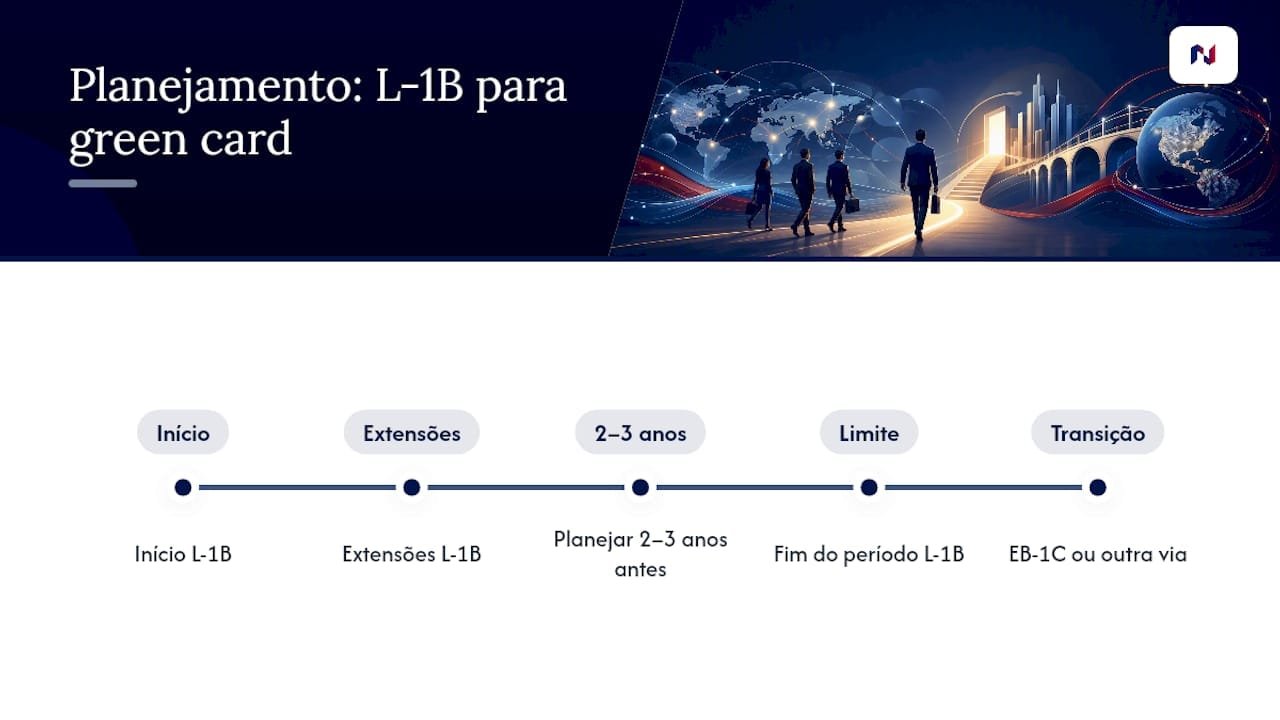
The L-1B visa has a total stay limit in the United States that allows for initial periods and extensions; unlike the L-1A, aimed at executives and managers, which allows for a longer stay, the L-1B has a lower limit. This difference between L-1A and L-1B is important in the career planning of technical professionals who intend to move into managerial positions within the same American company.
Once the limit is reached, those seeking permanent residency typically migrate to the EB-1C category, aimed at executives and managers transferred within the company, or other green card pathways depending on their professional profile. Planning this transition two or three years in advance, even during the L-1B period, avoids the risk of the employee losing status without a clear path to continuity in the United States.
Risks and RFEs: frequent causes and how to prepare solid responses.
Requests for additional evidence (RFE) in L-1B petitions follow a pattern. The most common triggers are specialized knowledge described too generically, poorly documented corporate relationships, and a lack of clarity regarding control when the employee works at third-party facilities.
A well-structured response to an RFE follows this logic:
-
A summary letter listing each of the officer's requests and indicating where the response is located.
-
Supplementary evidence organized by topic, not by date of issue.
-
Additional technical statement, if specialized knowledge was the point in question.
Pro tip: Create an initial index that matches the officer's requests point by point. This structure, recommended by USCIS's own RFE model, speeds up the review process and reduces the chance of a second round of requests.
Naventia resources and support for preparing L-1B petitions.
Naventia provides practical materials for those structuring an L-1B petition:
-
Internationalization guide for the United States with document readiness checklist
-
Five-step planning to align corporate structure before filing the application.
-
Support in drafting technical reports and organizing the evidence dossier.
The consultant's role here is not to fill out forms. It's to anticipate where the immigration officer will press and close that gap before the application is filed.
How immigration reform could change L-1B requirements
Immigration reform proposals in the United States often include revisions to work visa criteria, and the L-1B visa has been subject to greater scrutiny in previous political cycles, especially regarding the definition of specialized knowledge. There are no confirmed regulatory changes in effect that alter the three central pillars described in this guide, but the category's history shows real fluctuations in the rigor of the analysis depending on the administration in power.
In practice, this means that the standard of evidence that was sufficient a few years ago may not be sufficient today, even without a formal change in the text of the law. Periods of increased scrutiny tend to coincide with increases in RFE rates, especially in cases where specialized knowledge is described too broadly or the corporate relationship depends on complex corporate structures.
The practical recommendation for Brazilian companies is to treat documentation as if the standard of requirement were always the highest possible, regardless of the political climate. A robust petition in any regulatory scenario remains robust if the rules tighten; a petition with minimal evidence runs a real risk when scrutiny increases. Companies planning multiple transfers over the next few years benefit from keeping their corporate and technical documentation always up-to-date, rather than rebuilding it for each new request.
Control and supervision when the employee works at third-party facilities.
When an L-1B visa recipient physically performs work at a client's or partner's premises, rather than at the U.S. employer's office, USCIS requires additional proof of control. This requirement stemmed from regulatory concerns about the use of the visa to simply allocate labor to third parties without a real supervisory relationship, a phenomenon known as the third-party worksite issue.
The 9 FAM confirms that this control and supervision must be explicitly demonstrated when placement occurs outside the employer's own premises. This means presenting the service agreement between the American employer and the end client, evidence that the employer continues to control the employee's salary, performance evaluation, and task assignments, and proof that the work to be performed specifically requires the claimed specialized knowledge, and not just generic labor.
Technology and consulting firms, which frequently allocate professionals to client projects, are the most affected by this criterion. The practical recommendation is to document the supervisory relationship from the beginning of the contract with the American client, and not just when preparing the petition. Service contracts that already include clear clauses of technical subordination to the original employer greatly facilitate this part of the evidence.
Author's perspective: final recommendations for employers
Preparing robust documentation before filing is worth more than any procedural shortcut. Prioritize evidence of specialized knowledge and corporate relationships over any other item in the dossier. At Naventia, we are usually called upon when the petition has already been prepared in a generic way and the client has received a Request for Evidence (RFE) that could have been avoided with more specific evidence from the outset.
— Flavio Inacarato
How Naventia helps your company prepare the L-1B petition.
Naventia is the alternative to preparing an L-1B petition on your own or relying solely on a US law firm without knowledge of the Brazilian operational reality: our team works on the corporate structure, technical documentation, and alignment between HR in Brazil and the legal team in the United States before any filing.
Our services cover document readiness assessment, drafting technical letters with impact quantification, corporate planning for new office establishments, and direct coordination with U.S. offices that will file Form I-129. The goal is to reduce the risk of RFE (Request for Financial Expenses) before it happens, not to correct it afterward. Companies already operating in the United States and seeking to expand their in-house team will find in Naventia's initial assessment a clear mapping of what is needed to complete each of the three eligibility pillars. If your company is considering transferring a technical professional to the United States, Schedule a conversation with Naventia. and find out what needs to be adjusted before archiving.
Sources
Frequently Asked Questions
What are the requirements for the L-1B?
There are three requirements: a qualified corporate relationship between the Brazilian and American companies, at least one continuous year of employment in the last three years, and specialized knowledge proven by technical documentation.
What is the difference between L-1A and L-1B?
The L-1A visa is aimed at executives and managers and allows for up to seven years of residency; the L-1B visa is for professionals with specialized knowledge and has a limit of five years.
Does the L-1 visa entitle you to a green card?
The L-1 visa does not automatically grant a green card, but L-1A holders, and to a lesser extent L-1B holders, can migrate to the EB-1C category at the end of their visa term, depending on their position and function in the United States.
How do I get an L-1B visa?
The company needs to file Form I-129 proving the three pillars of eligibility; specialized consultancies such as Naventia They help organize corporate and technical documentation before filing to reduce the risk of RFE (Request for Financial Information).
What characterizes specialized knowledge for L-1B purposes?
Product, process, or operational know-how that would be difficult and costly to transfer to another employee, supported by evidence such as manuals, patents, and company impact metrics.