


BLUF: In the US, parent companies and subsidiaries may be the same legal entity for ownership purposes, but require entirely separate registrations, tax obligations, and accounting controls.
Ignoring this separation is one of the most common reasons for tax headaches for expanding companies. This content explains the necessary filings, the tax impacts of operating in two jurisdictions, and a practical roadmap for structuring this presence without surprises.
In summary:
- Companies operating in the US need an EIN and state registration, as the EIN alone does not formalize the company.
- The subsidiary does not have its own legal personality, which can generate liabilities and risks that fall on the Brazilian parent company.
- Taxation in the US occurs at two levels, federal and state, and can lead to double taxation, requiring specialized analysis of tax credits.
- Choosing between a branch or a subsidiary depends on the desired risk level; a subsidiary offers greater asset protection and risk isolation.
- Before opening a business in the US, it is essential to conduct a diagnostic assessment with local professionals, including an accountant and a lawyer, to avoid extra costs.
Index
- What is a matrix and what is its legal role?
- Parent company and subsidiary in the USA: how the subsidiary differs from the parent company
- CNPJ, EIN, and state registration: what replaces what in the US
- Parent company and subsidiary in the US: taxation when they are in different countries.
- Parent company and subsidiary in the USA: subsidiary or new company, advantages and disadvantages.
- Head office and branch in the USA: a practical guide to opening a branch.
- Branch, subsidiary, LLC or C-Corp: what each structure implies
- What practice shows about structural decisions
- How does Naventia support the opening of a branch or subsidiary in the USA?
- Sources
- Frequently Asked Questions
What is a matrix and what is its legal role?
The parent company is the company that holds the controlling stake and centralizes strategic decision-making for a business group. It consolidates results, is responsible for broader legal obligations, and typically holds the capital that sustains the units linked to it.
Companies maintain a parent company for two practical reasons: centralized control over financial and strategic decisions, and consolidation of results for accounting and governance purposes. This has concrete legal effects:
- The parent company is usually responsible for obligations incurred on behalf of the group, depending on the chosen structure.
- Results from affiliated units are included in the parent company's consolidated accounting.
- Decisions regarding expansion, hiring, and investment typically originate from headquarters, even when operations are run locally.
This concentration of responsibility is precisely the point that changes when a company decides to open a branch outside the country where its parent company is registered.
What is a branch office and how does it differ from the parent company in practice?
A branch is an extension of the parent company, without its own legal personality and without separate assets by default. It exists to operate locally on behalf of the same legal entity that constituted the parent company, which has direct consequences regarding risk and liability.
In practice, this means:
- The subsidiary typically has limited operational autonomy, as strategic decisions remain tied to the parent company.
- Your local tax obligations (state registration, licenses, fees) are assessed separately, even without your own legal personality.
- The financial statements of a subsidiary are usually incorporated into those of the parent company, which requires rigorous accounting controls to avoid mixing revenues and expenses from different jurisdictions.
This lack of asset separation is the reason why many Brazilian companies evaluate, before any registration, whether an independent subsidiary would not be a safer choice.
CNPJ, EIN, and state registration: what replaces what in the US
There is no single document in the US equivalent to a CNPJ (Brazilian company registration number). The closest federal identifier is the EIN (Employer Identification Number), issued by the IRS, used to open bank accounts, hire employees, and file federal taxes. But the EIN alone does not formalize the company: state registration is also required.
- Obtain the EIN. The request is made directly to the IRS and is free when requested by the company itself or by an authorized representative.
- Register the entity in the chosen state. Each state has its own registration requirements, fees, and deadlines, making the choice of state a strategic, not a bureaucratic, decision.
- Assess the need for a DBA. (Doing Business As) when the company will operate under a name different from the one officially registered.
- Confirm local banking requirements. Before opening an account, be aware that some banks require additional documentation or physical presence, as shown in Naventia's guide on opening a bank account in the US.
Without the correct EIN (State Taxpayer Identification Number) and state registration, contracts, invoicing, and bank account opening are blocked, delaying any real business operation.
Taxation and accounting when parent company and subsidiary are in different countries.
This is where most Brazilian companies underestimate the complexity. Because the branch office does not have its own legal personality, debts and liabilities incurred in the US can, depending on the structure, fall on the parent company in Brazil. This completely changes the risk calculation for those deciding between a branch office and a subsidiary.
In the US, taxation occurs at two levels: federal and state, and both apply to locally generated operating income, even when the profit is passed on to the parent company. Add to that the risk of double taxation, when the same income is taxed in both the US and Brazil.
Treaties and tax credits can mitigate this impact, but proper application depends on specific analysis with an accountant specializing in international taxation, never on generic assumptions.
- Debts of the parent company can affect the subsidiary when there is no formal segregation of assets.
- Revenue generated in the U.S. is taxed at both the federal and state levels before being transferred to Brazil.
- Transactions between parent company and subsidiary require separate accounting records, including attention to transfer pricing when there is a sale of products, services, or royalties between the two parties.
- A Complementary Law No. 87/1996 It organizes tax jurisdiction among federative entities in Brazil and serves as a reference for understanding how Brazil handles the allocation of taxes in operations that cross internal borders, a line of reasoning that helps to understand the logic behind the division of powers in the international arena as well.
The Brazilian Federal Revenue Service maintains specific guidelines for Brazilian companies with operations abroad., including ancillary obligations that many parent companies only discover after the subsidiary is already operating, according to the Federal Revenue Service portal. It's worth reviewing these requirements before formalizing any structure, not after.
Branch or new company in the USA: advantages and disadvantages
The choice between opening a branch or forming an independent company in the US depends on risk appetite and the stage of operation.
- Advantage of the branch: It maintains operational continuity and direct control from the parent company over the American unit.
- Advantage of the branch: It simplifies accounting consolidation, since the results are entered directly into the parent company's balance sheet.
- Disadvantage of the branch: It exposes the parent company's assets to risks and liabilities generated in the US.
- Disadvantage of the branch: This increases tax complexity, as it requires simultaneous monitoring in two jurisdictions without the protection of a separate entity.
When a U.S. operation involves raising investment, intensive hiring, or significant commercial exposure, an independent subsidiary (such as an LLC or C-Corp) is usually the most prudent choice, precisely because it isolates the risk.
Pro tip: Before choosing between a branch and a subsidiary, simulate a scenario of a lawsuit or unpaid debt in the US and see which structure best protects the parent company's assets.
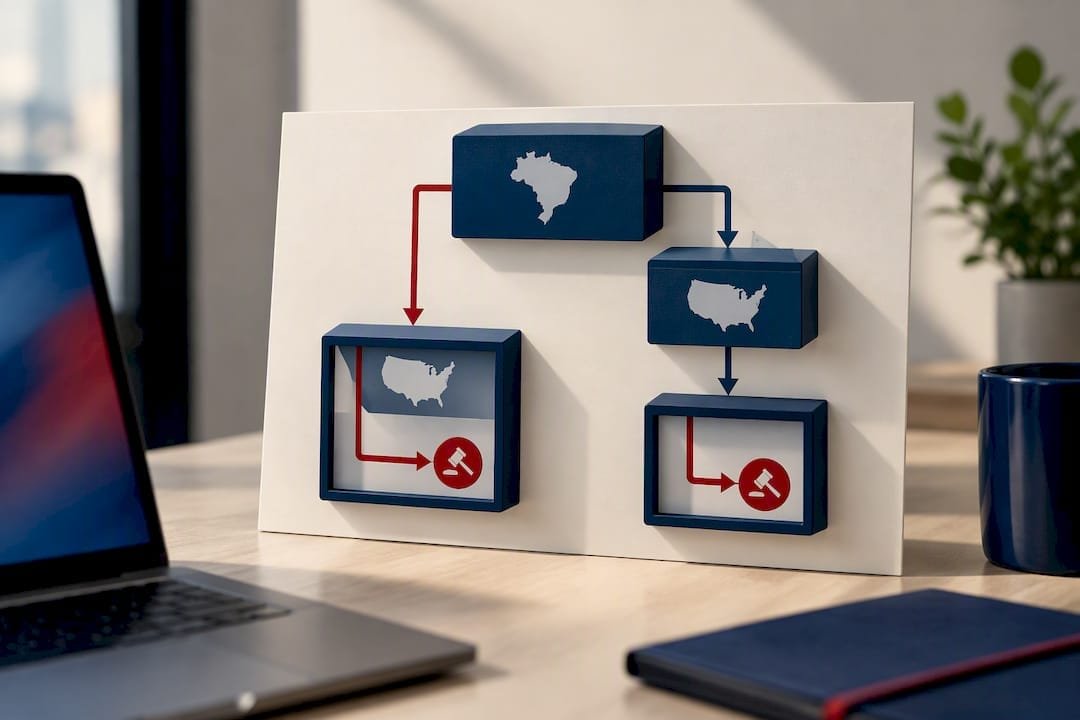
How to open a branch in the USA: a practical guide
Opening a branch in the US involves sequential steps, and skipping one of them usually leads to expensive rework later.
- Define the attendance model. Decide between a branch, subsidiary, LLC, or C-Corp before any registration, based on risk and business objective.
- Choose the state of registration. Delaware, Wyoming, and Nevada are common options, but the state where the operation actually takes place may also require its own registration.
- Apply for the EIN from the IRS. and formalize the entity's state registration.
- Open an American bank account., with the parent company's and partners' documentation organized beforehand, including corporate documents and proof of representation.
- Formalize intercompany contracts Between parent company and subsidiary, detailing services provided, transfer pricing, and responsibilities.
- Involve an American accountant and lawyer. Before operating, not after: most of the tax errors that Naventia observes in foreign companies It stems from decisions made without this prior review.
Corporate documents from the parent company, minutes of the election of representatives, and proof of address are usually required in almost all states, so it's worth gathering everything before starting the process.
Branch, subsidiary, LLC or C-Corp: what each structure implies
The choice of corporate structure determines liability, taxation, and the ability to grow in the US.
- Branch: It does not separate the assets of the parent company, exposes the Brazilian company to American risks, but simplifies accounting consolidation.
- Subsidiary: As a legally independent entity, it isolates the risk from the parent company and allows for separate taxation, at the cost of increased bureaucratic maintenance.
- LLC: A flexible and popular structure among foreigners for combining asset protection with simplified taxation, although it requires attention to specific rules when the partners do not reside in the USA, as detailed in Naventia's content on LLC taxation for Brazilians.
- C-Corp: It is preferred by companies seeking investment because it accepts different classes of shares, but it is subject to corporate taxation and potentially double taxation of dividends.
When the goal includes long-term asset protection, it is also worth evaluating an international holding company structure, which is compared in detail in Naventia's guide on LLCs, Corporations, or Holding Companies.
What practice shows about structural decisions
I'm Flavio Inacarato, and I closely follow the recurring mistakes Brazilian companies make when trying to establish a presence in the US without prior review: choosing a state without considering the actual business, non-existent intercompany contracts, and opening bank accounts without understanding compliance requirements.
At Naventia, the standard that works is simple: diagnosis before registration, American accountant and lawyer involved from the start, and no structuring decisions made solely based on precedent or short-term savings. Companies that skip this step often pay double later to correct it.
— Flavio Inacarato
How does Naventia support the opening of a branch or subsidiary in the USA?

The experts involved in the process are based in the United States, allowing for guidance based on local knowledge regarding state selection, entity type, and the actual tax risks of the operation. Services include company formation and structuring, tax planning, support for opening a bank account, and assistance with business visas.
A typical project might begin with diagnosing the ideal structure and continue until the company is positioned in the American market. To evaluate your case, learn more about... Naventia's internationalization services.
Sources
For further verification and reading: Supplementary Law No. 87/1996 on tax jurisdiction, the Federal Revenue Service website with guidelines for companies with operations abroad, and Naventia's guide on international expansion to the USA.
Frequently Asked Questions
How do you say "head office" and "branch office" in English?
The parent company is called a "parent company" or "headquarters," and a subsidiary is a "branch." When the American unit has its own legal personality, the correct term becomes "subsidiary," not "branch.".
What is the difference between a parent company and a subsidiary in the US?
The parent company is the entity that holds corporate control and centralizes strategic decisions, while the subsidiary is an extension of it, without its own legal personality. This means that the subsidiary's debts and risks can fall directly on the parent company, depending on the chosen structure.
What is the equivalent of a CNPJ in the US?
There is no exact equivalent, but the EIN, issued by the IRS, serves as a federal identifier for tax and banking purposes. It needs to be combined with the entity's state registration, as each state has its own formalization requirements.
How to open a parent company and branch office in the USA?
The process includes choosing the state of registration, applying for an EIN with the IRS, formalizing intercompany contracts with the parent company, and opening a bank account with the corporate documentation in order. Involving a US accountant and lawyer before operating avoids most of the common compliance errors among foreign companies.