
Yes. Every entrepreneur who forms an LLC in the United States must have a written LLC operating agreement, even when the state of registration may not require the document by law.
It is the main proof that the company operates as an entity separate from your personal assets, and regulates ownership, management, profit distribution, and exit rules among partners.
Some states, like New York, may impose a deadline for formalizing it. Draft it, sign it, keep an accessible copy, and have it reviewed by a specialist before opening a bank account in the US.
In summary:
All partners in a US LLC must have a written operating agreement, even when state law does not require it, to ensure asset segregation.
The internal contract governs ownership, management, profit distribution, and exit rules, and also serves as evidence against creditors and investors.
It is essential to include clauses identifying the partners, contributions, profit distribution, management, and rules for transferring shares, especially before any conflict arises.
Legislation, such as that of New York, requires formalization within specific timeframes, varying according to the state of registration, which impacts the preparation of the document.
It is recommended to review the agreement periodically and adapt its content to changes in society, thus avoiding future problems with banks or partners.
Index
-
What is an LLC operating agreement and why does it matter for Brazilian entrepreneurs?
-
Essential elements that every LLC operating agreement should contain.
-
Choosing the state of education: practical impacts on your operating agreement.
-
How to draft an LLC operating agreement: a step-by-step guide for Brazilians.
-
Naventia's specialized support for your operating agreement.
What is an operating agreement and why does it matter for Brazilian entrepreneurs?
The operating agreement is the internal contract that governs how your LLC functions: who the partners are, how decisions are made, and what happens if someone wants to leave.
O Small Business Administration (SBA) It describes the document as an essential part of corporate governance and recommends its creation even in states where the law does not mandate it.
There is a practical difference that confuses many people: the Articles of Organization It is the public document, registered with the state, that gives legal status to the LLC.
The operating agreement, on the other hand, is private, doesn't go to any public body, and deals with the internal rules of the business. These are documents with completely different functions, and one does not replace the other.
Banks, investors, and even courts treat the operating agreement as concrete proof that the company is a separate entity from its owner. Without this contract:
-
It becomes more difficult to prove who has the authority to manage the business account;
-
In a legal dispute, a creditor may argue that the LLC is merely an extension of the partner's personal assets.;
-
Investors tend to hesitate before signing any agreement with the company.
The absence of a written contract opens the door for creditors to try to disregard the separation between you and the LLC, which is the exact opposite of what motivates someone to form this structure.
Essential elements that every operating agreement should contain.
Practical guides like the LLC Operating Agreement: Complete Guide They list a minimum set of clauses that appear in virtually any well-drafted contract. Ignoring any of them usually leads to conflict later on, when it's too late to negotiate calmly.
-
Identification of partners and percentage of ownership. — who owns what, in clear numbers.
-
Capital contributions — what each partner contributed and how future contributions work.
-
Profit and loss distribution — it doesn't always follow the percentage of participation; this needs to be explicit.
-
Management structure — if the LLC is member-managed (partners manage directly) or manager-managed (A designated manager makes the day-to-day decisions).
-
Rules for transferring shares — right of first refusal, terms of sale and buy-sell clauses between partners.
-
Dissolution and alteration procedures — how to resolve impasses and how the contract itself can be amended in the future.
Pro tip: Define the buy-sell clause before any friction arises between partners. Once the relationship is already strained, no one agrees on a method for valuing the company, and it is precisely this detail that avoids months of dispute.
Choosing the state of education: practical impacts on your operating agreement.
The state where you register your LLC changes what can and cannot be included in the agreement. A comparative study of the 50 states shows that the requirements regarding the form, term, and content of the operating agreement vary. They vary significantly between jurisdictions..
Some concrete examples:
-
New York The legislation is interpreted as requiring a written agreement within 90 days of the formation of the LLC.
-
Delaware It offers broad contractual freedom, which explains why so many foreign LLCs are formed there.
-
California It imposes stricter rules on certain waivers of rights that partners cannot simply contract out externally.
Contractual freedom has limits in any state: statutory rights of third parties and certain judicial remedies cannot be waived simply because the contract says so.
A generic template downloaded from the internet often fails precisely here, attempting to replace a rule that state law does not allow to be changed.
When choosing where to form an LLC, consider maintenance costs, the level of corporate privacy, and the predictability of the local legal environment, not just the startup fee.
And after deciding, it's worth reviewing the contract with a licensed lawyer in that specific state. Rules change from border to border, and what applies in one place may not apply 500 kilometers away.
How to draft an operating agreement: a step-by-step guide for Brazilians.
Drafting this contract doesn't have to be complicated, but it does require order. Follow this sequence:
-
Before you start writing, decide on the basics. — Who are the partners, what percentage does each one own, how much capital will each one contribute, and who will manage the day-to-day operations?.
-
Draft the minimum clauses. — Use clear language, avoid copying legal terms that you yourself do not understand, and especially detail the exit rules and the method of valuing the company in case of a sale of shares.
-
Review and sign — All partners must sign; witnesses are generally not required, but a bilingual version (English and Portuguese) helps to avoid misunderstandings between Brazilian partners.
-
Save and use the document. — Keep accessible copies for the American bank, for the accountant, and in your own internal company records.
-
Review periodically Whenever a partner joins, leaves, or changes their percentage of ownership, the contract needs to be updated; it cannot be left as it was on the day the partner was founded.
Pro tip: Save both the signed version in the cloud and on paper. American banks often require the physical or scanned document when opening a business account, and a lost file can delay the process for weeks.
Common mistakes when using templates and how to avoid them.
The most common mistake is downloading a generic template from the internet without checking if it complies with the rules of the chosen state. A template designed for Delaware may simply not work in New York, or worse, fail to meet a local requirement without anyone noticing until a problem arises.
Other recurring mistakes:
-
Do not update the contract after a partner joins, leaves, or changes their stake in the company.
-
Making verbal agreements between partners and never putting them in writing, creating discrepancies in memory months later.
-
Maintaining bank and accounting records that are inconsistent with what the contract describes weakens limited liability protection precisely when it is most needed.
-
Leaving the exit rules and the company valuation method blank opens the door to costly litigation between partners.
Documents and practical next steps for Brazilian companies
Operating agreements rarely circulate alone. American banks usually require the signed contract along with other documents to authorize the opening of a business account.
-
Operating agreement signed by all partners;
-
Articles of Organization registered in the state;
-
EIN (Federal Tax Identification Number, equivalent to a US CNPJ).
An EIN should be requested soon after the formation of the LLC, as it unlocks tax obligations in the US and is a prerequisite for opening a bank account.
For Brazilian business owners, this is also the time to understand the initial aspects of double taxation between Brazil and the U.S. and to seek an accountant specializing in both countries, not just a local professional in the U.S.
Maintaining consistent banking, accounting, and contractual records is what, in practice, preserves the asset protection that the operating agreement promises on paper.
Author's perspective: practical lessons from Naventia
In the cases we've followed at Naventia, the error pattern repeats itself: a partner downloads a ready-made template, signs it without reviewing it, and only notices the gap when a conflict arises or the bank rejects the documentation.
We coordinated legal review in the US along with fiscal adjustments for Brazil precisely because a generic contract rarely solves both issues simultaneously.
Specialized consulting is worthwhile when there is more than one partner, significant capital, or an expansion plan; a basic model only serves as a starting point.
— Flavio Inacarato
Naventia's specialized support for your operating agreement.
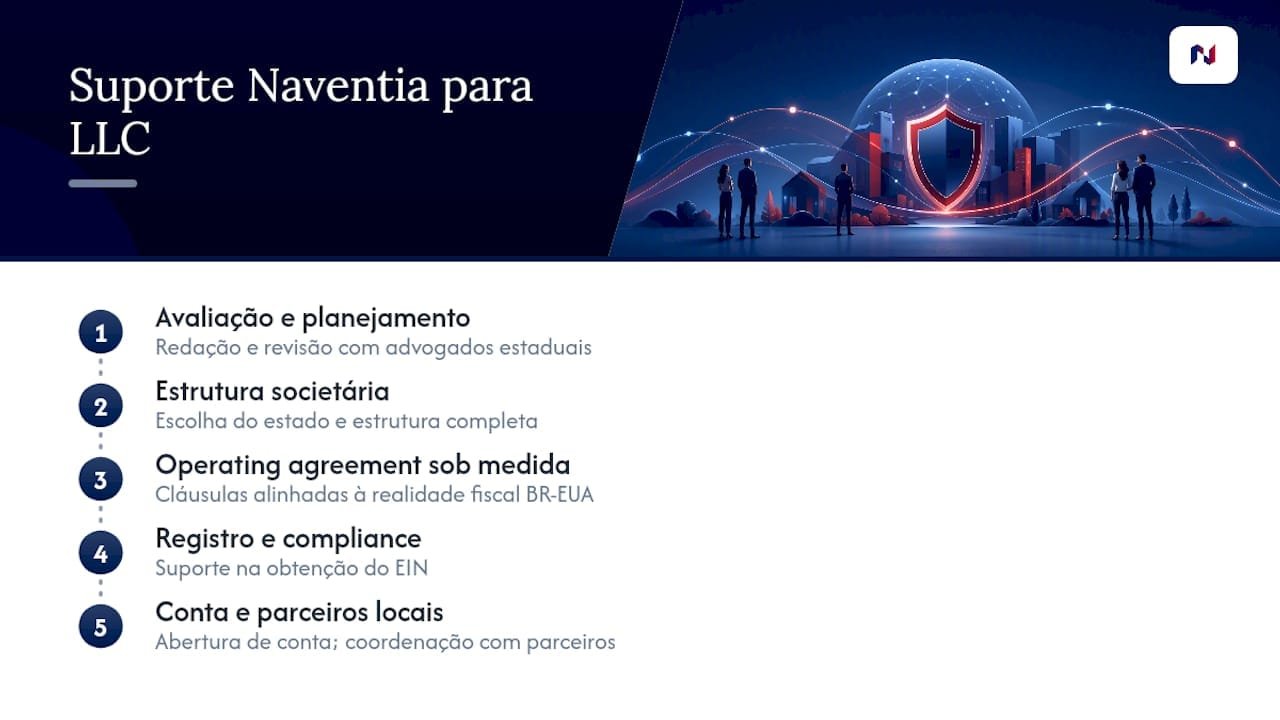
There are alternatives to drafting this contract yourself or copying a ready-made template from the internet: consulting firms can coordinate the drafting and review of the operating agreement with licensed attorneys in the chosen state, aligning each clause with the tax realities between Brazil and the USA.

We handle the complete corporate structuring of your LLC, from choosing the state to opening a US bank account, including support in obtaining an EIN.
This reduces the risk of a poorly drafted contract compromising your asset protection later on, and avoids rework when the bank or accountant requests adjustments to the document.
If you have already decided to form or have already formed your LLC and want a custom-drafted operating agreement, Discover Naventia's services. and schedule a conversation about structuring your business in the US.
Sources
For further information, consult the SBA guide on operating agreements, the comparative survey of the 50 states, and the... Updated practical guide on state requirements..
Frequently Asked Questions
Is an operating agreement mandatory in all states?
No. Most states do not require the document by law, but some, like New York, impose a deadline or written form, and the SBA recommends having it even where it is not required.
Does a sole proprietorship LLC need this type of contract?
Yes. Even sole proprietorship LLCs benefit from the document, because it reinforces the separation between owner and business in the eyes of banks and creditors.
What is the difference between Articles of Organization and operating agreement?
The Articles of Organization are registered with the state and legally create the LLC. The operating agreement is private and defines the internal rules for ownership, management, and profit distribution.
What happens if I use a generic template without any adaptation?
The model may ignore specific requirements of the chosen state or leave exit clauses blank, which often leads to costly litigation between partners later on.
Does Naventia help draft this contract for Brazilians?
Yes. It is possible to have specialized coordination for drafting and reviewing the operating agreement with lawyers licensed in the US, aligning the contract with the tax reality of the Brazilian partner.