
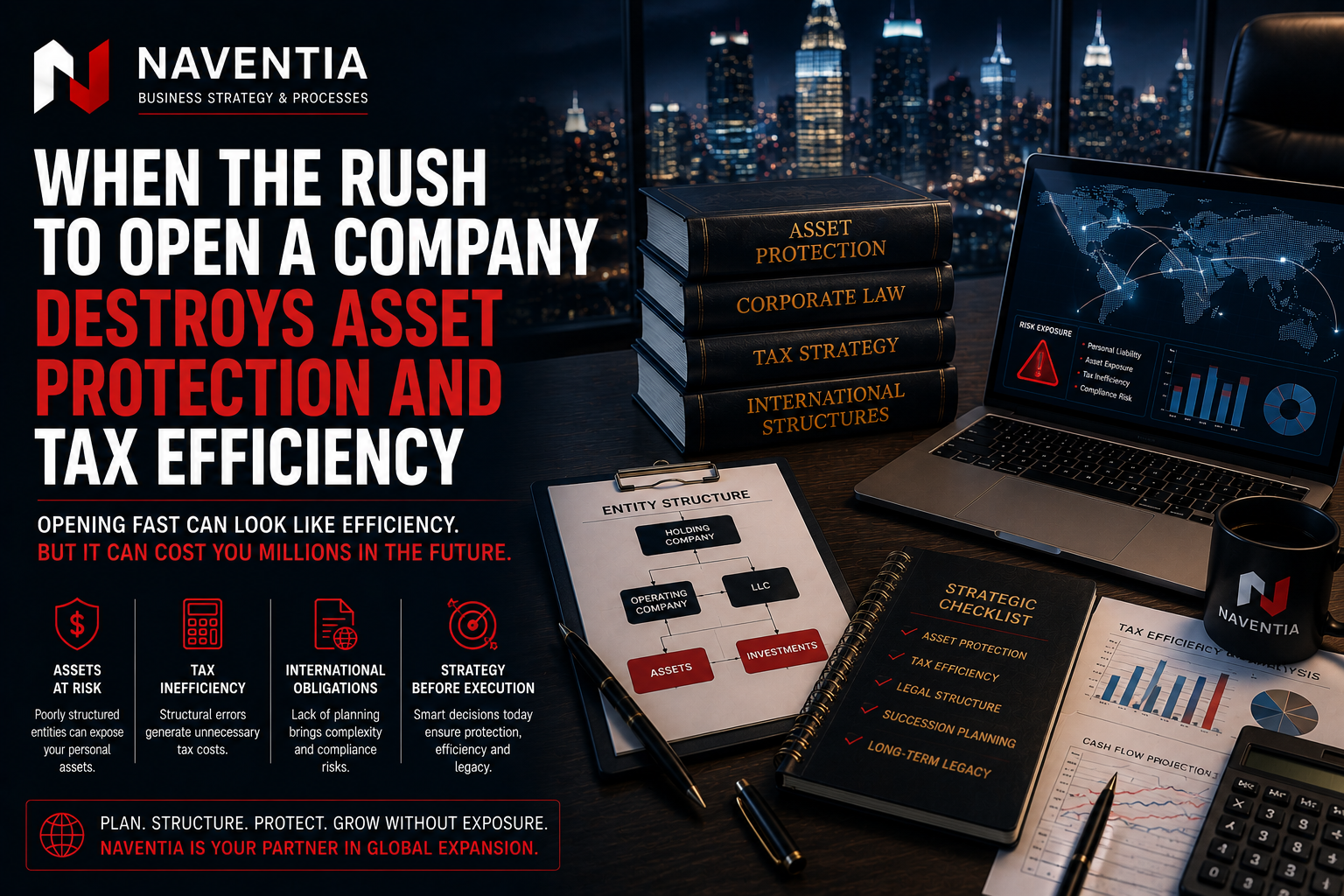
Opening a company in the United States too quickly is one of the most expensive mistakes international entrepreneurs make when expanding globally.
One of the most common things we hear from founders considering the U.S. market is:
“I want to open my company as fast as possible.”
The urgency makes sense.
The American market is attractive.
A strong currency creates opportunity.
The legal system appears straightforward.
And everywhere you look, there are promises like:
“Open your LLC in just a few days.”
The problem?
Fast incorporation does not always mean smart structuring.
And when we are talking about:
- asset protection
- international tax planning
- wealth preservation
- succession planning
- cross-border ownership structures
Speed without strategy can cost years of planning.
And in some cases…
Millions in unnecessary exposure.
The mistake that looks efficient—but can become a liability
Most entrepreneurs begin with questions like:
“Which state should I incorporate in?”
Or:
“Wyoming or Florida?”
Or even:
“Should I open an LLC or a Corporation?”
These are important questions.
But none of them should come first.
Before any legal entity discussion, there is a much more strategic question:
What role will this U.S. structure play within your global wealth strategy?
Without answering that…
Incorporation becomes execution without architecture.
And execution without architecture often creates:
- unnecessary asset exposure
- tax inefficiencies
- unexpected reporting obligations
- structures that become expensive to fix later
This is where many entrepreneurs mistake speed for strategy.
The pattern we see most often
The most common sequence usually looks like this.
Step 1
Open an LLC quickly.
Step 2
Open a U.S. business bank account.
Step 3
Start moving international funds.
Step 4
Only afterward seek tax or legal advice.
At first, this feels practical.
But in reality, it often creates avoidable structural problems.
1. Personal assets become exposed
When a structure is created directly under an individual’s name—without ownership layers, governance design, or asset segregation—international assets may become vulnerable to:
- shareholder disputes
- personal litigation
- family conflicts
- succession complications
- business liabilities
The structure that was supposed to protect wealth…
May not protect anything.
2. Tax efficiency gets compromised
Choosing the wrong structure can trigger consequences such as:
- accelerated taxation in your home country
- taxation on undistributed profits
- complex international reporting
- permanently higher tax costs
In some cases…
The money saved during incorporation turns into a permanent tax burden.
And that burden follows the business for years.
3. Unexpected international compliance obligations
Entrepreneurs who open entities without planning often discover reporting obligations only later.
These may include:
- international tax reporting
- beneficial ownership disclosures
- cross-border entity reporting
- multi-jurisdiction compliance requirements
And the challenge is not simply filing.
The challenge is filing correctly.
Poor compliance can create expensive problems later.
What sophisticated entrepreneurs do differently
Experienced international founders do not start with incorporation.
They start with strategic design.
First: define the objective
What is this structure actually being built for?
- operating a business?
- protecting assets?
- succession planning?
- international investing?
- global expansion?
Without clarity of purpose, there is no efficient structure.
Then: design the architecture
Only after defining the objective do decisions like these make sense:
- LLC or Corporation
- Holding company or direct operating entity
- Individual ownership or intermediary entities
- State selection
- Banking strategy
- Cross-border tax planning
This is where real strategy begins.
Only then: execute
Now operational execution makes sense:
- entity formation
- EIN registration
- banking setup
- compliance frameworks
- contracts and governance
When done in the right order, risk goes down.
Efficiency goes up.
Long-term flexibility increases.
The most expensive mistake of all
Entrepreneurs who rush to open companies often believe they are saving time.
In reality…
They are often buying future complexity.
And poorly designed international structures are rarely fixed without significant cost.
Final thoughts
Opening a company in the United States may take only a few days.
But building an efficient international structure can affect:
- your wealth
- your family
- your succession strategy
- your tax exposure
- your business growth for the next decade
Before incorporating…
Ask yourself:
Are you simply opening a company… or are you building an international wealth structure?
That answer changes everything.
Companies that prioritize asset protection in the U.S. before incorporation preserve more wealth, reduce tax exposure, and scale internationally with far more confidence.
Talk to Naventia
At Naventia, we help entrepreneurs structure international operations with legal intelligence, tax efficiency, and long-term wealth protection.