


Escolher o modelo de negócio nos EUA — produto, serviço ou consultoria — é uma das decisões mais importantes para empresas brasileiras que planejam expandir internacionalmente.
Muitos empresários começam a jornada de internacionalização fazendo perguntas como:
“Em qual estado devo abrir minha empresa?”
Ou:
“Devo abrir uma LLC ou uma Corporation?”
Essas perguntas são importantes.
Mas existe uma pergunta ainda mais estratégica que precisa ser respondida antes de qualquer decisão jurídica ou operacional:
Seu modelo de negócio nos EUA realmente tem aderência ao mercado americano?
Porque a verdade é simples:
Nem tudo que funciona no Brasil funciona nos Estados Unidos.
E o contrário também é verdadeiro.
Modelos que crescem com facilidade no mercado brasileiro muitas vezes encontram resistência, margens menores ou dificuldade de conversão quando tentam escalar nos EUA.
Por isso, antes de pensar em estrutura societária, vistos, marketing ou operação local…
A pergunta real é:
Produto, serviço ou consultoria — qual modelo realmente se adapta melhor ao comportamento do cliente americano?
O primeiro erro: achar que vender nos EUA depende apenas de tradução
Muitos empresários acreditam que internacionalização significa:
- traduzir o site para inglês
- abrir empresa nos Estados Unidos
- criar um LinkedIn internacional
- investir em tráfego pago
Mas a realidade do mercado americano é mais exigente.
Nos Estados Unidos, empresas não compram versões traduzidas de negócios brasileiros.
O mercado compra:
- especialização
- clareza de posicionamento
- eficiência operacional
- prova de resultado
- diferenciação real
Se seu modelo de negócio não comunica isso…
A expansão vira custo.
Esse ponto se conecta diretamente com:
Planejamento estratégico para entrar nos EUA: o que precisa existir antes da operação
https://naventia.com/planejamento-estrategico-entrar-nos-eua/
Modelo 1: Produtos físicos
Produtos brasileiros podem performar bem no mercado americano?
Sim.
Mas existem desafios importantes.
Principais barreiras
Empresas que vendem produtos físicos normalmente enfrentam:
- logística internacional
- custos de importação
- compliance regulatório
- compressão de margem
- necessidade de escala operacional
Por isso, produtos costumam performar melhor em cenários específicos.
Quando produtos costumam funcionar melhor
Nicho premium
Produtos com forte diferenciação tendem a performar melhor.
Exemplos:
- cosméticos
- wellness
- alimentos especiais
- design autoral
- lifestyle
Comunidades específicas
Produtos podem encontrar forte aderência em:
- comunidade brasileira
- comunidade latina
- nichos culturais específicos
Problemas técnicos ou industriais
Produtos especializados também podem performar bem em segmentos como:
- indústria
- engenharia
- construção
- tecnologia aplicada
- equipamentos especializados
O maior risco
Sem escala ou diferenciação clara…
Produtos entram em guerra de preço.
E nos Estados Unidos, competir com gigantes como Amazon ou grandes distribuidores costuma ser extremamente difícil.
Modelo 2: Serviços especializados
Para muitas empresas brasileiras, serviços costumam ter uma barreira de entrada menor.
Especialmente em áreas como:
- marketing
- tecnologia
- recrutamento
- operações
- finanças
- BPO
- serviços corporativos
Por que serviços costumam entrar mais rápido?
Porque normalmente exigem:
- menor investimento inicial
- menor necessidade de capital operacional
- validação comercial mais rápida
- possibilidade de operação remota
Isso não é só intuição de mercado. O próprio guia oficial da U.S. Small Business Administration sobre pesquisa de mercado e análise competitiva reforça esse ponto: empresas que validam demanda e mapeiam a concorrência antes de comprometer capital têm taxa de fracasso mensuravelmente menor do que as que pulam direto para o lançamento.
Esse modelo também conversa diretamente com:
Como validar demanda nos EUA antes de abrir operação
https://naventia.com/como-validar-demanda-nos-eua/
O desafio real
Nos Estados Unidos, serviços genéricos costumam perder força.
Termos como:
- Marketing Agency
- Business Consulting
- Financial Services
Sozinhos, raramente geram alta conversão.
O mercado americano normalmente compra:
especialização por nicho.
Exemplos que performam melhor:
- Growth Strategy for SaaS Companies
- Financial Operations for Healthcare Groups
- Recruiting for Construction Companies
Quando existe nicho claro…
A taxa de conversão muda completamente.
Modelo 3: Consultoria
Consultoria costuma ser um dos formatos com maior potencial para empresários brasileiros experientes.
Principalmente quando existe:
- experiência prática
- autoridade técnica
- histórico comprovado
- metodologia própria
- diferenciação intelectual
Nos Estados Unidos, consultoria pode escalar muito bem.
Mas existe uma condição:
Você precisa vender transformação — não horas.
Consultorias que costumam performar melhor
Os segmentos mais fortes costumam ser:
- expansão internacional
- processos e eficiência operacional
- compliance
- growth strategy
- tecnologia
- M&A
- private advisory
- operações corporativas
O erro mais comum
Entrar com proposta genérica.
Se sua consultoria não possui:
- método claro
- framework próprio
- posicionamento forte
- nicho definido
O mercado americano vai comparar sua empresa por preço.
E isso destrói margem.
Esse ponto conversa diretamente com:
Como montar processo comercial nos EUA sem inflar a estrutura cedo demais
https://naventia.com/processo-comercial-nos-eua/
No fim das contas, a escolha entre produto, serviço ou consultoria não é uma decisão estética — é uma decisão de risco, capital e velocidade de validação. Empresas brasileiras que tratam essa escolha como ponto de partida estratégico, e não como detalhe operacional, chegam ao mercado americano com uma estrutura de custos compatível com a realidade que vão encontrar, em vez de descobrir isso da forma mais cara possível: já operando.
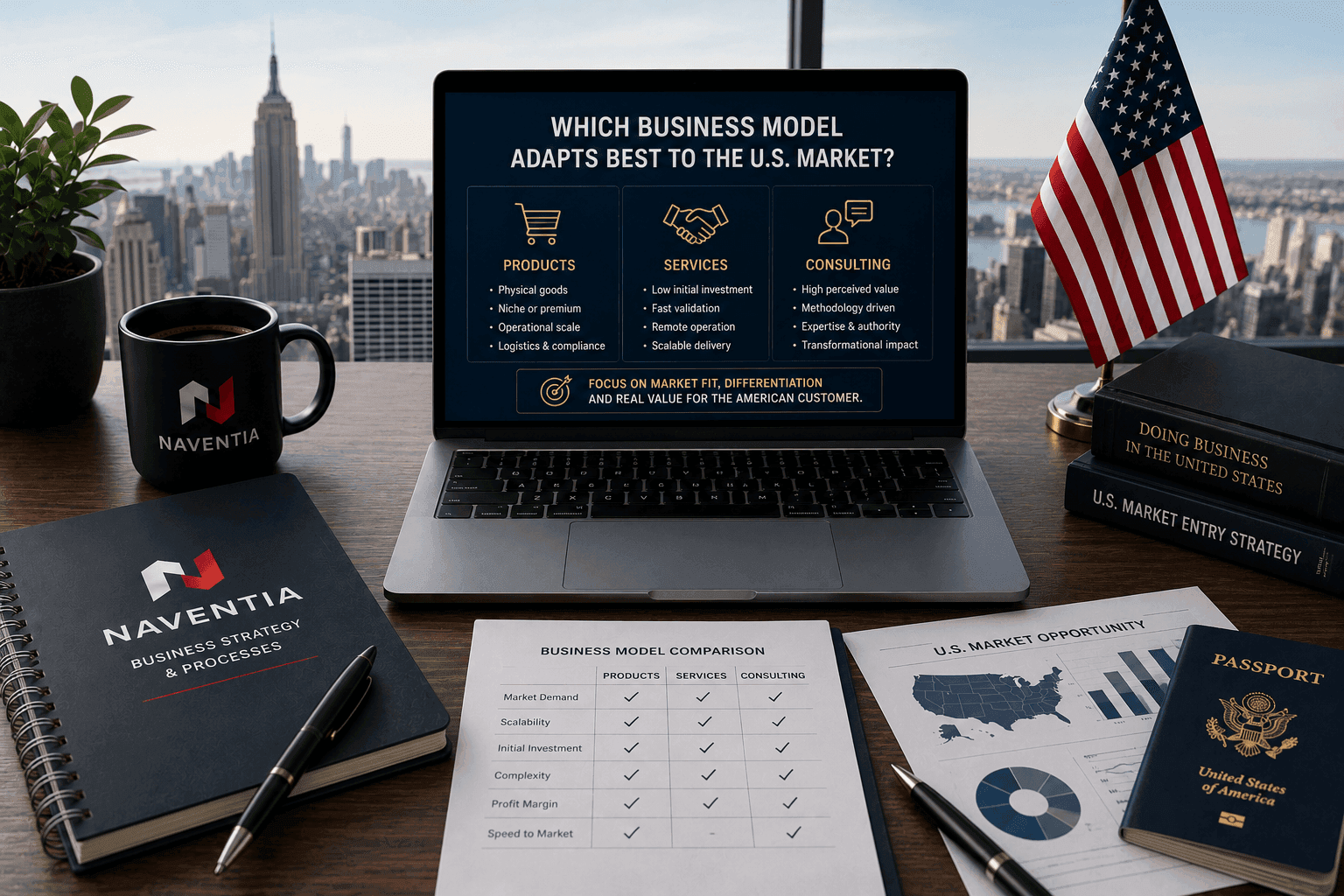
Então, qual modelo de negócio nos EUA adapta melhor?
A resposta profissional sempre depende da maturidade da empresa: o melhor modelo de negócio nos EUA muda conforme o estágio de internacionalização.
Mas olhando velocidade de entrada, validação comercial e risco operacional…
A ordem costuma ser:
1. Serviços especializados
Mais rápidos para validar.
Menor investimento inicial.
Maior flexibilidade.
2. Consultoria de nicho
Maior margem.
Maior autoridade.
Menor necessidade de estrutura pesada.
3. Produtos físicos
Maior potencial de escala.
Mas também maior complexidade operacional.
O que empresas inteligentes fazem antes de entrar nos EUA
Antes de abrir operação, empresas maduras validam:
- Existe demanda real?
- Meu posicionamento faz sentido?
- Meu ticket é competitivo?
- Meu modelo escala?
- Minha operação sustenta a entrega?
Porque internacionalização não começa com documentos.
Começa com market fit.
Conclusão
O melhor modelo de negócio nos EUA não é necessariamente o que mais funciona no Brasil.
É o modelo que melhor se adapta ao comportamento do cliente americano.
E essa diferença pode economizar anos de tentativa e erro.
Antes de abrir empresa.
Antes de contratar.
Antes de investir em marketing.
Faça uma pergunta:
Seu modelo de negócio realmente está pronto para competir nos Estados Unidos?
Essa resposta muda tudo.
A Naventia atua ao lado de empresas que querem expandir com estratégia, segurança e visão global.
Se esse é o seu momento, talvez seja hora de dar o próximo passo — com quem já entende o caminho.