
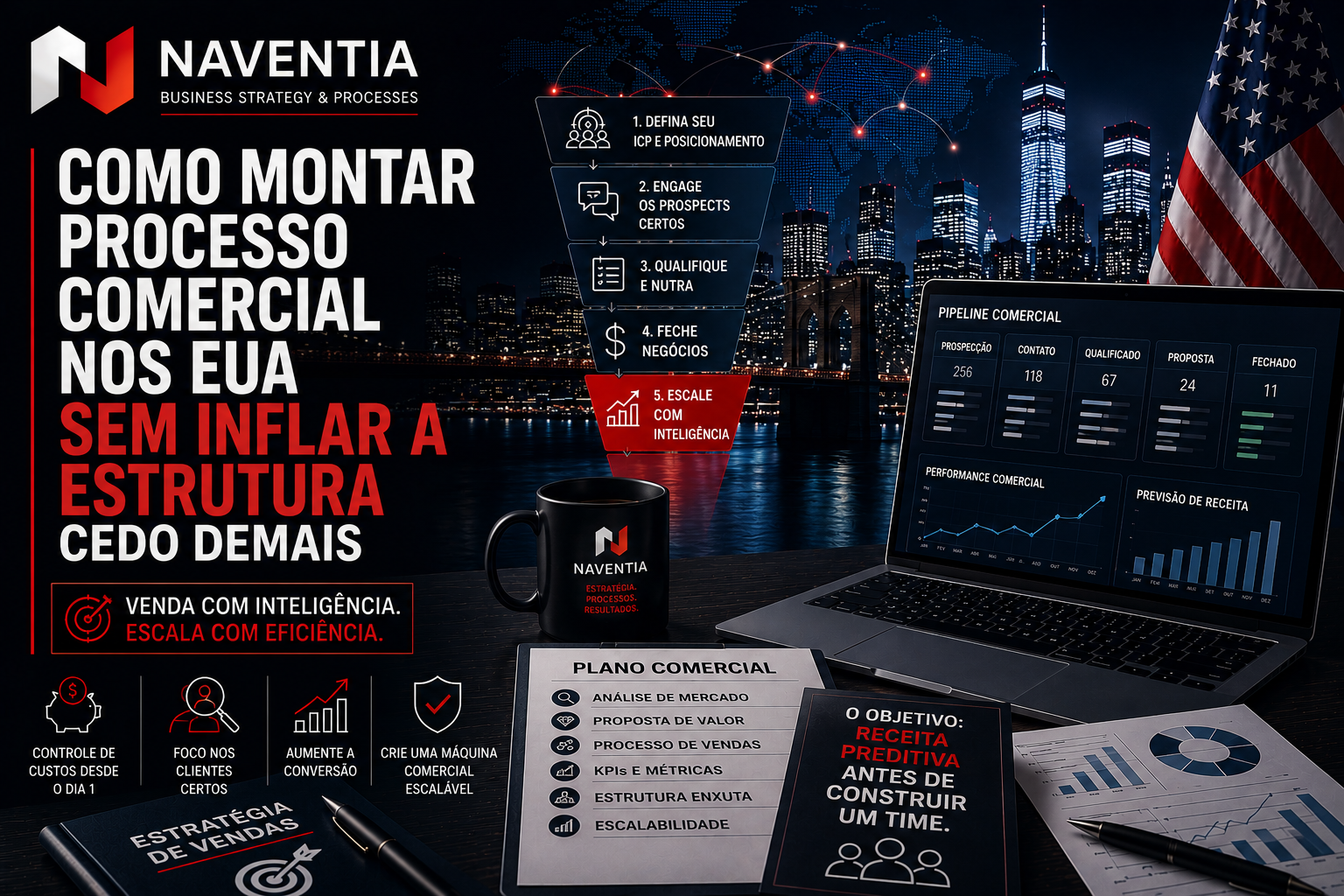
Montar um processo comercial nos EUA do jeito certo é o que separa empresas que escalam vendas com previsibilidade daquelas que queimam caixa contratando cedo demais.
Uma das cenas mais comuns entre empresários brasileiros que decidem entrar no mercado americano é previsível.
Nos primeiros meses da expansão, a empresa já:
- abre entidade nos Estados Unidos
- contrata equipe local
- investe em branding internacional
- implementa CRM
- compra ferramentas comerciais
- inicia campanhas de marketing
- e, em alguns casos, até aluga escritório
Tudo parece profissional.
O problema?
Ainda não existe previsibilidade comercial.
E quando a receita não acompanha a velocidade dos custos, a operação entra em colapso.
O que deveria ser crescimento vira pressão financeira.
Nos Estados Unidos, o erro não está em crescer.
O erro está em escalar custos antes de escalar demanda.
Antes mesmo de contratar ou montar uma operação local, o ideal é validar mercado.
Esse tema foi aprofundado em:
Como validar demanda nos EUA antes de abrir operação
https://naventia.com/como-validar-demanda-nos-eua/
Sem validação, a estrutura vira custo.
Não vantagem competitiva.
O erro que mais destrói caixa na entrada nos EUA
Empresários acostumados ao mercado brasileiro muitas vezes tentam replicar a mesma lógica operacional no exterior.
O raciocínio costuma ser simples:
“Se eu montar uma estrutura profissional desde o início, os clientes vão perceber valor.”
Nos Estados Unidos, isso raramente funciona.
Porque o mercado americano não compra estrutura.
Ele compra:
- clareza de posicionamento
- prova de resultado
- especialização
- previsibilidade de entrega
- eficiência comercial
Ou seja:
Antes de contratar pessoas…
Você precisa construir uma máquina comercial.
Esse erro aparece com frequência em empresas que entram sem planejamento.
Falamos mais sobre isso em:
Entrar nos EUA sem planejamento: os erros mais caros que empresários brasileiros cometem
https://naventia.com/erros-ao-entrar-nos-eua-os-erros-mais-caros-que-empresarios-brasileiros-cometem/
Processo comercial nos EUA não começa com contratação
Esse é um dos maiores equívocos de empresas em expansão internacional.
Muitos acreditam que vendas nos EUA começam contratando:
- Sales Representative
- Business Development Manager
- Account Executive
- SDR
Mas a realidade é diferente.
Contratar sem processo não cria vendas.
Só cria custo.
Antes de contratar, sua empresa precisa validar cinco pilares comerciais.
Definição de ICP (Ideal Customer Profile)
Quem realmente compra sua solução?
Seu cliente ideal está em:
- startups?
- middle market?
- enterprise?
- family businesses?
- indústrias?
Sem ICP claro, prospecção vira desperdício.
Mensagem comercial adaptada ao mercado americano
O discurso que funciona no Brasil nem sempre funciona nos Estados Unidos.
Empresas americanas compram:
- objetividade
- ROI
- previsibilidade
- especialização
Não compram apresentações genéricas.
Esse ponto foi aprofundado aqui:
Como adaptar proposta de valor para o cliente americano
https://naventia.com/como-adaptar-proposta-de-valor-para-o-cliente-americano/
Oferta com aderência comercial
Sua proposta precisa responder:
- qual problema você resolve?
- por que sua solução importa?
- qual resultado você entrega?
- por que escolher sua empresa?
Sem clareza, não existe pipeline saudável.
Ticket médio sustentável
Seu preço suporta:
- CAC internacional?
- ciclo comercial?
- follow-up?
- aquisição paga?
- expansão futura?
Muitas empresas entram com pricing inadequado e perdem margem logo no início.
Ciclo real de venda
Quanto tempo um cliente americano leva para comprar?
- 7 dias?
- 30 dias?
- 90 dias?
- 6 meses?
Sem essa previsibilidade, contratação vira aposta.
A metodologia que empresas mais inteligentes usam
Na Naventia, o processo comercial internacional costuma seguir três fases.
Fase 1: prova de mercado
Antes de qualquer contratação, testamos:
Posicionamento
Quem responde melhor?
Mensagem
Qual narrativa gera resposta?
Oferta
O que realmente converte?
Canal
O mercado responde melhor em:
- LinkedIn?
- Email outbound?
- Referral?
- Paid media?
- Partnerships?
O objetivo nessa fase não é escala.
O objetivo é previsibilidade.
Fase 2: processo comercial enxuto
Com o mercado validado, criamos a operação mínima viável.
CRM estruturado
Pipeline organizado.
Sem improviso.
Cadência comercial
Follow-ups previsíveis.
Mensagens consistentes.
Scripts comerciais
Processo replicável.
Indicadores comerciais
Acompanhamos KPIs como:
- meetings booked
- show rate
- proposal rate
- close rate
- sales cycle
Agora a empresa deixa de vender por esforço.
E começa a vender por processo.
Fase 3: escala inteligente
Só depois disso a contratação faz sentido.
E agora com clareza:
- quem contratar
- em qual função
- em qual estágio
- com qual meta
- com qual payback esperado
Nesse momento, o time não entra para descobrir o mercado.
Ele entra para escalar algo que já funciona.

O erro mais caro de todos
Segundo o guia de marketing e vendas da SBA, um processo comercial nos EUA bem definido é o que diferencia empresas que crescem com previsibilidade daquelas que só reagem ao mercado.
Muitos empresários ainda pensam:
“Vou contratar para vender.”
Empresas mais maduras pensam diferente:
“Vou validar para depois contratar.”
Essa simples mudança pode economizar dezenas — e em alguns casos centenas — de milhares de dólares no primeiro ano de operação.
Conclusão
Expandir para os Estados Unidos não significa montar uma estrutura grande.
Significa montar a estrutura certa.
A empresa que cresce no mercado americano não é a que contrata mais cedo.
É a que aprende mais rápido.
Antes de contratar.
Antes de montar escritório.
Antes de inflar folha de pagamento.
Faça uma pergunta:
Seu processo comercial já vende sem depender de estrutura pesada?
Se a resposta for não…
Sua empresa ainda não está pronta para escalar.
Fale com a Naventia
Na Naventia, ajudamos empresas brasileiras a estruturar processos comerciais internacionais com previsibilidade, eficiência e crescimento sustentável.
Se sua empresa está entrando no mercado americano, talvez o próximo passo não seja contratar.
Talvez seja validar.
A Naventia atua ao lado de empresas que querem expandir com estratégia, segurança e visão global.
Se esse é o seu momento, talvez seja hora de dar o próximo passo — com quem já entende o caminho.