
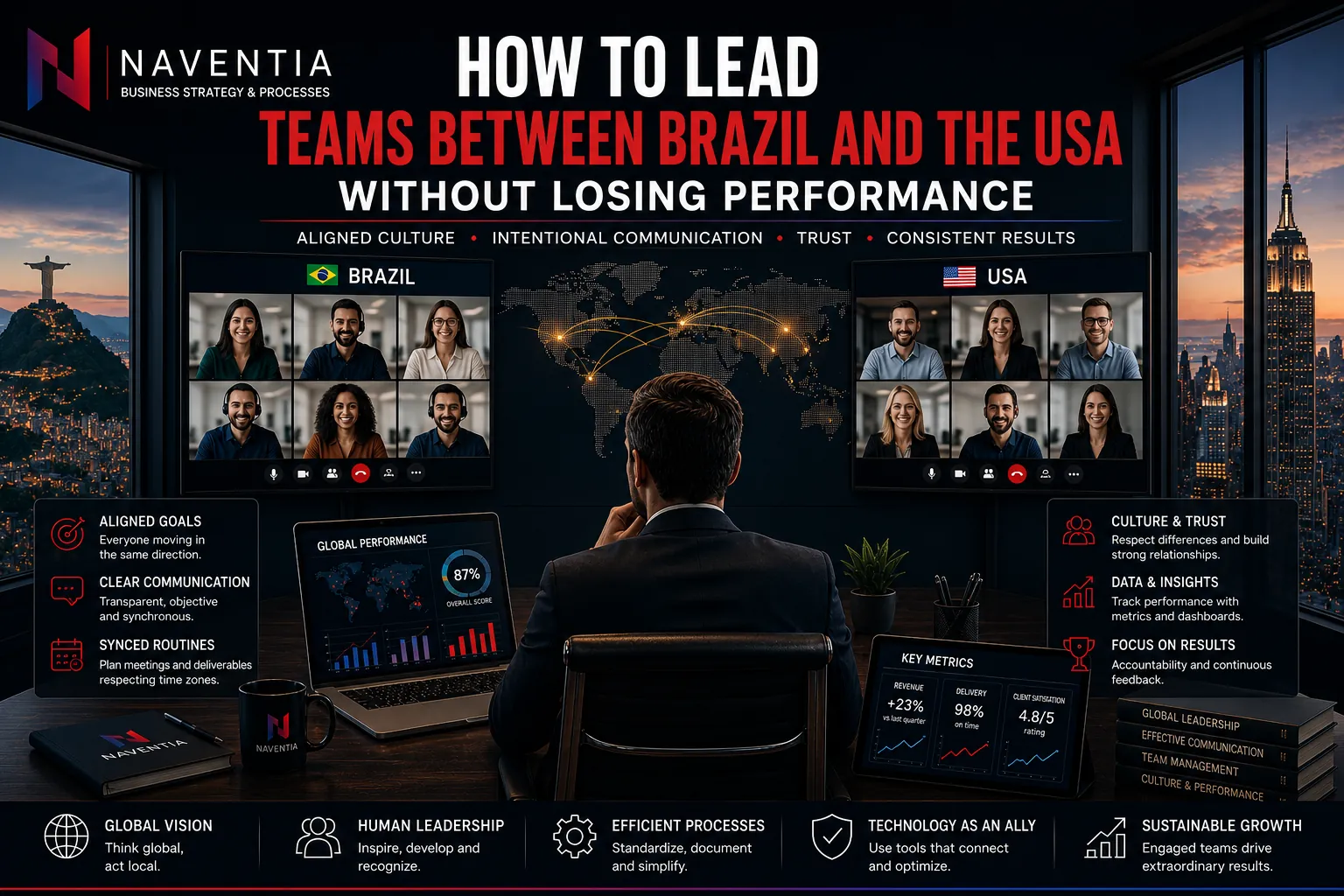
Why leadership becomes more complex after international expansion
Leading international teams requires clear expectations, disciplined communication, and leadership adapted to different business cultures.
Leading teams across Brazil and the US is one of the biggest challenges companies face after expanding internationally. Yet, it is rarely discussed during the planning stage.
When Brazilian companies prepare to enter the American market, conversations usually revolve around legal structures, taxation, sales strategies, and customer acquisition. Those topics deserve attention because they directly affect how quickly a new operation can become profitable.
What often goes unnoticed is that international expansion changes something much deeper than the market a company serves.
It changes the way people work together.
The challenge doesn't begin when the company incorporates in the United States. It begins when the first American employee joins the team, when decisions are made across time zones, and when different expectations about leadership, accountability, and communication start shaping everyday operations.
Many executives assume that language will be the biggest obstacle.
Experience suggests otherwise.
Translation software can solve communication barriers. Technology can solve scheduling conflicts. What technology cannot solve is the difference between how Brazilian and American professionals understand leadership.
That is why international expansion to the US. requires much more than opening a company abroad. It requires building an organization capable of operating across different business cultures.
The mistake of exporting your management style
One situation appears repeatedly among Brazilian companies entering the US market.
The business grows successfully in Brazil under a leadership model based on proximity. Founders approve major decisions, participate in important negotiations, maintain close relationships with customers, and stay deeply involved in day-to-day operations.
For years, this approach works remarkably well.
As the company expands internationally, the natural tendency is to replicate exactly the same management style.
That is where problems usually begin.
American professionals generally expect something different from leadership.
They expect clear objectives, measurable outcomes, defined responsibilities, and enough autonomy to deliver results without constant supervision.
Brazilian managers often interpret frequent meetings as support.
American professionals may interpret the very same behavior as micromanagement.
Neither perspective is wrong.
They simply reflect different business cultures.
This challenge is closely connected to what we discussed in The Founder Is the Biggest Bottleneck in International Expansion. Organizations that depend excessively on founders for operational decisions usually struggle much more when managing distributed teams across multiple countries.
Autonomy is not the absence of leadership
One of the biggest misconceptions about international management is believing that giving autonomy means losing control.
Successful global organizations prove the opposite.
High-performing international teams operate with greater autonomy because expectations are clearer, not because leadership is weaker.
Instead of supervising every activity, effective leaders focus on defining priorities, measuring results, and removing obstacles.
That shift changes everything.
Employees stop asking for permission to perform routine tasks.
Managers stop becoming operational bottlenecks.
Decision-making becomes faster.
Performance becomes more consistent.
Companies that successfully lead teams across Brazil and the US. understand that autonomy is not a cultural preference.
It is an operational advantage.
Communication is about expectations, not language
Many companies invest heavily in translating presentations, websites, proposals, and marketing materials.
All of that matters.
But communication problems during international expansion rarely originate from vocabulary.
They originate from expectations.
Brazilian business culture often values context, relationship-building, and diplomacy. Conversations tend to include background information before reaching a conclusion. Feedback is frequently softened to preserve relationships.
American corporate culture is generally more direct.
Constructive criticism is not necessarily viewed as personal.
Quick decisions are often interpreted as efficiency.
Objective communication signals confidence rather than distance.
When these two communication styles meet without preparation, misunderstandings become inevitable.
Brazilian professionals may perceive Americans as cold or impatient.
American professionals may perceive Brazilians as unclear or overly indirect.
Over time, these small misunderstandings reduce trust, slow execution, and create unnecessary friction within the organization.
These are some of the same challenges explored in Cultural Differences That Slow International Expansion, where organizational culture becomes as important as commercial strategy.
The process creates consistency.
Companies that consistently perform well across Brazil and the United States rarely rely on exceptional individuals.
They rely on exceptional systems.
Processes replace assumptions.
Responsibilities are documented.
Performance indicators are transparent.
Decision-making criteria are shared across teams.
As a result, the organization becomes less dependent on individual management styles and more dependent on operational discipline.
Trust is no longer built through constant supervision.
It is built through predictable execution.
This is one of the reasons why strategic planning for entering the US market should include governance, leadership development, and organizational design from the very beginning.
International expansion is not only a commercial project.
It is an organizational transformation.
For a broader governance reference, see the OECD Principles of Corporate Governance.

Culture becomes the company's operating system
As companies grow internationally, culture stops being a set of values displayed on a website.
It becomes the operating system that guides decisions.
It determines how meetings are conducted.
How conflicts are resolved.
How are priorities established.
How accountability is measured.
Most importantly, it allows people working thousands of miles apart to make decisions based on the same principles.
Companies that build this level of cultural consistency stop thinking of Brazil and the United States as separate operations.
They become one organization operating across multiple markets.
That transition requires intention.
It requires leadership.
It requires structure.
Most of all, it requires understanding that international expansion is not simply about selling in another country.
It is about building a company capable of performing consistently regardless of geography.
Conclusion
Many organizations spend months preparing legal documents, designing market strategies, and evaluating tax structures before expanding to the United States.
Those decisions are essential.
But companies that sustain long-term growth usually discover that their greatest competitive advantage has little to do with legal structures.
It comes from their ability to lead teams across Brazil and the US. while maintaining alignment, accountability, and performance.
International growth is ultimately built by people.
Organizations that learn how to connect different cultures under a shared vision do more than expand internationally.
They build businesses capable of competing anywhere in the world.
Naventia works alongside companies that want to expand with strategy, security, and a global vision.
If this is your moment, perhaps it's time to give it a try. next step — with those who already understand the way.