

Internationalize your company For the US in 2026, it's a strategic decision that requires more than just willpower—it requires method, timing, and the right structure.
Many people ask the wrong question.
The question is not: “Is it worth opening a business in the USA?”
The right question is: “"Does it make sense for my business model to internationalize to the US right now?"”
Because the United States remains one of the world's most important markets for expansion, capital, scale, and global positioning. In January 2026, the US Census Bureau recorded 532,319 business applications, high of 7,2% Regarding December 2025, a clear sign of strong business activity. Furthermore, the official program SelectUSA claims to have already facilitated more than US$ 390 billion in investments, supporting more than 265,000 jobs in the USA.
But here's the point that almost no one talks about honestly:
Going international to the US is not a glamorous decision. It's a decision about model, timing, and execution.
When is it worth it?
Expanding into the US tends to make sense when your company has already moved beyond the survival phase and needs a new growth driver.
In practice, this happens when you see at least one of these scenarios:
1. Your current market has begun to limit your scale.
You already sell well in Brazil, but you realize that your average order value, demand, margin, or international reputation could grow much more in a larger market.
2. Your service or product has international reach.
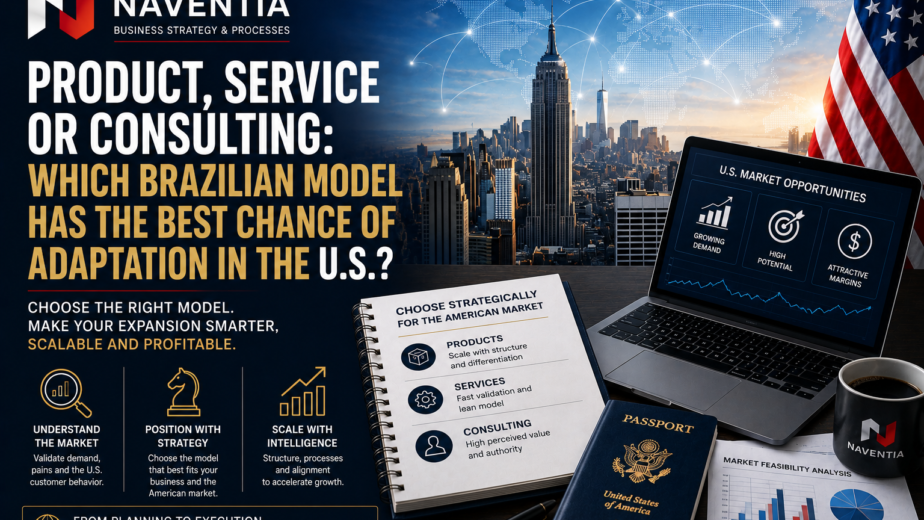
Not every Brazilian business is exportable. But many are. Especially B2B services, specialized consulting, technology, education, integrative health, engineering, niche operations, and knowledge-based businesses.
3. You want to dollarize part of the revenue.
Revenue in dollars isn't just about currency hedging. It's about value repositioning, access to a different type of customer, and potentially increasing margins.
4. You are seeking global credibility.
For some businesses, being in the US is not just about operations. It's also about branding, perceived robustness, and opening up new alliances.
5. There is a real commercial plan
Without it, internationalization becomes mere business tourism. The legal structure might come together quickly, but the business still lacks a market.
When it's not worth it
Now for the uncomfortable part.
For many companies, It's not worth entering the US yet..
And that's not failure. That's strategic clarity.
It's not worth it when:
1. The company does not yet have a predictable commercial process in its home market.
If you still rely on improvisation to sell, entering another country tends to amplify the chaos, not the growth.
2. The business lacks a clear value proposition.
In the US, a confusing message is costly. The market is competitive, fast-paced, and less tolerant of vague positioning.
3. The decision is being made impulsively.
“Many are leaving,” “it seems more professional,” “I want to have an American company”—all of that is emotional, not strategic.
4. The company wants to establish the structure before validating demand.
This is one of the most common mistakes. Formalizing doesn't replace traction.
5. The cash register does not support the entry cycle.
Internationalization requires substantial capital. Not only to open a business, but also to sustain testing, adaptation, marketing, sales, compliance, and learning.
The biggest mistake Brazilian business owners make.
The most common mistake is to confuse opening a company with internationalization strategy.
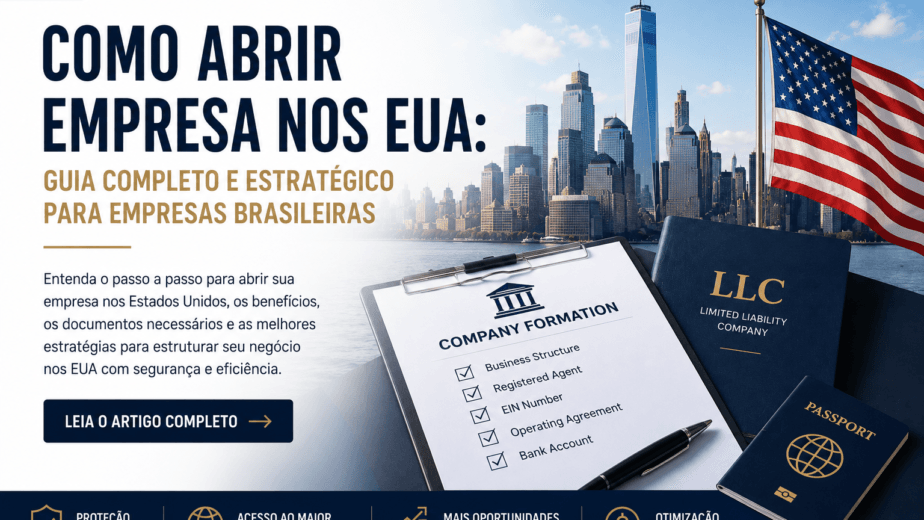
Opening an LLC, obtaining an EIN, or structuring an entity is only the visible layer. And even that layer requires care: the IRS makes it clear that an entity's tax classification can vary depending on its structure and choices, including via... Form 8832, ...and that LLCs may have different tax treatments for federal purposes. The IRS itself also warns of specific reporting obligations, such as... Form 5472 in certain cases with foreign participation.
I.e:
Having a company in the US doesn't mean you're ready to operate in the US.
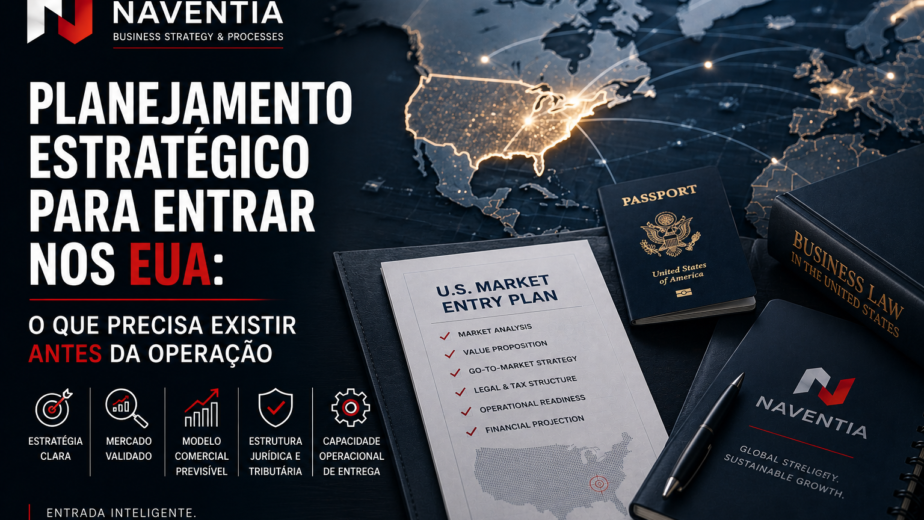
Serious internationalization involves, at a minimum:
entry thesis
priority niche
tailored offer
coherent corporate structure
tax understanding
business plan
operational process
market narrative
execution discipline
Without this, the company becomes a pretty but unproductive American business entity.
What does 2026 truly demand?
By 2026, entering the American market requires less dazzle and more precision.
The US remains attractive, yes. The business environment continues to be active, and the institutional framework for foreign investment remains robust. SelectUSA continues its operations precisely to facilitate productive investments in the country, which demonstrates the continued official interest in international capital.
But the market doesn't reward amateurism.
He rewards companies that enter with:
clear focus
objective offer
adaptability
response speed
The right structure for the right stage.
The 5 questions you need to answer before deciding.
Before saying “let’s go to the USA”, answer with brutal honesty:
1. What exactly are we looking for there?
Revenue? Positioning? Investor? Asset protection? Business expansion?
2. Does our product or service solve a real pain point for the American customer?
Not for the Brazilian customer living in the US. For the real market.
3. Do we have the resources and stamina to learn?
Because the entry curve is almost never linear.
4. Have we already validated the demand, or are we just making assumptions?
5. Can our current operation grow without collapsing?
If these answers are weak, perhaps the best course of action is not to open now.
Perhaps it's about preparing now so you can enter the market correctly later.
And that, strategically, might be the smartest decision.

So, is it worth it?
Yes — for the right company, at the right time, with the right structure and a real execution plan.
No — not for those seeking status, in a hurry, or looking for shortcuts.
Expanding internationally to the US by 2026 could be one of the most powerful decisions in a Brazilian company's trajectory.
But only when this expansion ceases to be a generic dream and becomes a project built with method.
Because in the end, the question was never "is it worth going to the USA?"“
The question has always been:
“"Is my company ready to transform its international presence into real growth?"”
If the answer is yes, the expansion could be a game-changer.
If the answer is no, the best investment might be to build the preparedness before the structure.
To see how this decision translates into practice, see the Case study: When it made sense to start a business in the US — and when it didn't..
Naventia works alongside companies that want to expand with strategy, security, and a global vision.
If this is your moment, perhaps it's time to give it a try. next step — with those who already understand the way.