


Tax on remittances abroad can involve two distinct taxes: IOF, levied on the foreign exchange transaction, and IRRF, which is levied on the economic nature of the amount sent.
Before finalizing the currency exchange, confirm the purpose of the remittance, the recipient's tax residence, and the documentation proving the transaction. It's also worth checking if there's an obligation to declare the transfer in the DIRF (Brazilian Income Tax Return), DIRPF (Brazilian Individual Income Tax Return), or, in certain cases, the CBE (Brazilian Central Bank's Foreign Exchange Transactions).
In summary:
- The withholding tax rate varies between 15% and 25%, depending on the tax jurisdiction of the beneficiary, as well as the nature of the payment.
- The applicable IOF (Tax on Financial Transactions) ranges from 1.10% to 3.5%, depending on the declared purpose of the remittance, and may include an additional percentage for specific credit operations.
- Remittances for studies, research, medical expenses, or personal needs, with supporting documentation, may be fully exempt or have reduced rates.
- Withholding income tax (IRRF) is the responsibility of the paying source, which must collect it by the date of the taxable event, in addition to declaring it in the DIRF (Annual Income Tax Return), and the remittance must be reported in the DIRPF (Individual Income Tax Return) or CBE (Brazilian Business Registration Certificate) if applicable.
- Proper classification of the transaction and adequate documentation prevent tax problems, especially in frequent transactions or international corporate structures.
Index
- Tax on remittances abroad: which taxes apply (IRRF and IOF)
- Tax on remittances abroad: when it is exempt or has a reduced rate.
- How to calculate withholding tax and who is responsible for collecting it.
- Which declarations accompany the remittance: DIRF, DIRPF and CBE
- Checklist for international money transfer taxes before sending money.
- Naventia's perspective on tax risks in international remittances.
- How Naventia helps Brazilian companies structure remittances securely.
- Sources
- Frequently Asked Questions
Tax on remittances abroad: which taxes apply (IRRF and IOF)
Confusing the two taxes is the most common mistake among those who send money abroad.
O Withholding Income Tax (Withholding Income Tax) applies to the economic content of the payment: a service rendered, a profit distributed, a loan repaid. In contrast, IOF (Tax on Financial Transactions) applies to the foreign exchange transaction itself, regardless of what is being paid.
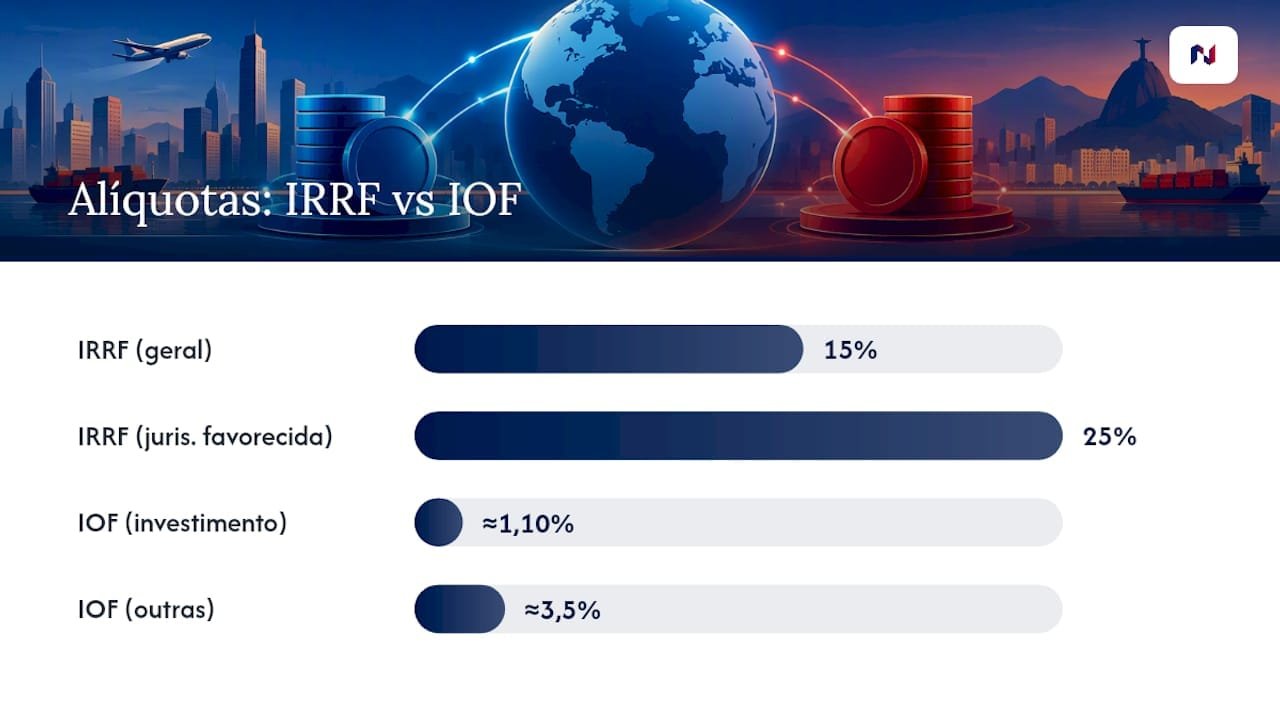
The general withholding tax rate on remittances to non-residents is 15%, but it increases to 25% when the beneficiary resides in a tax-favorable jurisdiction, according to guidance from... Attorney General's Office of the National Treasury.
A common example: payment for training services provided by a foreign company, a situation that... Consultation Solution No. 6.007/2022 It specifically addresses this, confirming the withholding according to the technical nature of the service and the jurisdiction of the provider.
The IOF tax, in turn, varies according to the declared purpose of the remittance:
- approximately 1,10% for transfers for investment purposes;
- approximately 3.5% for most other overseas remittances;
- an additional percentage for specific credit operations, when applicable.
These percentages are fixed in decree that amends the IOF regulations.
Pro tip: The exchange rate displayed by the bank on the screen reveals nothing about withholding tax. These are separate calculations, applied to different bases, and the final amount of the remittance can vary considerably depending on which tax has the greatest impact on your situation.
Tax on remittances abroad: when it is exempt or has a reduced rate.
Not all remittances are subject to the full tax rate.
The legislation provides for exemptions and reductions for specific purposes, as long as the documentation proves the use of the money.
- Remittances for funding studies, scientific research, or cultural activities are usually exempt from withholding income tax.,
- in accordance with current legislation.
- Medical and hospital expenses abroad are also treated as tax-exempt in most cases.
- For coverage of personal travel expenses,
- Law No. 14,537/2023 established a tiered tax rate system between 6% and 9% throughout the period from 2023 to 2027, always respecting monetary limits defined by law.
Documents such as school registration,
A medical report, service provider invoice, and beneficiary's tax residency certificate are frequently required by the bank before releasing the foreign exchange under these conditions.
Keeping these documents avoids future questioning, both from the financial institution and from regulatory authorities.
How to calculate withholding tax and who is responsible for collecting it.
The responsibility for withholding and collecting the IRRF (Brazilian income tax withheld at source) lies with the paying source, not with the recipient of the funds abroad.
The collection must occur on the date of the event that generates the tax liability, that is, at the time of payment, credit, delivery or remittance of the amount.
- Identify the nature of the payment. (service, dividend, interest,
- (rent) to find out which tax rule applies.
- Verify the tax jurisdiction of the beneficiary.15% is the general rule, 25% if there is preferential taxation in the destination country.
- Calculate the tax base. before applying the tax rate,
- considering whether there is a gross-up clause in the contract.
- Collect the tax by the date the tax liability arises., thus avoiding a late payment fee.
The distribution of profits and dividends has become more closely monitored since the Internal Revenue Service reinforced its guidelines on the withholding of income tax.,
highlighting the responsibility of the paying legal entity and the need for record-keeping via EFD-Reinf and DCTFWeb.
Pro tip: If the contract stipulates that the Brazilian company assumes the withholding tax (gross-up), the amount actually paid increases. Simulate both scenarios before signing any international contract involving recurring payments.
Which declarations accompany the remittance: DIRF, DIRPF and CBE
Sending the money and collecting the tax does not fulfill the obligation.
The Brazilian Federal Revenue Service requires that remittances to residents abroad be included in the DIRF (Annual Income Tax Return) submitted by the paying source., even when there was no retention.
- DIRF: generally mandatory for those who paid, credited, or remitted funds to non-residents,
- Regardless of whether retention has occurred.
- DIRPFIndividuals must report remittances on their annual tax return, especially when the amounts exceed certain limits set by the tax authorities.
- The official program is available at PGD DIRPF.
- CBERequired by the Central Bank for taxpayers with significant assets held abroad, with the annual limit equivalent to US$$ 1 million as of December 31, as defined by... international capital regulations.
Companies that send funds to establish or capitalize structures abroad often run into problems with the CBE (Brazilian Central Bank's Foreign Exchange Transactions): the remittance amount may not generate withholding income tax, but it can still constitute an asset that needs to be declared to the Central Bank every year.
Checklist for international money transfer taxes before sending money.
Reducing the risk of misclassification of the remittance begins before the exchange is closed, not after.
- Create a transaction record including the sender, beneficiary, purpose, nature of the value, and who is responsible for the tax.
- Gather a contract, invoice, or receipt that proves the purpose declared to the bank.
- Obtain a tax residency certificate for the beneficiary when the tax rate depends on the jurisdiction.
- For health or education remittances, please have a medical report or proof of enrollment on hand.
- Keep all documentation for at least five years, including withholding tax receipts and corporate resolutions.
Pro tip: Banks and fintech companies request similar documentation, but the rigor of the analysis varies.
Smaller currency exchange brokers tend to require less documentation upon entry, which does not eliminate their tax liability if the classification is incorrect.
Naventia's perspective on tax risks in international remittances.

The most common mistake among Brazilian companies that internationalize is not the wrong tax rate, but the lack of documentation to support the chosen classification. Many remittances of dividends, royalties, or intercompany payments are treated as "simple transfers," without a formal contract behind them, which exposes the company in a subsequent audit.
Recent changes regarding profits and dividends make this precaution even more urgent for those operating with a corporate structure in the US linked to Brazil.
Before any recurring remittance, it's worth reviewing the intercompany contract, confirming coordination with the responsible accountant, and drawing up a compliance plan that can withstand an audit.
— Flavio Inacarato
How Naventia helps Brazilian companies structure remittances securely.
Settling the tax on remittances abroad before finalizing the currency exchange avoids rework.
Naventia is the alternative to resolving this issue on your own using internet forums: while most Brazilian companies only discover the incorrect tax rate after the bank has already withheld the tax, Naventia structures the contract and tax flow before the first real leaves the country.

The work combines tax planning Internationally, corporate structuring in the United States and coordination with Brazilian accounting firms ensure that the classification of each remittance (service, dividend, contribution) is already defined in the contract before the foreign exchange transaction.
This avoids two common headaches: the improper withholding of income tax due to misclassification and the unexpected gross-up that appears when the contract doesn't define who pays for what.
If your company frequently sends or receives international funds, or plans to establish a US office in 2026,
Discover Naventia's consulting services and schedule a consultation before closing your next international deal.
Sources
- Withholding Income Tax (IRRF) Source — Attorney General's Office of the National Treasury
- D12499 — decree that amends IOF regulations
- Questions and answers DIRF — Federal Revenue Service (DIRF 2025)
Frequently Asked Questions
What is the tax on remittances abroad?
Generally, two taxes apply: the IOF (Tax on Financial Transactions),
Regarding the foreign exchange transaction, and the withholding tax (IRRF) is based on the economic nature of the amount sent (service, dividend, interest).
The withholding tax rate varies between 15% and 25% depending on the beneficiary's tax jurisdiction.
What are the fees for international money transfers?
The IOF (Tax on Financial Transactions) varies according to the purpose: 1.10% for investment and 3.5% for most other remittances, according to the decree that regulates the IOF.
For personal expenses, the withholding income tax rate follows the scale between 6% and 9% stipulated in Law No. 14,537/2023.
How is the receipt of remittances from abroad taxed?
The tax treatment depends on the nature of the amount received and who the beneficiary is in Brazil.
Individuals must report the amount on their income tax return (DIRPF), while the paying source abroad follows the rules of its country of origin, not Brazilian law.
Is there a tax on shipping invoices?
The shipping note itself does not generate tax, but it serves as proof of the purpose declared to the bank.
The nature of the transaction described in the invoice (service, investment, donation) determines whether withholding income tax (IRRF) applies and which IOF rate applies.
How much does it cost to hire a consulting firm for tax planning on remittances?
Naventia's consulting fees are determined according to the project scope, including contract review, corporate structuring, and international tax planning.
Details for each service are available on the Naventia services page.