

For a broader governance perspective, see the OECD Principles of Corporate Governance.
Choosing between an LLC, a Corporation, or a Holding Company is one of the most important decisions entrepreneurs make when expanding into the United States.
Yet most business owners start with the wrong question.
Instead of evaluating their company’s stage, long-term objectives, and tax implications, they usually ask:
“Which structure is the best?”
The reality is that there is no universally best structure.
There is only the structure that makes the most sense for a specific business, at a specific stage, with specific goals.
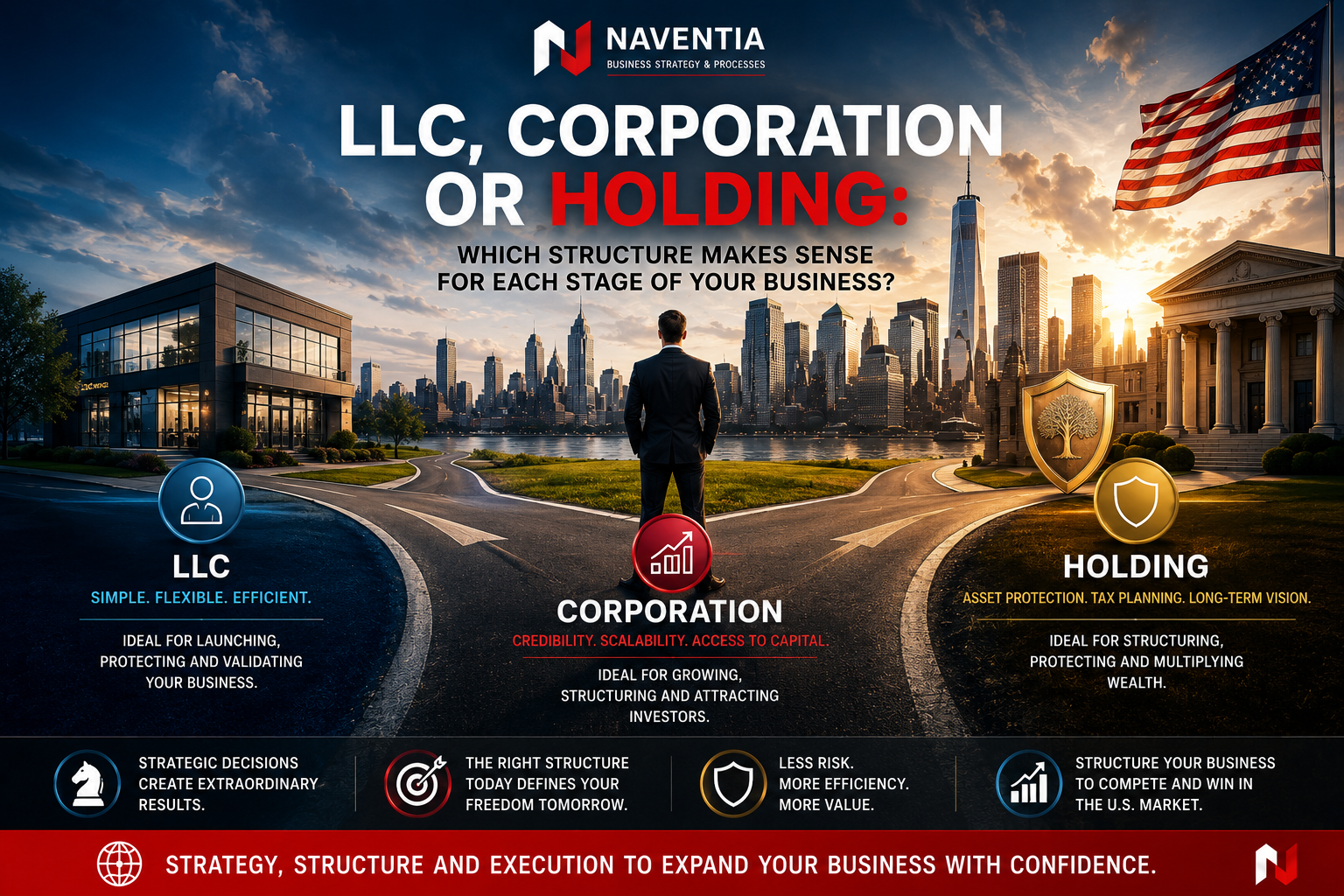
An LLC may be ideal for market validation and lean operations.
A Corporation may be better suited for attracting investors and scaling rapidly.
A Holding Company may become essential for asset protection, succession planning, and international wealth management.
The problem is that many entrepreneurs choose a structure based solely on speed, cost, or generic advice found online.
International business structures should be designed to support growth, reduce risk, and create long-term efficiency.
Before opening a company in the United States, it is critical to understand the role that structure will play within the broader strategy of the business.
Why the Business Structure Matters
Many entrepreneurs view company formation as a simple administrative step.
In reality, the structure you choose affects:
- international taxation
- asset protection
- corporate governance
- investor relations
- succession planning
- profit distributions
- company valuation
- future expansion opportunities
In other words, your choice of structure influences not only your current operations but also your future growth potential.
A decision made today can either create competitive advantages or become a limitation years from now.
When an LLC Makes Sense
The Limited Liability Company (LLC) is one of the most popular structures among foreign entrepreneurs entering the U.S. market.
Its popularity comes from its flexibility and simplicity.
In many situations, an LLC is an excellent choice for companies in the early stages of international expansion.
It often makes sense when the goal is to:
- validate market demand
- establish an initial U.S. presence
- provide professional services
- operate with a lean structure
- test a business model before making larger investments
Some of the most attractive benefits include:
- operational flexibility
- relatively simple administration
- limited liability protection
- lower maintenance costs
However, there is an important point that many entrepreneurs overlook.
An LLC should not be chosen simply because it is easy to establish.
The way an LLC is treated for tax purposes can create significant implications for business owners living outside the United States.
This has become even more relevant following recent international tax developments affecting foreign-owned LLCs.
That is why an LLC should always be evaluated within a broader international tax and business planning strategy.
When a Corporation Is the Better Choice
A Corporation is often the preferred structure for companies with ambitious growth plans.
Particularly when the objective includes:
- raising capital
- attracting investors
- issuing shares
- building stronger governance
- preparing for rapid expansion
Investors in the United States are generally more comfortable with traditional corporate structures.
This familiarity makes it easier to handle:
- venture capital investments
- equity ownership
- stock option programs
- mergers and acquisitions
- future exits
Technology companies, startups, and businesses with significant growth potential often choose a Corporation because it creates a more scalable framework.
Although corporations typically involve more formal governance requirements than LLCs, they provide strategic advantages for businesses focused on long-term expansion.
The key question is not:
“Which structure is cheaper?”
The better question is:
“Which structure supports the company I want to build?”
When a Holding Company Makes Sense
A Holding Company is frequently misunderstood.
Unlike an LLC or Corporation that actively conducts business operations, a Holding Company primarily exists to own assets, investments, or interests in other companies.
A Holding structure can make sense when entrepreneurs are focused on:
- asset protection
- succession planning
- wealth preservation
- ownership organization
- managing multiple businesses
- centralizing strategic control
Business owners with significant assets often use holding structures to separate operational risk from personal or family wealth.
This separation can create greater stability and long-term protection.
Holding Companies are also widely used to facilitate generational wealth transfer and simplify succession planning.
For growing business groups, a Holding Company can serve as the central entity that oversees multiple operating companies within a single corporate architecture.
The Most Common Mistake: Following Trends
One of the most common mistakes entrepreneurs make is choosing a structure because it is currently popular.
Over the last several years, the LLC became almost synonymous with international expansion.
Many business owners started believing that:
LLC = Best Option
But business structuring is far more nuanced than that.
The ideal structure depends on factors such as:
- company maturity
- tax residency of owners
- growth objectives
- investor expectations
- tax strategy
- asset protection needs
Different companies require different structures.
Copying another company’s setup can create serious problems in the future.
Which Structure Makes Sense at Each Stage of Business Growth?
Although every situation requires individual analysis, there are common patterns.
Stage 1: Market Validation
Objectives:
- test demand
- acquire first customers
- validate positioning
Typical structure:
LLC
Why?
Because flexibility and simplicity are often more important than complex governance.
Stage 2: Structured Growth
Objectives:
- increase revenue
- build teams
- create processes
- expand sales
Typical structure:
LLC or Corporation
The decision depends on ownership goals and future growth plans.
Stage 3: Scale and Capital Raising
Objectives:
- attract investors
- accelerate growth
- establish governance
Typical structure:
Corporation
At this stage, scalability and investor readiness become critical.
Stage 4: Wealth Preservation and Succession
Objectives:
- protect assets
- organize ownership
- preserve family wealth
- plan succession
Typical structure:
Holding Company
The Holding becomes a strategic component of the overall business architecture.
For a deeper look at how holding structures protect international wealth, see international asset holding in the U.S.. Prefere ler em português? Confira LLC, Corporation ou Holding: qual estrutura faz sentido para cada estágio da empresa.

Structure Is Not Bureaucracy. It Is Strategy.
Sophisticated companies understand that choosing a business structure is not simply a legal decision.
It directly impacts:
- growth
- taxation
- asset protection
- fundraising
- valuation
- long-term flexibility
That is why the conversation should not start with:
“Which entity should I open?”
It should start with:
“What does my structure need to accomplish over the next five or ten years?”
This perspective helps avoid mistakes that often become visible only after the company has grown.
And restructuring later is almost always more expensive than planning correctly from the beginning.
Final Thoughts
LLCs, Corporations, and Holding Companies are not competing options.
They are different tools designed for different objectives.
The best structure is not the fastest to open.
It is not the cheapest.
And it is not necessarily the most popular.
The best structure is the one that supports your current stage while preparing your business for its next phase of growth.
Before making a decision, ask yourself one simple question:
Is your structure designed for the company you have today—or for the company you want to build tomorrow?
The answer will determine much more than your legal entity.
It will influence your ability to grow with efficiency, protection, and long-term vision.