
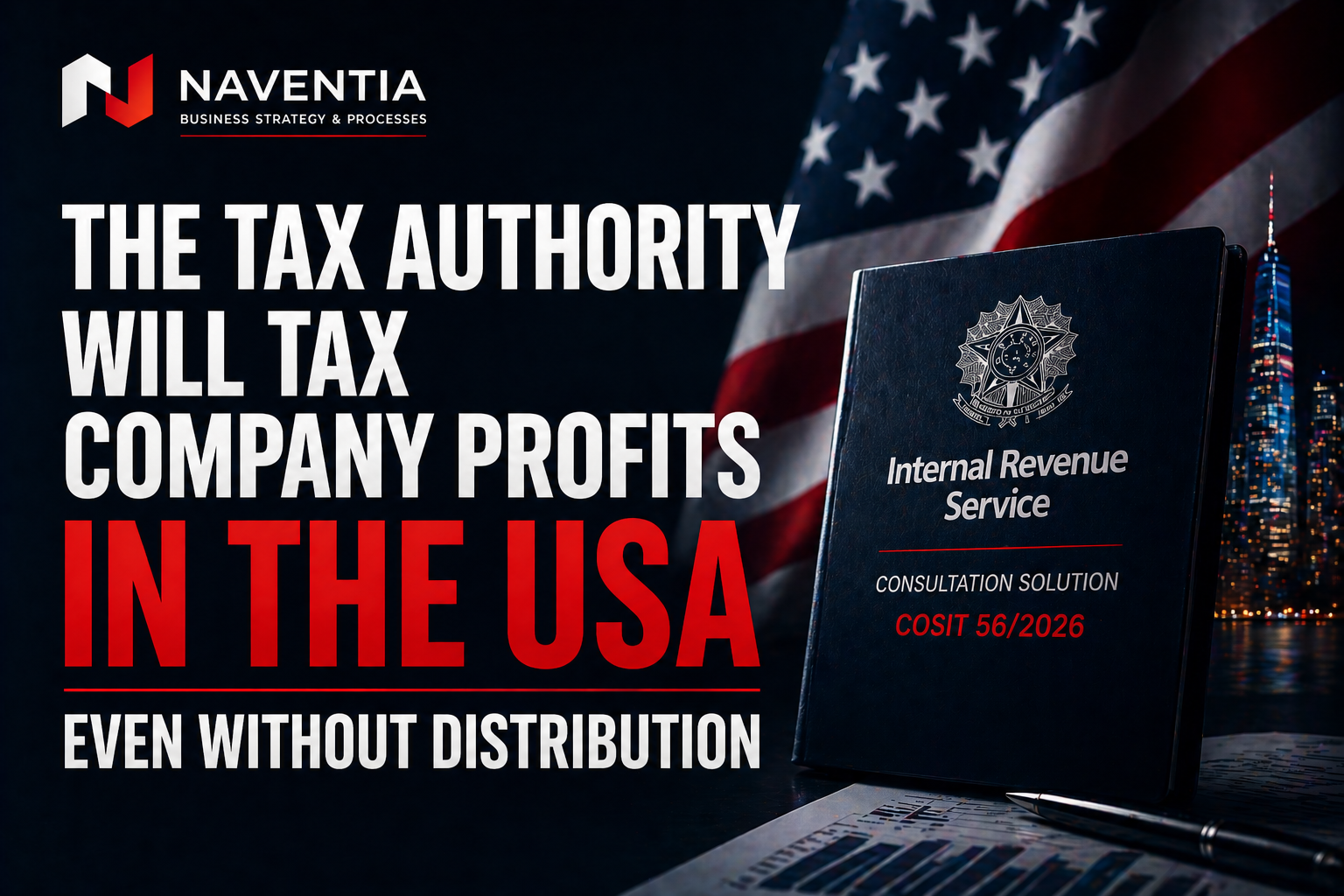
U.S. LLC taxation for Brazilians has changed dramatically after COSIT 56/2026.
For years, thousands of Brazilian entrepreneurs opened companies in the United States believing they were making a smart strategic move.
The logic seemed simple:
- earn in dollars
- reduce taxes
- operate globally
- protect assets
But the reality has changed.
And it changed quietly — exactly how the most impactful tax changes usually happen.
For years, thousands of Brazilian entrepreneurs opened companies in the United States believing they were making a smart strategic move.
The logic seemed simple:
- earn in dollars
- reduce taxes
- operate globally
- protect assets
And for a long time, that structure appeared to work.
But the reality has changed.
And it changed quietly — just like the most impactful tax changes usually do.
Brazil’s Federal Revenue Service issued COSIT 56/2026 and, in practice, created a completely new scenario for Brazilian residents who own LLCs in the United States.
This is not a technical detail.
It is a structural shift.
The real problem — and why most people are explaining it wrong
Most discussions about COSIT 56 are missing the central issue.
The problem is not the ruling itself.
The real problem is this:
Brazil may now tax profits generated by your U.S. LLC even if the money never leaves the company.
That is the turning point.
And it changes the entire logic behind many international structures.
What is happening in practice
If your LLC is treated as a “pass-through entity” in the United States — which is extremely common — and you are a Brazilian tax resident, Brazil’s tax authority may interpret the company’s profits as already belonging to you personally.
That means:
- the profits may be taxable in Brazil
- even without dividend distributions
- even without transferring money to your personal account
- even if all profits remain inside the company
The result?
- annual taxation in Brazil
- reduced reinvestment capacity
- pressure on cash flow
- increased international tax exposure
This breaks the logic that supported many LLC structures over the last decade.
Why this is such a serious issue
Let’s be direct.
Most Brazilian entrepreneurs who opened LLCs made three strategic mistakes.
1. They confused simplicity with efficiency
Opening an LLC is easy.
Building an international structure correctly is not.
Many entrepreneurs optimized for speed instead of architecture.
And that difference now matters.
2. They ignored tax residency
The company may be in the United States.
But the owner is still a Brazilian tax resident.
And that changes everything.
Cross-border structures do not operate in isolation.
Tax residency always matters.
3. They never built tax governance
For many entrepreneurs, there was no real planning.
Only operation.
No international tax architecture.
No profit distribution strategy.
No long-term governance model.
What once looked efficient…
Now becomes vulnerable.
The real-world impact
Imagine a company generating $300,000 per year through a U.S. LLC.
Before COSIT 56:
- taxes in Brazil were often triggered only when profits were distributed
Now:
- profits may become taxable annually in Brazil
- even if all earnings are reinvested
- even if no money is withdrawn personally
This directly impacts:
- cash flow
- reinvestment capacity
- operational scalability
- long-term growth
This is how companies become financially pressured without immediately understanding why.
The most expensive mistake now
The biggest mistake is maintaining the same structure while hoping:
“Nothing will happen.”
That is not strategy.
That is exposure.
International tax risk rarely explodes overnight.
It accumulates quietly.
Then arrives with:
- penalties
- interest
- audits
- tax assessments
And by that point, restructuring becomes much more expensive.
The solution: where real strategy begins
There is no universal solution.
But there are structural paths — and this is where most entrepreneurs make mistakes.
Stop thinking about “opening a company”
Instead, start thinking about:
- corporate architecture
- tax flow
- jurisdiction
- tax residency
- international governance
This is no longer about incorporation.
It is about international structure design.
Rethinking how profits are treated
Most entrepreneurs now face three strategic paths.
Option 1: Converting into a Corporation (C-Corp)
In this structure, the company stops being treated as a transparent entity.
That creates:
- clearer separation between shareholder and company
- lower risk of automatic taxation in Brazil
- more predictable governance
Option 2: LLC tax election (“check-the-box”)
The LLC remains operationally the same but elects corporate taxation in the U.S.
This can:
- preserve operational flexibility
- reduce exposure under Brazilian interpretation
- improve structural efficiency
Option 3: Full international restructuring
For more sophisticated cases, restructuring may involve:
- holding companies
- international tax planning
- ownership redesign
- residency planning
- cross-border governance structures
This is no longer a simple adjustment.
It becomes long-term international strategy.
The point nobody talks about
COSIT 56 is not the real problem.
It is only the symptom.
The real issue is that many entrepreneurs internationalized their company…
But never internationalized their strategy.
U.S. LLC taxation for Brazilians: official sources
For current guidance, consult the official IRS resources and the Naventia services for international structures.
How to assess U.S. LLC taxation for Brazilians before taking action
U.S. LLC taxation for Brazilians should be assessed as a business, cash-flow and governance question—not as a generic incorporation decision. The first step is to map where the owner is tax resident, how the LLC is classified in the United States, how profits are retained or distributed, and which people actually make the strategic decisions. Those facts determine the risk profile; the name of the entity alone does not.
A practical review should also separate operating income from capital contributions, loans, reimbursements and shareholder withdrawals. When records treat all cash movements in the same way, it becomes much harder to explain the economic purpose of each transaction or to model the tax effect of a future distribution. Clean bookkeeping in both jurisdictions is therefore part of the structure, not merely an administrative task.
A decision framework for U.S. LLC taxation for Brazilians
- confirm the owner’s current tax residency and any planned change of residency;
- document the LLC’s ownership, management and profit-allocation rules;
- compare the U.S. classification with the Brazilian treatment of the same income;
- prepare cash-flow scenarios for retained profits, distributions and reinvestment; and
- obtain coordinated advice from qualified U.S. and Brazilian professionals before implementing a change.
This analysis does not mean that every U.S. LLC must be converted or replaced. It means that U.S. LLC taxation for Brazilians can no longer be managed by assumptions made at the time of incorporation. A structure that was commercially appropriate two years ago may require different governance, documentation or tax treatment today.
The goal is not to chase a universal “lowest-tax” answer. The goal is to build a defensible structure aligned with the company’s operating model, the entrepreneur’s residency and the long-term plan for reinvestment, financing and succession.
U.S. LLC taxation for Brazilians should be reviewed before any new investment, distribution or financing decision. A structured review of U.S. LLC taxation for Brazilians makes it possible to compare cash-flow effects, governance requirements and documentation responsibilities. For owners who remain Brazilian tax residents, U.S. LLC taxation for Brazilians is a continuing compliance issue, not a one-time incorporation choice. Sound decisions on U.S. LLC taxation for Brazilians require coordinated analysis of both jurisdictions. Addressing U.S. LLC taxation for Brazilians early can preserve flexibility while the business grows.

Global businesses require global thinking
If you want to operate internationally, you need to think internationally.
That means:
- compliance
- governance
- tax structure
- long-term planning
- operational architecture
Companies that ignore those elements will eventually pay the price.
Literally.
Final thoughts
The question is no longer:
“Is it worth having an LLC in the United States?”
The real question now is:
Is your structure prepared to survive the new international tax environment?
That is the question that matters.
Talk to Naventia
If you own a U.S. LLC while living in Brazil, now is the time to review your structure.
At Naventia, we help entrepreneurs redesign international operations with legal intelligence, tax efficiency, and long-term protection.
A Naventia atua ao lado de empresas que querem expandir com estratégia, segurança e visão global.
Se esse é o seu momento, talvez seja hora de dar o próximo passo — com quem já entende o caminho.