

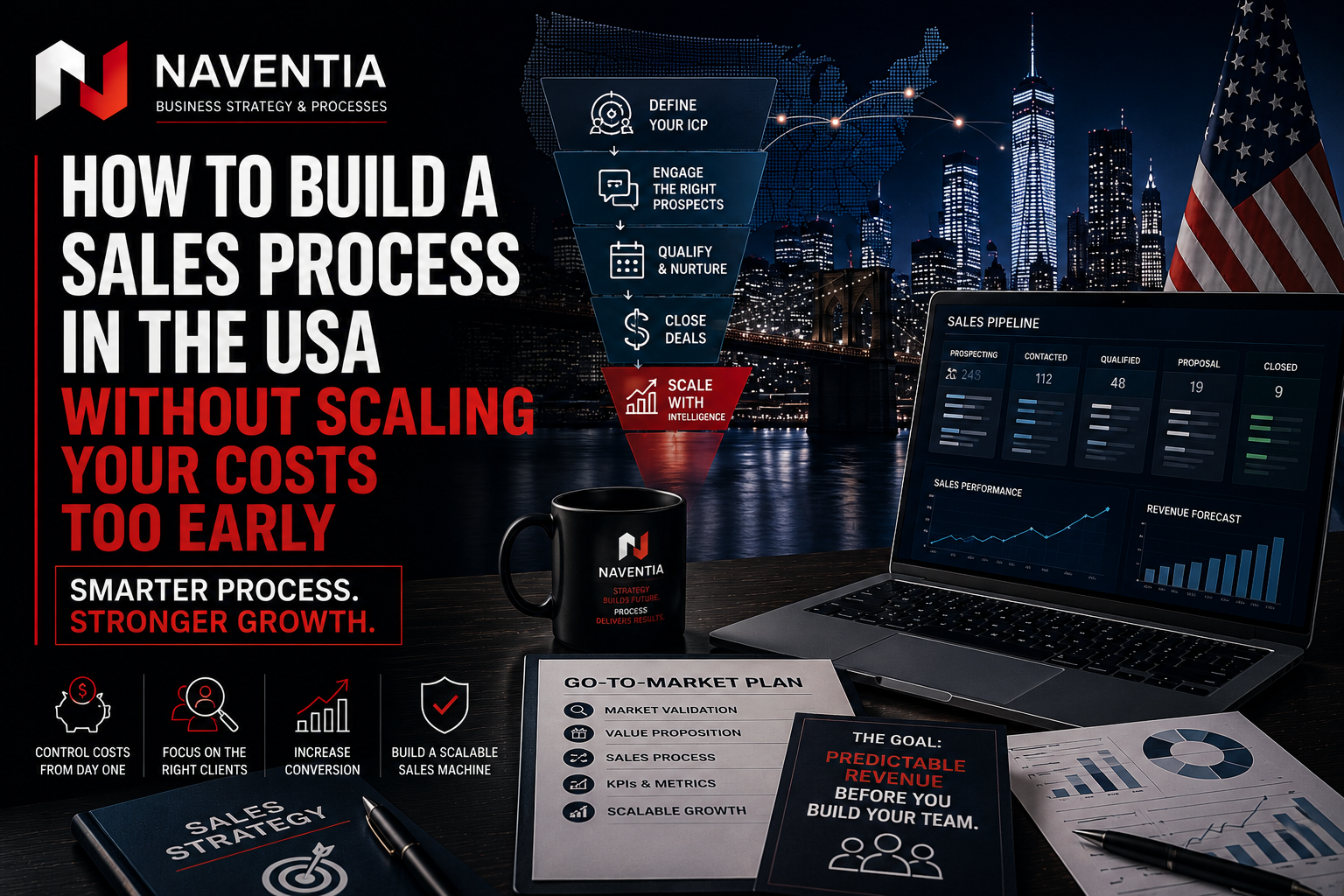
Building a sales process in the US is one of the most overlooked priorities for international companies entering the American market.
In the first months of expansion, many companies already:
- incorporate a U.S. entity
- hire local sales talent
- invest in branding
- implement CRM platforms
- buy sales tools
- launch marketing campaigns
- and sometimes even lease office space
According to the SBA’s guide to marketing and sales, a defined sales process is what separates companies that scale predictably from those that burn cash chasing deals. This matters even more once a company builds a sales process in the US, where buyer expectations and sales cycles differ sharply from the home market. For teams focused on speed of response as part of that process, see our guide on sales responsiveness in the US.
Everything looks professional.
The problem?
There is still no sales predictability.
And when revenue fails to keep up with the speed of rising operational costs, cash flow starts collapsing.
What should be international growth quickly turns into financial pressure.
In the American market, the mistake is not growing.
The mistake is scaling costs before scaling demand.
The mistake that destroys cash flow during U.S. expansion
Many international entrepreneurs try to replicate the same operating logic that worked in their home country.
The thinking usually sounds like this:
“If we build a professional structure from day one, clients will come.”
In the U.S., that rarely works.
Because American buyers do not buy structure.
They buy:
- clarity of positioning
- proof of results
- specialization
- predictable execution
- measurable ROI
This means that before building a team…
You need to build a sales engine.
Without a validated sales process in the US, hiring usually turns into expensive trial and error.
And in the United States, trial and error happens in dollars.
Sales infrastructure does not start with hiring
This is one of the biggest misconceptions in international expansion.
Many founders assume that entering the U.S. market means immediately hiring:
- Sales Representatives
- Business Development Managers
- Account Executives
- SDRs
But the reality is different.
Hiring without a process does not create sales.
It only creates overhead.
Before hiring anyone, companies need to validate five core commercial pillars.
1. Define your ICP
Who is your ideal customer?
Are you targeting:
- startups?
- mid-market companies?
- enterprise accounts?
- family businesses?
- industrial clients?
Without a clear ICP, prospecting becomes expensive guesswork.
2. Validate your commercial messaging
What works in your local market will not automatically work in the U.S.
American buyers typically respond to:
- clarity
- specialization
- business outcomes
- efficiency
- predictable ROI
If your message feels generic, conversion drops.
3. Test your offer
Your offer needs to answer one question immediately:
Why should an American buyer choose your company?
That means validating:
- positioning
- differentiation
- pricing
- urgency
- perceived value
Without clarity here, pipeline creation becomes difficult.
4. Validate your pricing model
Can your pricing support:
- customer acquisition costs?
- outbound sales efforts?
- follow-up sequences?
- paid media?
- future scaling?
Many companies enter the U.S. with pricing models that destroy margin before growth even begins.
5. Understand your real sales cycle
How long does your buyer actually take to make a decision?
- 7 days?
- 30 days?
- 90 days?
- 6 months?
Without understanding sales velocity, hiring becomes speculation.
A strong sales process in the US requires market validation, clear positioning, and repeatable execution before scaling.
The framework smart companies use
At Naventia, we typically structure commercial expansion into three stages.
Phase 1: Market proof
Before hiring anyone, we test:
Positioning
Who responds best?
Messaging
What generates engagement?
Offer
What actually converts?
Channel
Where does the market respond best?
- LinkedIn?
- Cold email?
- Referrals?
- Paid media?
- Strategic partnerships?
At this stage, the goal is not volume.
The goal is predictability.
Phase 2: Lean sales process
Once the market is validated, we build the minimum viable commercial infrastructure.
CRM structure
A clean pipeline.
No improvisation.
Follow-up cadence
Consistent touchpoints.
Repeatable conversations.
Sales scripts
Scalable messaging.
KPIs
We track:
- meetings booked
- show rate
- proposal rate
- close rate
- sales cycle
At this stage, companies stop selling through effort alone.
They start selling through systems.
Phase 3: Smart scaling
Only now does hiring make sense.
And now with clarity:
- who to hire
- for which role
- at what stage
- under which KPIs
- with what expected payback
Now your team is not entering to discover the market.
They are entering to scale what already works.
Why international companies lose momentum in the U.S.
Many companies enter the American market with strong products, technical expertise, and even solid financial resources.
Yet they still struggle to turn meetings into revenue.
Why?
Because their commercial habits are often still based on their home market.
Common mistakes include:
- overexplaining instead of creating clarity
- focusing on relationship before showing value
- failing to communicate ROI early
- inconsistent follow-up
- weak market positioning
American buyers usually expect:
- clarity
- speed
- specialization
- proof of execution
- predictable outcomes
Once companies understand this, sales stop depending on individual effort.
They start operating like a system.

<h2>Final thoughts</h2><p>Expanding into the United States does not mean building a large structure.</p><p>It means building the right structure.</p><p>Companies that master their <strong>sales process in the US</strong> grow faster, preserve capital, and scale with much more predictability.</p><p>Before hiring.</p><p>Before opening an office.</p><p>Before increasing payroll.</p><p>Ask yourself:</p><p><strong>Can our sales process generate revenue without heavy infrastructure?</strong></p><p>If the answer is no…</p><p>You are not ready to scale yet.</p><h2>Talk to Naventia</h2><p>At Naventia, we help companies structure international sales operations with predictability, efficiency, and sustainable growth.</p><p>If your business is entering the U.S. market, your next step may not be hiring. Your next step may be validation.</p><p>A responsible <strong>sales process in the US</strong> should be designed around market evidence and repeatable execution. Companies can consult the <a href=”https://www.sba.gov/business-guide/manage-your-business/market-research-competitive-analysis”>U.S. Small Business Administration guidance on market research</a> and review the <a href=”https://www.sec.gov/education/smallbusiness”>SEC small-business resources</a> before scaling.</p><p>At Naventia, we help companies build a sales process in the US with strategic clarity and controlled costs.</p><p><a href=”https://naventia.com/”>https://naventia.com/</a></p>
Companies that get their sales process in the US right early on avoid the two most common traps: hiring a full sales team before proving demand, and building expensive tooling around a process that has not been tested with real buyers. Start lean, validate what works, then invest.