

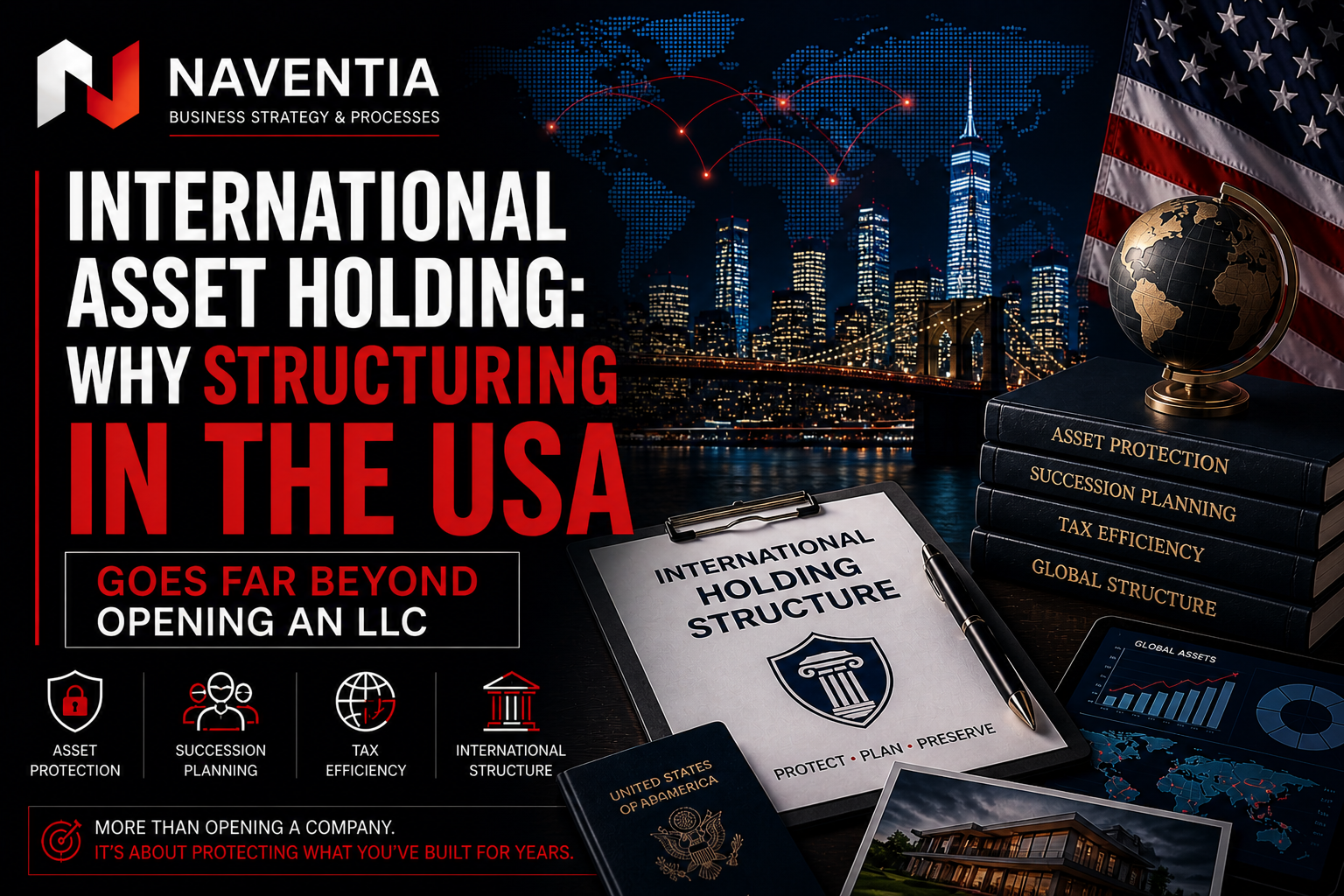
For many founders, international asset holding is the real reason to structure a business in the U.S. — not just opening a company, but protecting wealth across borders.
One of the most common questions Brazilian entrepreneurs ask when considering a U.S. business structure is straightforward:
“Should I open an LLC or a Corporation?”
It is a legitimate question.
But in most cases, it starts in the wrong place.
When the real objective involves asset protection, international estate planning, succession strategy, or cross-border risk segregation, the legal entity itself is not the starting point.
The real question is different:
What role should this U.S. structure play within the entrepreneur’s global wealth strategy?
That is what separates a simple company formation from a truly strategic international structure.
Many entrepreneurs focus on operational entities before understanding the long-term tax, legal, and wealth implications of that decision.
An LLC is not a holding company. It is a vehicle.
An LLC (Limited Liability Company) can be an excellent business structure.
In the United States, LLCs often provide:
- management flexibility
- liability protection
- operational simplicity
- pass-through taxation at the federal level in many scenarios
For entrepreneurs planning to operate commercially in the U.S., an LLC is often one of the most efficient structures available.
But here is where many business owners make a critical mistake:
An LLC is not automatically an international asset holding structure.
A holding company serves a different purpose.
Its role is to:
- own assets
- isolate legal and business risks
- organize international succession
- separate liabilities across jurisdictions
- support long-term tax efficiency
In other words:
The LLC may be the vehicle.
The strategy is the architecture behind it.
And architecture requires planning.
What an international holding structure can actually solve
When properly designed, an international holding structure can serve multiple strategic purposes at the same time.
Asset protection
One of the most valuable functions of an international holding company is risk segregation.
Assets held through a properly structured U.S. entity may, depending on the jurisdiction and structure, be insulated from personal or business liabilities arising in the entrepreneur’s home country.
This may include situations such as:
- business litigation
- shareholder disputes
- tax enforcement actions
- marital property disputes
- operational liability exposure
Of course, the effectiveness of this protection depends entirely on how the structure is designed.
Entity formation alone does not create protection.
Strategy does.
International estate planning
Another issue many foreign entrepreneurs overlook is estate exposure in the United States.
Real estate, investments, or business interests held directly by non-resident individuals may be subject to U.S. estate tax.
For non-resident foreigners, exemption thresholds can be dramatically lower than those available to U.S. citizens or residents.
This can create substantial wealth transfer risks.
A properly designed holding structure may help support:
- succession planning
- intergenerational wealth preservation
- tax exposure reduction
- asset continuity for heirs
For entrepreneurs building global wealth, this is not a technical detail.
It is a strategic issue.
Global tax efficiency
An international holding structure may also support cross-border capital planning.
Depending on how the structure is designed, it may help organize:
- dividend distributions
- royalty payments
- intercompany financing
- international asset consolidation
For companies operating across multiple jurisdictions, this can directly impact:
- global effective tax rates
- cash flow predictability
- international compliance
- capital allocation efficiency
Without planning, the same structure designed for growth can create unnecessary tax exposure.
The risk of structuring without strategy
Many entrepreneurs open an LLC in their own name believing they have automatically created protection.
In reality, without proper planning, the opposite may happen.
Poorly designed structures can create:
- unnecessary reporting obligations
- cross-border tax inefficiencies
- succession vulnerabilities
- regulatory exposure
- operational complexity without strategic benefit
Depending on the structure, foreign owners may also face compliance obligations such as:
- FBAR reporting
- FATCA disclosures
- IRS reporting requirements
- international ownership declarations
Without a clearly defined strategic purpose, the entity becomes another administrative burden.
Not a solution.
Where legal strategy actually begins
Forming a company, obtaining an EIN, and opening a business bank account are often the easiest parts of the process.
The real complexity comes before that.
This is where strategic questions need to be answered:
- What is the purpose of this structure?
- What assets will be held?
- Who will ultimately own the entity?
- How will succession be handled?
- How will profits be distributed?
- What tax obligations will exist across jurisdictions?
Jurisdiction selection also matters.
States such as:
- Delaware
- Wyoming
- Florida
offer very different legal, tax, and operational characteristics.
Choosing based only on formation cost is rarely a strategic decision.

What sophisticated entrepreneurs do differently
Entrepreneurs who build successful international structures usually do not start by asking:
“LLC or Corporation?”
They start by asking:
These questions are the foundation of a sound international asset holding strategy.
- What exactly needs protection?
- What assets are being internationalized?
- What does this structure need to accomplish over the next 5 to 10 years?
- Is succession planning involved?
- Is international expansion part of the strategy?
- Are there tax exposure risks across jurisdictions?
Those answers define the structure.
Not the other way around.
Final thoughts
Opening an LLC in the United States may be relatively simple.
Building an effective international holding structure is not.
It requires:
- legal strategy
- tax planning
- estate planning
- governance design
- long-term international alignment
For entrepreneurs with meaningful assets or growing international operations, the most important question is not:
“LLC or Corporation?”
The real question is:
What does this structure need to do for my wealth over the next decade?
The answer to that question determines everything that comes next.
Talk to Naventia
If you are evaluating international structures for asset protection, succession planning, or global business expansion, strategy needs to come before incorporation.
According to the IRS guidance for international businesses, cross-border structures carry specific reporting and tax obligations that must be planned for in advance. This is exactly why international asset holding should be treated as a strategic decision, not an afterthought — the right international asset holding structure protects wealth while keeping compliance simple.
At Naventia, we help entrepreneurs build international structures with legal intelligence, tax efficiency, and long-term growth in mind.